
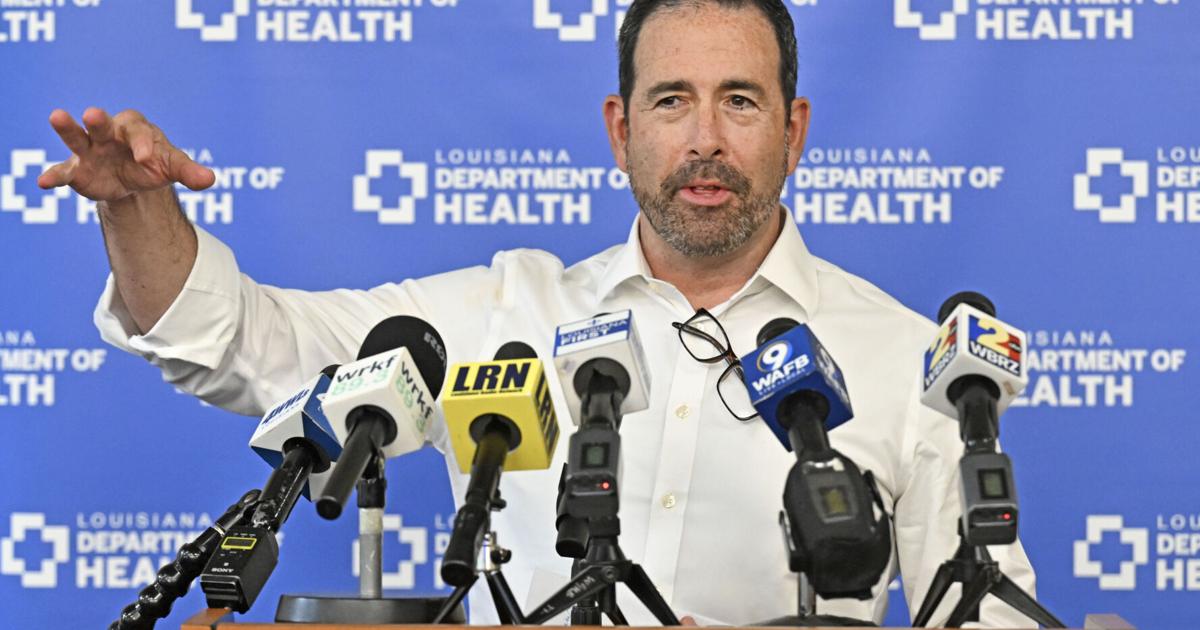
Louisiana health secretary Bruce Greenstein laid out his plans and priorities for the state’s largest agency on Wednesday, vowing to streamline how the department serves residents and putting a new focus on nutrition and other elements of healthy living.
In what was billed as the Louisiana Department of Health’s first “annual shareholder meeting,” Greenstein, who took over the department in April, announced plans to form a new Office of Health and Nutrition, which will “bring together chronic condition management and food policy.” He also said he plans to create an inspector general within the department to root out waste, and that he’s focused on programs to reduce cancer deaths, overdoses and infant mortality.
“If you’re comfortable with how we do things right now, be ready to get uncomfortable over the next year,” Greenstein said.
The roughly four-hour presentation, streamed online and attended by safety-net health providers, disability service operators and patient advocates, offered the most detailed roadmap yet for how the $21.4 billion agency which oversees Medicaid, public health, state hospitals and social services, may change under its new secretary and a newly appointed surgeon general.
It included some elements of federal health policy, which has shifted under U.S. Health Secretary Robert F. Kennedy, Jr. toward wellness and nutrition under the banner of Make America Healthy Again, or MAHA. And LDH’s focus on oversight and what Greenstein called “radical transparency” appeared to take note of Gov. Jeff Landry’s recent emphasis on ensuring that government agencies were improving their efficiency.
Greenstein said the department’s major goals include improving health outcomes, tightening oversight of public spending and modernizing how LDH operates, from aging data systems to how programs work across agency lines.
He said that the agency’s leadership would be expected to identify where performance has lagged, explain what will change in 2026 and be accountable for results.
In her first public remarks as the state’s new surgeon general, Dr. Evelyn Griffin outlined an agenda looking at “root causes” of health issues, and a push for stronger data systems to identify gaps in care.

Louisiana Surgeon General Dr. Evelyn Griffin laid out priorities at a Louisiana Department of Health meeting on Wednesday, Jan. 21, 2026.
“We need to return the focus back to foundational elements of health, such as nutrition with whole foods, daily movement, quality, sleep and stress management,” Griffin said, adding that they should be integrated with conventional medicine and evidence-based practices.
Other priorities for the surgeon general include further reducing opioid-related deaths among pregnant women through Project MOM, a statewide program aimed at preventing pregnancy-associated overdoses, and increasing breastfeeding rates through existing maternal health programs. According to her presentation, her office will emphasize “family, faith and fearlessness.”
While Louisiana has been ranked third-highest for opioid deaths, LDH officials said there is progress. Deaths went down by 31%, from 1,130 deaths in 2023 to 770 deaths in 2024.
Louisiana mothers had the highest state death rate in 2023, according to a report from The Commonwealth Fund. The state had a maternal mortality rate of about 42 per 100,000 live births, compared to the national average of 18.6.
Griffin, who was appointed surgeon general by Landry in December after Dr. Ralph Abraham resigned to become the principal deputy director at the Centers for Disease Control and Prevention, drew national attention in recent weeks over her views on vaccines as a newly appointed member of the federal Advisory Committee on Immunization Practices.
Griffin was appointed to that role by Kennedy and voted against continuing the committee’s recommendation for routine hepatitis B vaccination for newborns.
Vaccination policy was not discussed during the Louisiana Department of Health meeting. In a subsequent interview, Greenstein said the department’s approach to vaccine promotion — revised under the previous surgeon general to discontinue mass vaccination efforts such as flu fairs and to advise LDH employees against recommending specific vaccines — is unlikely to change.
During the presentations, other LDH officials detailed initiatives already underway or launching in 2026, including a $200-plus million rural health transformation effort with federal funds, expanded crisis response infrastructure for people considering suicide, tighter Medicaid oversight that includes work requirements, rooting out Medicaid and SNAP fraud and waste, and new limits on SNAP purchases of candy and soft drinks.
Several speakers underscored efforts to modernize data systems, reduce administrative overhead, renegotiate vendor contracts, and redirect savings toward direct care, workforce capacity and quality outcomes.
Greenstein said the meeting was the first in a recurring series, pledging that LDH will hold annual “shareholder” meetings to open its books to public comment and share progress and goals.
“It’s better and easier to be open, transparent and collaborative than it is to scheme away in our office and have a whiteboard we don’t show anyone,” Greenstein said. “We are constantly being improved by the input from stakeholders from around the country.”