
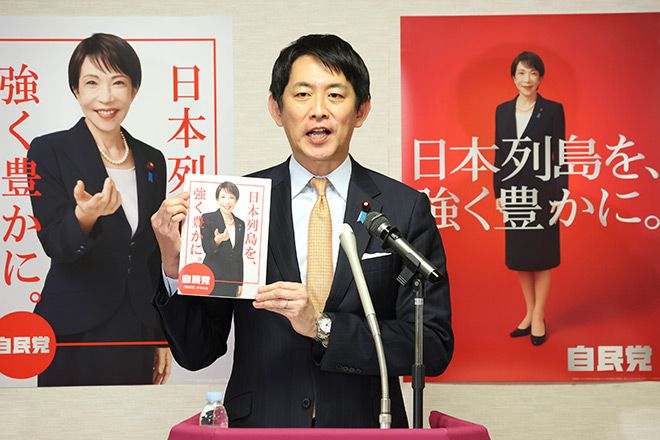
Prime Minister Sanae Takaichi’s envisioned enhanced security framework was placed front and center in the ruling Liberal Democratic Party’s campaign pledges for the Feb. 8 Lower House election.
“Complex crises, such as attempts to change the status quo by force, have become the norm around the world,” Takayuki Kobayashi, chairman of the LDP’s Policy Research Council told a news conference to announce the party’s manifesto on Jan. 21. “We will establish a system capable of responding to a new era and defend Japan to the end.”
The LDP platform, titled “Making the Japanese Archipelago Strong and Prosperous,” is built around five pillars: the economy, regional revitalization, diplomacy and national security, social security and constitutional revision.
It also incorporates policies set out in the coalition agreement concluded with Nippon Ishin (Japan Innovation Party) in October.
While opposition parties are calling for a consumption tax cut, the LDP pledged to “accelerate consideration” on exempting food and beverage items from the tax for two years.
The LDP proposed that funding sources and an implementation schedule will be discussed at a national council, to which opposition parties will be invited.
It did not specify when the measure would be implemented or how it would be financed.
In diplomacy and security, the LDP noted China’s military buildup and North Korea’s nuclear weapons development. The party said it will revise within the year the three key national security documents, including the National Security Strategy, ahead of schedule.
It also pledged to abolish provisions that restrict the types of defense equipment that may be exported to five categories.
The manifesto said the LDP will strengthen the government’s intelligence‑gathering and analysis capabilities by creating a National Intelligence Bureau that directly reports to the prime minister’s office, as well as establishing an external intelligence agency.
With Tokyo-Beijing ties strained over Takaichi’s remarks on a Taiwan contingency, the LDP platform said Japan will “seek to build a constructive and stable relationship” with China, while “responding to provocative actions calmly and resolutely.”
Under Takaichi’s mantra of “responsible proactive fiscal policy,” the LDP pledged to drive economic growth through “crisis management investment,” an approach that promotes joint public-private outlays to address risks and social challenges.
As for policy on foreign nationals, an issue under discussion within the government and ruling coalition, the LDP said it will review laws and rules concerning foreign ownership and acquisition of real estate to “dispel public concerns.”
The party said it will pursue legislation for broader use of maiden names as common-law aliases, instead of adopting an optional system that allows married couples to use separate surnames.
The optional system is increasingly supported within the business community and elsewhere.
Nippon Ishin also released its campaign pledges on Jan. 21.
Like its larger coalition partner, Nippon Ishin called for strengthening Japan’s security framework, including the early revision of the three national security documents and the removal of the five-category restriction on defense equipment exports.
Nippon Ishin’s manifesto also focused on policies such as reducing social insurance premiums and establishing a secondary capital capable of serving as a backup for Tokyo’s functions during disasters and other emergencies.