
TRURO — In a presentation to the conservation commission on Nov. 3, Northwestern University Professor Alessandro Rotta Loria said he had designed a novel technique that could “completely disrupt the way we protect coastlines” by turning sand as hard as cement.
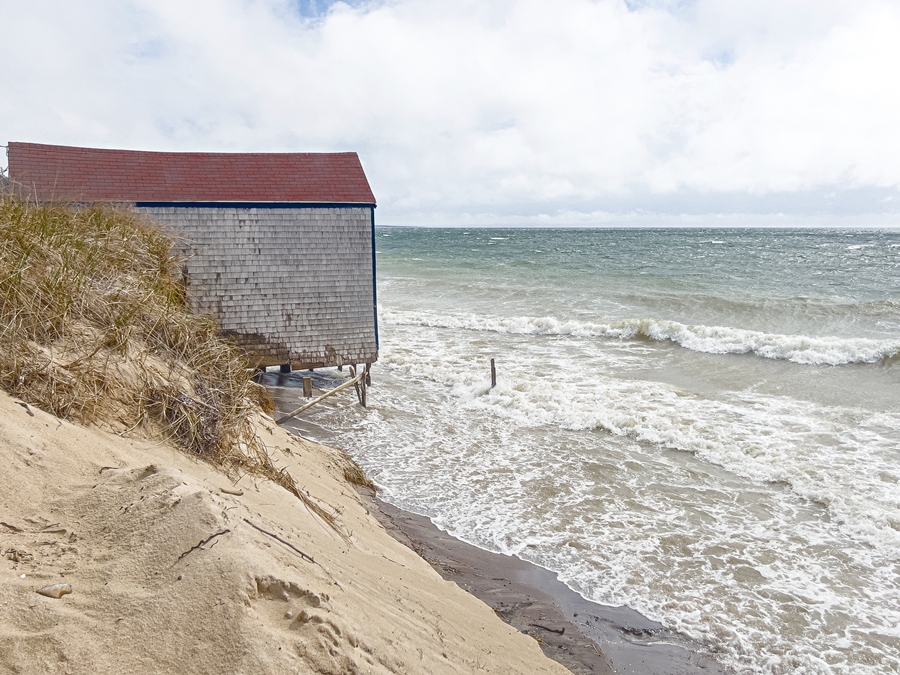 Sand beaches are one of the most dynamic environments on the planet, according to Mark Borrelli of the Center for Coastal Studies. (Photo by Nancy Bloom)
All it would take, said Rotta Loria, a professor of civil and environmental engineering, would be an electrical current running through lengths of mesh similar to chicken wire and the minerals that occur naturally in salt water and sand.
Rotta Loria was there because he’s been asked by a group of eight North Truro homeowners to test his technology on the coastal bank in front of their houses.
Since that meeting, he’s been back twice to answer questions as the commission considers whether to approve the first phase of the project. It would involve test sites on two of the eight properties that stand along a roughly 2,000-foot stretch of fast-eroding bayside shoreline just south of Cold Storage Beach.
The two test sites — one at 19 Avocet Road and the other at 8 Falcon Lane — would be the first in the world to try using Rotta Loria’s strategy to combat erosion outside of the lab.
“My hope is, if this works, it revolutionizes the way erosion is dealt with globally,” said Wendy Lurie, who lives at 19 Avocet Road. Lurie found Rotta Loria while researching ways people in coastal settings elsewhere are fighting erosion.
Sacrificial Sand
Lurie told the Independent that since she and her husband bought their Truro house in 2019 the coastal bluff has eroded noticeably. According to the project proposal, the short-term erosion rate there is almost a foot a year.
In 2020, she organized neighbors to install coir logs, long tube-shaped devices filled with straw or coconut fiber, to reinforce the bank. The logs, however, biodegraded quickly. What’s more, they needed to be constantly covered with new loads of “sacrificial sand,” said Lurie. She said that because of rising sea levels, the sacrificial sand she and her husband had been putting down was being washed away by high tides at an unsustainable rate.
“It’s no longer possible to keep the bank covered all the time unless we literally add sand once a week,” said Lurie.
After discovering the limitations of the coir logs, Lurie started looking for a more permanent solution that could be a “one-time shot.” She found Professor Rotta Loria’s research and has been working with him for close to a year to try to find a way to implement his electric-powered sand calcification idea in Truro.
Calcifying the Shore
Lurie connected Rotta Loria with coastal geologist Stan Humphries of Plymouth-based Environmental Consulting & Restoration LLC to work up a proposal and arrange permitting to try the experiment at the two test sites.
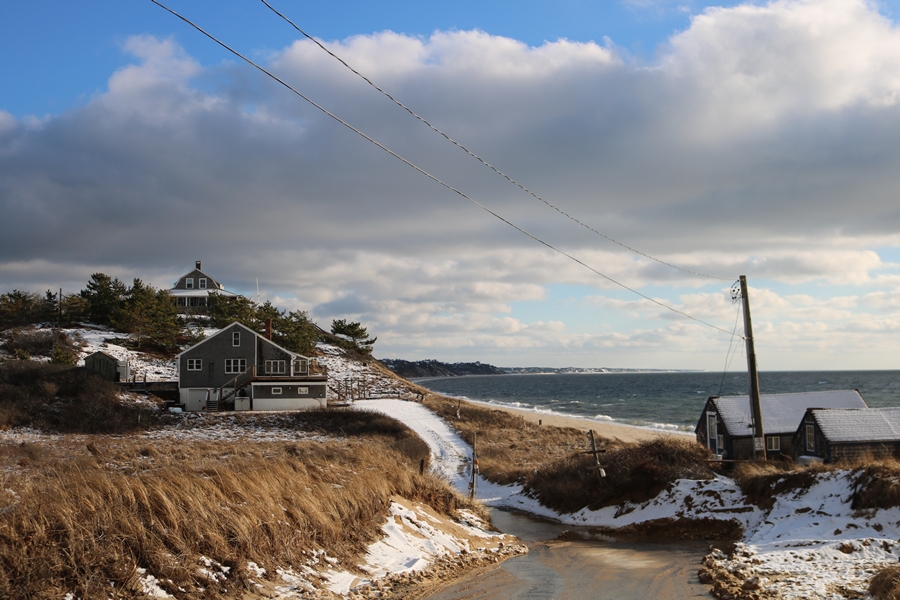 A view of Cold Storage Beach looking south. (Photo by Jack Styler)
First, they told the commission, they propose to install flexible sheets of stainless-steel mesh. The mesh would be anchored in the coastal bank and electrified with low-voltage current generated by the homeowners’ solar panels. As the mesh is electrified, Rotta Loria said, a steady stream of ocean water dispersed by a pump system will bind and calcify the minerals in the sand to create a hard-yet-porous material that will be more resistant to erosion than the existing sand.
Rotta Loria told the commission that the project would be fully reversible. While he expected that results would be measurable at the site in about three months, he said that in his lab, the sand had begun to calcify in about a month.
Center for Coastal Studies coastal geologist Mark Borrelli told the Independent that whatever the method, there are problems with trying to harden the shore.
He said that if property owners along a dynamic coastline stabilize their section of the bank, the beach below the bank will continue to wash away. And neighbors who do not implement their own bank stabilization methods will see their bluffs erode faster. The result — which has been observed where seawalls have been built and is a reason why seawalls are prohibited in most cases by state law — would be a “lower and lower” beach and a “jagged effect” on the coastline, according to Borrelli.
While he said it is “totally understandable” that homeowners want to protect their property, “if you stop erosion, you are causing it somewhere else.”
Lurie declined to say how much the experiment would cost but said it would be comparable to putting in coir logs, which is “very expensive.”
Borrelli said that the true cost of the project should include the effect it has on public beaches and on other properties along the coast.
Lurie said she has thought about the possibility that the project could adversely affect some of her neighbors down the beach. In fact, she said, when she first installed coir logs, she noticed how one of her neighbors who did not put in logs lost “three feet of beach in a two- or three-year span.” Lurie argues, however, that this project will be different because the size of the apertures of the wire mesh, which determine the thickness of the hardened sand, can be adjusted at the ends so that the fortified area “tapers off instead of ending abruptly.”
Borelli doesn’t believe that will change things much.
His advice to homeowners on rapidly eroding beachfronts: “sell.”
“If you really want those views from your back porch, I would, personally, go buy a property on a rocky coast in Maine,” said Borrelli. “This beach is eroding.”
Lurie told the Independent that she could not accept that. “Either we are all going to accept that the Outer Cape is going to be underwater,” she said, “or we are going to try to mitigate that as much as we can while causing as little damage as possible.”
A Question of Vision
The kinds of questions this puts before the conservation commission are not likely to go away, and experts don’t always agree on answers.
Gordon Peabody, the founder of Safe Harbor Environmental Services in Wellfleet, said he likes the sound of Lurie’s experiment, calling it “unique” and “very visionary.”
“We should really invite curiosity, not negativity,” said Peabody. “We owe it to the children to keep coming up with better solutions for ongoing problems for the world they’re going to inherit from us.”
Mark Adams, a retired National Park Service coastal geologist who lives in Provincetown, has similar worries about the future but pictures unintended consequences. “A professional geologist and a really sound environmental engineer can tell you the likelihood of erosion, enough to make decisions about mortgages and risk,” said Adams. “But they can’t tell you how to outrun nature.”
After looking at the project proposal, Adams said, “Anything that interferes with the natural process of sediment movement is not a good idea in the long term.”
Rotta Loria told the conservation commission that the dune hardening system would be paired with the planting of beach grass, a traditional coastal erosion measure. But commission member Clint Kershaw asked whether the vegetation would be able to tolerate the increased levels of calcium or magnesium introduced by the experiment.
Rotta Loria said he thought so, because the calcification process will make the soil less acidic, not more so. But, he said, he could answer the question only “at the conceptual and theoretical level.”
Rotta Loria did not respond to the Independent’s request for information for this story.
The Vote on a Test
The conservation commission is expected to vote at its Feb. 2 meeting on whether to approve installing the system at two test sites. The proposal calls for them to be monitored for about six months.
Bryan McCormack, the Cape Cod Cooperative Extension’s coastal processes and hazards specialist, is working on exactly what that monitoring would look like if the town were to approve the tests.
McCormack told the Independent that he will propose that the town look at three things. First, the town should determine whether the installation affects erosion rates at the site as well as parts of the beach updrift and downdrift. Second, McCormack said he would propose that the town observe how vegetation responds and, third, whether there is any concentrating of heavy metals at the project site.
Lurie said that if the project were to fail, the homeowners would be responsible for restoring the coastal dune to its pre-project condition.
If the project is approved and phase one is deemed a success, then all eight houses on the bluff would seek approval to put in their own systems.
Lurie said that she has spoken with Truro School Supt. Stephanie Costigan about a possible collaboration with the sixth-grade class where the students could help install the mesh into the bluff and catalogue the sand hardening.