
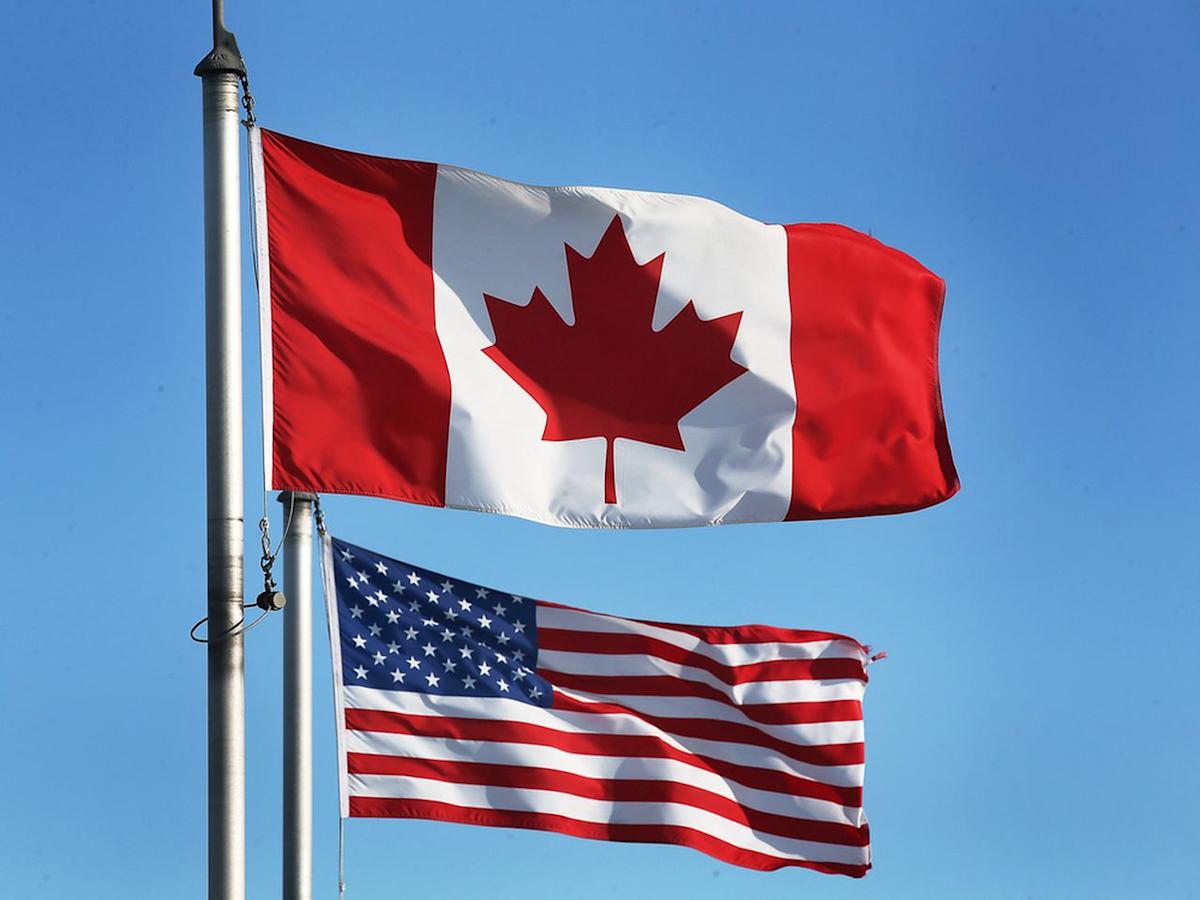
 A Canadian and an American flag are shown in Windsor, Ontario. (Credit: DAN JANISSE/Windsor Star/Postmedia files)
Without specifically mentioning any single nation during his World Economic Forum speech, Prime Minister Mark Carney was clearly setting the political stage for Canada to move away from the United States as a trusted economic and political ally.
Unlike U.S. President Donald Trump, who willingly and enthusiastically ridicules and puts down most of the world’s nations as basket cases led by numskulls and idiots — or as good guys he’s keen to work with (i.e. Vladimir Putin and Xi Jinping) — Carney prefers to paint the world in broad ideological and philosophical brushstrokes.
Carney has been doing this for years in speeches and in Value(s): Building a Better World for All, his 2021 book that projected environmental collapse if the world economic system were not purged of market fundamentalism, globalization and the role of individual freedom as the main determinants of value and values. Carney claimed in his book that the “rules-based architecture that Canada has long cherished is under strain.” The world economy needed to be reformed into stakeholder capitalism and the pursuit of sustainable development in the name of controlling the greatest crisis, “the tragedy of the horizon,” climate change.
These old themes were rarely mentioned by Carney at Davos. The existential climate crisis and net-zero carbon emissions were absent, replaced by alarmism about the rupture of the world order, the collapse of rules-based global governance and trading systems, and the unravelling of international structures that leave the world in the hands of hegemons. Unnamed as such are China, Russia and the United States.
To fend off the hegemonic trio, Carney proposes that the smaller nations that he describes as middle powers rise up. “The question for middle powers, like Canada, is not whether to adapt to this new reality. We must. The question is whether we adapt by simply building higher walls — or whether we can do something more ambitious.”
The objective is unclear, but it appears middle powers should form a power structure of their own, wrangling individually and collectively in opposition to the three major powers, thereby creating a kind of fourth hegemon. How that would work in the context of Carney’s recent trade and co-operation pact with China is hard to fathom. If China should move in on the Arctic, will Canada still be able to turn to the U.S. for protection? Or does Canada plan on raising a finger to say: “You can’t do that.”
There are many reasons to conclude that the Carney middle-power plan will not become a new world order. For Canada, the model implies breaking with the United States, a dubious project that stretches economic and political realities. There are four key reasons for doubting and rejecting the Carney go-it-alone plan.
• American democracy: Trump will not be president forever. He may get severely damaged in the coming midterm elections. And once out of power, new Republican and Democratic leaders will emerge, many aligned with Canadian sentiments. One of the potential leaders attending at Davos, Kentucky Gov. Andy Beshear, told CNN that the majority of Americans do not see Canada as a 51st state. “The American people believe in our relationship with Canada,” he said, just as they believe in the U.S. relationship with Europe.
As FP Comment editor William Watson wrote in this space yesterday, the old order is under threat from Trump, but Trump will eventually be gone and it makes no sense to act today as if his objectives and methods are permanent. The Canada-U.S. relationship is not dead. It will return.
• Economics and geography: It is absurd to think that Canada can begin to remove itself from logically integrated continental geographic and economic realities. Trump is technically accurate: The border across the continent of North America is an artificial line, but it is a voluntary line of mutual respect and agreement — and freedom. For most of the past 100 years, Canadians and Americans have existed as brothers and sisters, crossing borders without ID requirements and sharing essentially identical cultures, building free trade relationships that have helped create the most prosperous populations on the planet.
• Security: That a hegemonic world order exists cannot be denied, but its creators are China and Russia, two undemocratic and totalitarian nations that over the years have threatened world order, forcing the United States to take on the role of counter power to the expanding fantasies of the communist rulers. It is nonsensical to imply, as Carney does, that the pre-Trump world order of rules-based trade and military security has its origins in the Chinese and Russian hegemons.
Also, when it comes to North American security, Trump appears to be on the right track, assuming the accuracy of recent reports about Greenland and international support for a Golden Dome to protect the Arctic and all of North America against the real hegemons.
• Canadians: Carney may find it politically useful to take advantage of Trump’s irrational statements and erratic behaviour. Canadians are rightly incensed by his anti-Canadian rhetoric and claims. But just as Trump’s disruptive international behaviour and his extremism at home will not be permanent features of U.S. policy, his impact on Canadians’ sense of betrayal is also likely to recede.