
April 13, 1954, is a memorable day in baseball history, as it was the day that a 20-year-old outfielder named Henry Aaron debuted for the Milwaukee Braves. He went 0-for-5 as the starting left fielder in the team’s 9-8 loss to the Cincinnati Reds, and he wouldn’t record his first AL/NL hit until the team’s next game on the 15th. Aaron wasn’t the only rookie to play for the Braves that day. Right fielder Billy Queen entered the game in the bottom of the eighth inning after starter Andy Pafko was removed for a pinch-runner. He would only appear in 2 more major-league games. Then there was the second reliever of the day, Ray Crone. He pitched just 2/3 of an inning but induced two ground ball outs to stop the Reds from blowing the game open. Crone, the last survivor of that memorable game, died on January 15, in Waxahachie, TX, at the age of 94. During his playing career, he played for the Milwaukee Braves (1954-57) and New York/San Francisco Giants (1957-58). He also had a long scouting career that lasted into the 2000s.
Raymond Hayes Crone was born in Memphis, TN, on August 7, 1931. One of his brothers became a Franciscan priest, and a sister became a nun, but he discovered baseball. During his teenage years, he was active in all levels of amateur baseball in Memphis, and he was seldom the only Crone in the lineup. His brothers and cousins, Don and Basil and Harrell Crone were often playing behind him in the field. When the Crones played, victories usually followed. Ray, safe to say, was probably the best pitcher in the family. During an American Legion regional tournament in 1946, he threw an 18-inning game but lost 7-6 to Kannapolis. Just two days later, he tossed a 6-hit complete game to lead Corbitt Motors over Norfolk. In addition to his Legion ball, Crone also played for Christian Brothers College (high school). According to Memphis’ daily The Commercial Appeal, Crone had a 48-9 record for CBC and led the school to one state and two prep titles. He also won 48 games for Corbitt Motors in Legion ball against 5 losses, and the team won the Tennessee state title from 1946 to 1948. Between his high school and his Legion play, Crone had a 96-14 record with 3 no-hitters, 11 1-hitters and 18 shutouts. Unsurprisingly, several major-league teams were interested in the youngster when he graduated from CBC, but the Boston Braves signed him to its Milwaukee Brewers affiliate on June 28, 1949.
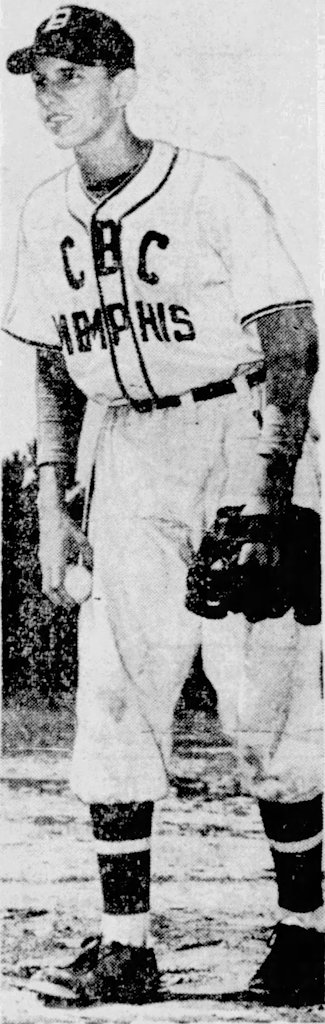 Ray Crone from his high school pitching career. Source: The Commercial Appeal, June 29, 1949.
The Braves sent Crone to the Owensboro Oilers of the Kitty League, and he won 9 games in 14 appearances with the team in 1949. He showed impressive stuff, striking out 102 batters in 89 innings. Crone edged Union City 7-6 on August 6, and he recorded the final out of the game by striking out former big-league slugger Rudy York, serving as Union City manager/first baseman, with the winning run on first base. Crone, given the nickname of “Schoolboy” because of his baby face, continued to impress as he made his way through the minors. He won 11 games for Evansville in 1950 and then 12 for Hartford in both 1951 and 1952. He joined the Jacksonville Braves in 1953 and became the staff ace — or one of them, at least. He and teammate Larry Lassalle tied for the South Atlantic League lead with 19 wins. Lassalle had the edge in ERA (2.34 to Crone’s 2.38) and strikeouts (185 to 174), but Crone threw 253 innings to Lassalle’s 204 and had one more complete game (20) and shutout (4) than his teammate. The team’s manager, Whit Wyatt, worked with Crone to develop an effective slider for the pitcher. With two of the best hurlers in the league and an outstanding season from 19-year-old Aaron (.362 average, 22 home runs, 125 RBIs), Jacksonville posted the best record in the regular season and made it to the league championship, where it lost in 7 games to the Columbia Reds, The parent club, having relocated to Milwaukee, brought Jacksonville’s best hitter and best pitcher to the majors in 1954.
Crone had impressed the Braves in spring training in past years, but manager Charlie Grimm saw noticeable change in the spring of 1954. “I’ve never seen so much improvement in a young boy in a year,” he said in March. “Last year Crone had a good fastball and a fine curve; now he’s got his control in shape to go along with his pitches.” However, as the rookie on the pitching staff, Crone had a hard time getting to pitch regularly once the season got underway. After his successful debut on April 13, he went 10 days before getting into another game, this time in St. Louis on the 23rd. The Braves and Cardinals entered the 14th inning locked in a 5-5 tie before Milwaukee scored 2 runs in the top of the inning. Crone entered in the bottom of the inning and struck out Tom Alston. Then Del Rice singled and Solly Hemus walked, but the rookie pitcher ended the game by striking out Dick Schofield and Rip Repulski to earn a save in his second career game. Through Crone’s first 6 relief appearances, he allowed just 1 run — a Stan Musial solo homer — in 8-2/3 innings. He was given a start against Chicago on May 23 and worked 10 innings to pick up his first big league win, 4-2. He struck out 7 and drove in the first 2 runs of the game with a single off Howie Pollet for his first major-league hit. Grimm said that Crone earned another start after his impressive game, but it never happened. The rookie remained in the bullpen as a mop-up reliever and was sent to the Triple-A Toledo for two months. Crone made the most of his demotion and threw a 7-inning no-hitter against Saint Paul on August 20. “I was in the bullpen every day with Milwaukee,” he said of his major-league experience. “I was up throwing every day but I didn’t actually pitch much. I don’t think I’ve for the arm for relief work.” Crone rejoined the Braves in September and was exceptional, allowing a run over 17-1/3 innings. He made a start against St. Louis on September 26 and tossed 9 shutout innings, but the Braves lost 2-0 in 11 innings. Crone finished the year with a 1-0 record and a 2.02 ERA in 19 games, with 33 strikeouts. He had the third-lowest ERA in baseball among all rookies with at least 40 innings pitched, behind Don Mossi (1.94 with Cleveland) and Gordon Jones (2.00 with St. Louis).
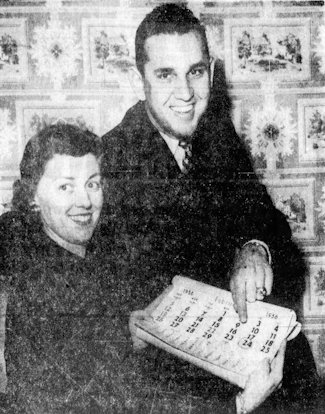 Newlyweds Ray and Joan Crone, with Ray pointing to the date he had to report to spring training. Source: Memphis Press-Scimitar, January 27, 1956.
Crone began 1955 with Milwaukee but didn’t have the same results. He was knocked out of his April 17 start against Cincinnati in the fourth inning after giving up 3 home runs, and his relief appearances didn’t fare much better. He was sent to the minors in May with 9 runs allowed in 8 innings of work. After a month in Toledo, he returned to the Braves and posted a 0.78 ERA in the month of June, with 3 wins in relief. His dramatic improvement earned him starts for the rest of the season, and Crone held his own. He threw complete game wins over the Reds, Dodgers and Giants in July, and he allowed just 3 hits while pitching his first career shutout, a 1-0 gem against the Cubs on September 5. Crone had a 10-9 record with the Braves in 33 games, including 15 starts. He had a 3.46 ERA and struck out a career-high 76 batters in 140-1/3 innings. He upped his win total to 11 in 1956 against 10 losses, but a few poor starts in August led to an elevated 3.87 ERA. A total of 21 of his 35 appearances were starts, as he spent September pitching out of the bullpen. He did participate in a historic moment, though it was done unwillingly. He started and lost the first game of a doubleheader against Pittsburgh on May 20, giving up a home run to Dale Long in the process. Long also homered off Warren Spahn in the second half of the twin-bill. Those games were the second and third straight games in which Long had homered, and he would extend his stretch to a record 8 games (since tied).
One of the people who watched Ray Crone pitch in 1956 was… Ray Crone. Well, Fr. Raymond Crone, to be exact. The pitcher’s brother, born N. Gordon Crone Jr., was ordained in the name of St. Raymond in 1949 and spent 7 years as a missionary in Brazil. He wasn’t able to watch his brother Ray pitch until July 1956. “I don’t know what my brother thinks of my pitching,” said the original Ray Crone. “He was a pretty fair softball catcher before he entered the seminary. And he can judge a player.”
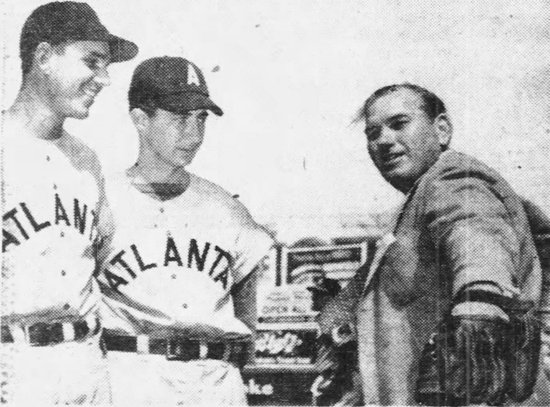 Crone, left, and Bill Currie, center, get some pitching tips from Dizzy Dean while they were trying out for the Atlanta Crackers. Source: The Atlanta Constitution, March 31, 1952.
Crone began 1957 working as a swingman and picked up wins in 3 of his starts. And then the Braves and New York Giants worked out a massive trade on June 15 that sent Crone, outfielder Bobby Thomson and infielder Danny O’Connell to the Giants in exchange for second baseman Red Schoendienst. “We were shocked,” Crone told the Memphis Press-Scimitar. “Since the trade deals were to end at midnight Saturday, we thought the rumor of the trade had died.” He was disappointed to leave the Braves, which went on to win the NL pennant and the World Series, to join the second-division Giants. “For me, I’ll never have a better opportunity to take my turn, and in the long run I’ll benefit and hope the Giants will also,” he added.
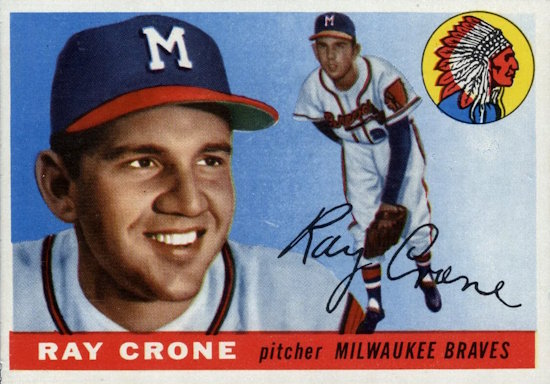
Crone stayed in the Giants’ starting rotation for most of the season, and he went 4-8 with a 4.33 ERA with his new team. It left him with a 7-9 record on the season and a 4.36 ERA. Crone gave up 185 hits in 163 innings, and the Giants hoped for better results in the following season. “Crone fell short of what we expected, but he has the equipment to make the deal look good over the long haul,” said Giants manager Bill Rigney. Crone joined the Giants in the team’s new home in San Francisco in 1958 and came out of the bullpen in the team’s second game against the Los Angeles Dodgers. The Dodgers were already head 10-1 when Crone entered the game, but he was wild. In 2/3 of an inning, he gave up 3 hits and 2 walks, allowing 3 runs to score, including 1 on a wild pitch. Crone made 1 start for the Giants, in which he earned a no-decision after allowing 3 runs in 5 innings. Beyond that, his other 14 appearances were as a reliever, and he had a 1-2 record and a 6.75 ERA. The Giants sold Crone’s contract to the Toronto Maple Leafs of the International League on July 19, 1958. He did not return to the majors.
Crone pitched for 5 seasons in the major leagues and had a 30-30 record in 3.87 ERA. He appeared in 137 games and made 61 starts, and he had 17 complete games, 1 shutout and 4 saves. In 546 innings, he had 260 strikeouts and 173 bases on balls, and he had a 1.332 WHIP and a 96 ERA+.
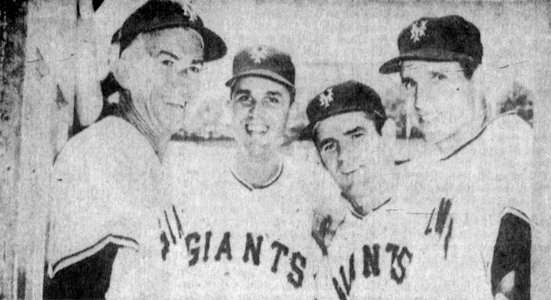 San Francisco Giants manager Bill Rigney, left, poses with his new Giants: Crone, Danny O’Connell and Bobby Thomson. Source: Memphis Press-Scimitar, June 17, 1957.
Crone pitched sporadically over the rest of 1958 and all of 1959. The Press-Scimitar noted that he suffered a bad case of influenza, which cut into his availability. “A pitcher to be successful must work in his turn to keep sharp,” Crone said. “When you lose your sharpness, then you must begin all over again. There is not anything the matter with my arm. Unless I get consistent work, it’ll take a long time to get back on the beam. That goes for any pitcher.” He was back to full strength in 1960 and threw 140 innings between Dallas-Fort Worth and Portland, both Triple-A teams. However, he had just a 5-12 record to show for it. He returned to Jacksonville of the Sally League in 1961, in the hopes of rekindling some of the magic from 1953 that got him promoted to the majors in the first place. By then, people had written Crone off with a “bad arm,” but he maintained it was something more. The trade turned him into something of a nomad, moving from the Giants to various minor-league teams, and each team tried to change him. “I was happy in Milwaukee, but when they got to the World Series, I wasn’t there. I had been traded to the Giants for Schoendienst,” he said. “I never blamed the Braves. They figured a trade was necessary, and they made it and it turned out fine — for them. It didn’t turn out so good for me.” Crone won 4 games and lost 5 for Jacksonville, and he was released in July so that the team could accommodate Houston bonus pitcher Wally Wolf. The move ended Crone’s playing career, and he finished with an 83-65 record in 11 minor-league seasons.
Crone returned to the Hartford area, which was where he had met his wife, Joan. He became a salesman and coached American Legion teams, and he generally stayed away from organized baseball for quite some time. It wasn’t until 1973 that he came back to the game, as a scout for the Montreal Expos. He and his family moved to Texas in 1977 for a scouting job with the Baltimore Orioles. Per Rod Nelson of the SABR Scouts Research Committee, Crone is credited with the signings of Ben McDonald, Arthur Rhodes, David Segui, Jack Voigt and Vaughn Eshelman, among many others. His son Ray Jr., was a good hitter in high school and was drafted by the Orioles out of Sam Houston University in 1985. He played in the minors in 1985 and ’86, and he eventually followed his father’s footsteps into the scouting world as well. Crone Sr. later scouted for the San Diego Padres and Arizona Diamondbacks and was named Midwest Scout of the Year in 2006.
Having been teammates with both Aaron and Willie Mays, Crone had great stories. He noted that his first experience with Aaron as a teammate came when he won a batting title in the Sally League in 1953. “I don’t think anyone could have guessed Henry would become the power hitter he did. At Jacksonville, he hit line drives. He was not your typical power hitter,” Crone recalled in a 2001 interview. “Not many people know, but Henry played second base. The next year, I was with him in winter ball in Puerto Rico. The Braves switched him to the outfield during that time.”
Ray and Joan Crone were married for 43 years before her death in 2000. Crone is survived by his children Carroll, Mary Kelly, Ray Jr. and foster son Robin, as well as their families.
For more information: Legacy.com
Follow me on Instagram: @rip_mlb
Follow me on Facebook: ripbaseball
Follow me on Bluesky: @ripmlb
Follow me on Threads: @rip_mlb
Discover more from RIP Baseball
Subscribe to get the latest posts sent to your email.