
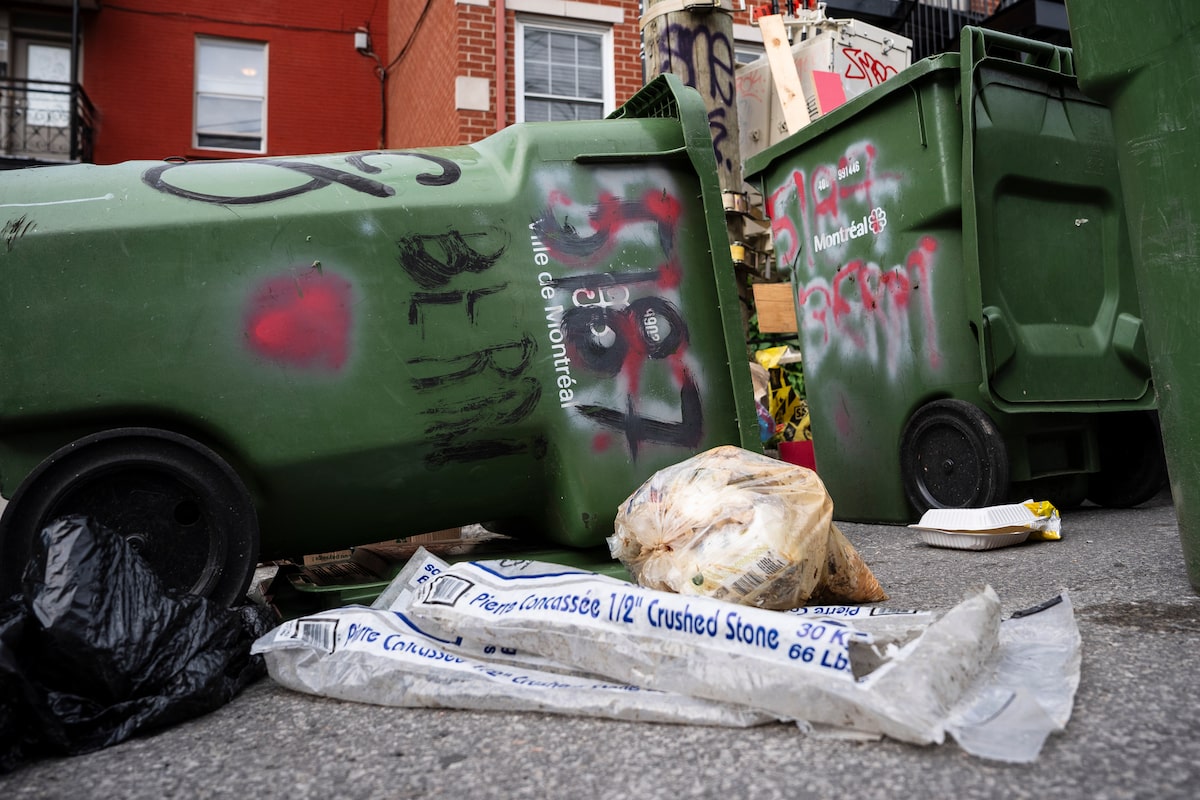
Garbage, which was put out for pickup on the incorrect day, lays on the ground next to recycling bins that were collected by sanitation workers in Montreal in June, 2025.Christopher Katsarov/The Canadian Press
Ontario has a pitiful record for recycling beverage containers. There’s a simple reason why: unlike most provinces, Ontario has no deposit system for non-alcoholic beverage containers.
Only 46 per cent of non-refillable containers for non-alcoholic beverages in the province are recycled, compared with 79 per cent for alcoholic non-refillables. In other provinces where both alcoholic and non-alcoholic containers have deposits, recycling rates are around 80 per cent.
A successful deposit-return program would significantly reduce the 1.7 billion plastic containers from Ontario that end up in the landfill or incinerator or become litter every year. Without change, Ontario is unlikely to hit its target to recycle or refill 80 per cent of its non-alcoholic empties. Ontario’s recycling programs are currently undergoing significant change, so it’s an opportune moment to expand the deposit-return system.
Deposit programs are the gold standard for encouraging reuse and recycling. Just like Ontario’s alcohol deposit return system, the promise of getting the 10 or 20 cents that was paid upon purchase would motivate consumers to return their bottles and cans to designated locations, instead of putting them in the blue box, trash, or abandoning them in a park or on the street. The waste-pickers that scour our parks and ditches would also be keen to collect and return these containers.
Opinion: Recycling won’t solve our planet-killing plastic-pollution problem
Ontario recently switched its system for picking up recyclables – instead of municipalities, it’s now overseen by Circular Materials, a not-for-profit run by producers of packaging waste, such as McDonald’s and Pepsi. The aim is to spur producers to make materials that are easier to recycle. It’s far from certain that the new convoluted system will boost recycling rates, whereas deposit programs have proven results.
The province was considering expanding its deposit program for non-alcohol beverage containers in 2024, when it suddenly abandoned its plans, upsetting environmentalists and the beverage industry, which supported the expansion. The Ontario government said an expanded deposit program would bring increased costs for consumers, although the bigger issue was likely grocery stores’ concerns about having to accept beverage containers – they didn’t want to carve out space to sort “dirty” containers.
Similarly, under Premier Doug Ford’s plan to expand alcohol sales, grocery stores with a licence to sell alcohol were expected to collect empties. A deal announced in November allowed them to get out of that obligation, and instead, they are paying the Beer Store to accept alcohol containers.
The current deal helps The Beer Store, but Ontario’s alcohol deposit system, which has operated out of the Beer Store since 1927 and boasts a 95 per cent return rate on refillable bottles, has been severely weakened. (The Beer Store started accepting all alcohol containers in 2007.) As part of Ontario’s plan to open up alcohol sales, around 120 Beer Stores have closed, and there’s no guarantee the rest will stay open.
The government now aims to ensure most Ontarians have a point of recycling within 10 kilometres, twice the distance of the previous 5-kilometre goal. Markham, Ont., for example, has just one place to return empties for its 350,000 residents after the closure of two Beer Stores. Many people won’t make the longer trek, particularly people without cars, which will lower recycling rates.
Instead of letting the successful alcohol deposit system erode, it could be strengthened by adding deposits for bottled water, soft drinks and juice containers. This bigger stream of materials would make it more viable for businesses to accept containers, and would give producers a relatively clean supply of aluminium and PET bottles that are easier to recycle.
Grocers should be pushed to reconsider taking returns. In other jurisdictions, after several years, the systems have been financially self-sustaining. These stores will find that customers coming in with containers are likely to pick up new items, driving sales. In Quebec and other places, independent operators have successfully installed “reverse vending machines” to take back containers. These can be housed inside stores or in parking lots, or operate in standalone stores.
The government should act quickly to expand the deposit system, and boost places to return containers. The logistical problems are real, but if the government has the will, it will find solutions, and will soon be able to match the other provinces on their beverage container recycling rates.