
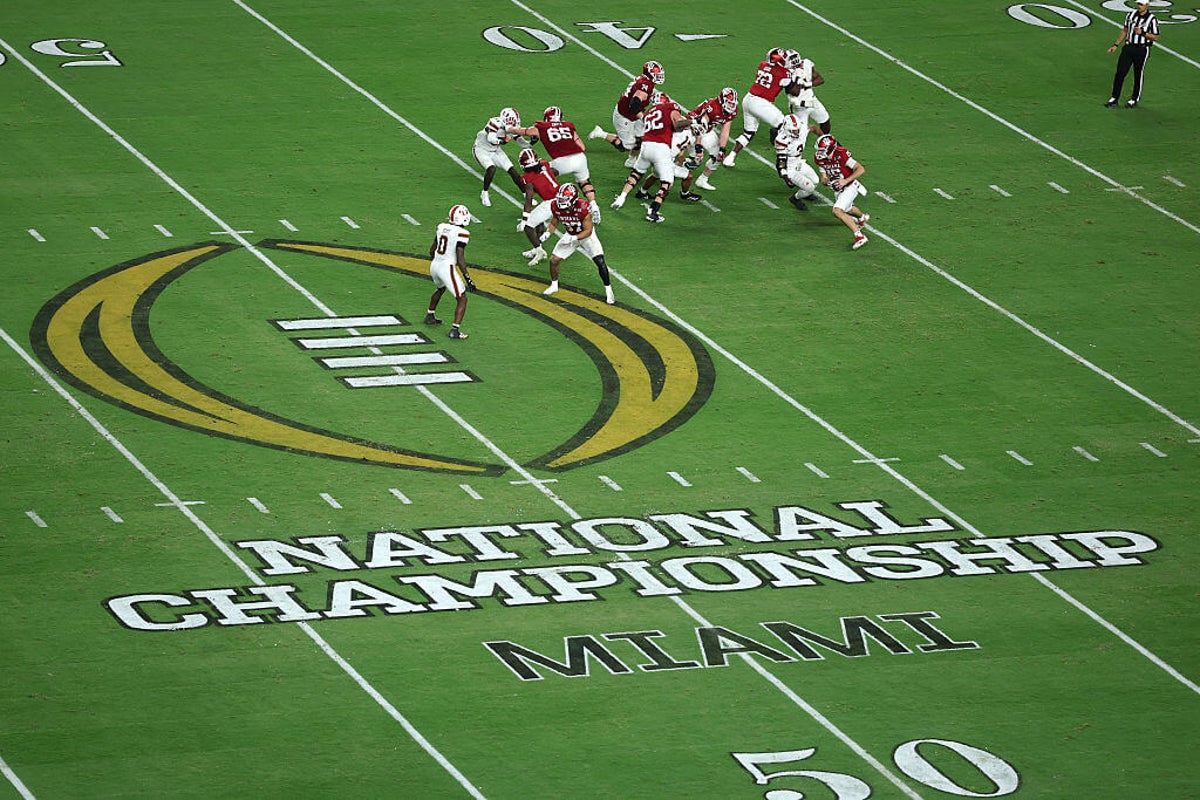
While the College Football Playoff will remain at 12 teams for the 2026 season after SEC and Big Ten leaders couldn’t agree on expansion, the CFP will still look different for the fourth consecutive year.
Since the field grew from four to 12 teams after the 2023 season, the 12-team setup has changed each successive year. In 2024, the four highest-ranked conference champions received first-round byes. In 2025, the seeding protocol changed, and the 12 qualifying teams were ranked from highest to lowest.
In 2026, for the first time, the Power 4 conferences will each be guaranteed a spot for their conference champion, along with one spot for the Group of 6 (formerly the Group of 5) conference champion. In addition, Notre Dame will be guaranteed a spot if it finishes ranked in the top 12, and the SEC and Big Ten will receive more than half of the revenue, a massive change from previous years.
The changes are not a result of the 2025 season, when the Group of 5 received two conference championship spots (American’s Tulane and Sun Belt’s James Madison made it in over ACC’s Duke) and Notre Dame missed out while ranked No. 11. It’s just a coincidence.
Rather, it’s a result of a memorandum of understanding the conferences and Notre Dame signed in the spring of 2024. The CFP never officially announced these changes because the office was waiting on a 2026 format decision. That took much longer than expected.
“The MOU is intact, it’s ratified,” CFP executive director Rich Clark said Sunday in Miami. “If we stay at 12, which it seems that fans love it, we’re in a good place with 12. We understand what that format will look like, and that’s what will occur.”
The 2025 field would have looked much different under the 2026 guidelines, though the ACC has announced it is changing the tiebreakers that left Miami out of its title game.
At the time of the MOU, the conferences and Notre Dame were working on a new CFP contract, as the original deal ran from 2014 to 2025. They hadn’t experienced a 12-team CFP yet and were considering expansion to 14 teams at the time. It was a clean slate to make something new, but a tight window.
Coming on the heels of paradigm-shifting conference realignment, the Big Ten and the SEC threw their weight around in the negotiations, and everyone else accepted a lopsided deal just to make sure they were a part of it. Under the previous CFP contract, decisions had to be unanimous among the commissioners and Notre Dame’s AD. No longer. The other conferences agreed to give the Big Ten and SEC control over the next format for 2026 to 2031, in exchange for guaranteeing a spot for each Power 4 champion and the top Group of 6 champion.
Notre Dame carved out its own guarantee with a top-12 ranking (or top-14 if it went to 14 teams) thanks to what people in the room described as a good working relationship between Big Ten commissioner Tony Petitti, SEC commissioner Greg Sankey and Notre Dame athletic director Pete Bevacqua. Nobody has been too interested in pushing Notre Dame to join a conference, as each league likes having access to valuable games against the Fighting Irish. The school has a contractual relationship with the ACC, which holds most of Notre Dame’s non-football sports. It was also meant to be a threshold if the CFP moved to multiple auto-bids for conferences.
The Notre Dame clause seemed to be forgotten by many college officials until Bevacqua reminded everyone last month in an interview with Yahoo Sports after the Irish were left out of the 2025 field. Reports out of USC indicated the news caused the Trojans to rethink their relationship with the Irish. Others questioned why schools should schedule Notre Dame.
It’s unclear why many school officials forgot. A Big Ten official confirmed to The Athletic that everyone in the league had been fully briefed on the details of the MOU.
In the summer of 2024, following the MOU, the CFP agreed to a new six-year deal with ESPN worth an average of $1.3 billion annually.
It’s not just the auto-bids that will change. The money distribution will, too. Over the first 12 years of the CFP, the Power 4 conferences equally split roughly 80 percent of the pot, adjusting to a per-school basis after conference realignment.
Now, multiple sources briefed on the revenue model at the time confirmed the new breakdown to be roughly 29 percent annually for both the Big Ten and SEC (more than $21 million per school), 17 percent for the ACC (around $13 million each), 15 percent for the Big 12 ($12 million each) and 9 percent for the Group of 6 conferences collectively (around $1.8 million per school). Oregon State and Washington State will each receive around $3.6 million as part of an addendum signed later. Those conference percentages were based on previous CFP appearances among member schools in each conference.
There also will no longer be performance bonuses for advancing in the field for most teams. Miami earned around $20 million for its run this season. Next year, it will be a flat number. The team at the bottom of the SEC or Big Ten standings will earn more than the top teams from other conferences that make the field. That financial layout was one point of Florida State’s lawsuit against the ACC.
Notre Dame will receive more than $12 million annually, with a $6 million boost for making the field, putting its payout near the Big Ten/SEC levels in those years it earns an invite.
All of this appears short-term, as both Big Ten and SEC officials want to expand the field beyond 12. If that eventually happens, there may need to be another adjustment to these details.
But while the CFP will remain at 12 teams for 2026, much of the value behind the scenes is about to change in a significant way.