
This story is part of the WHYY News Climate Desk, bringing you news and solutions for our changing region.
From the Poconos to the Jersey Shore to the mouth of the Delaware Bay, what do you want to know about climate change? What would you like us to cover? Get in touch.
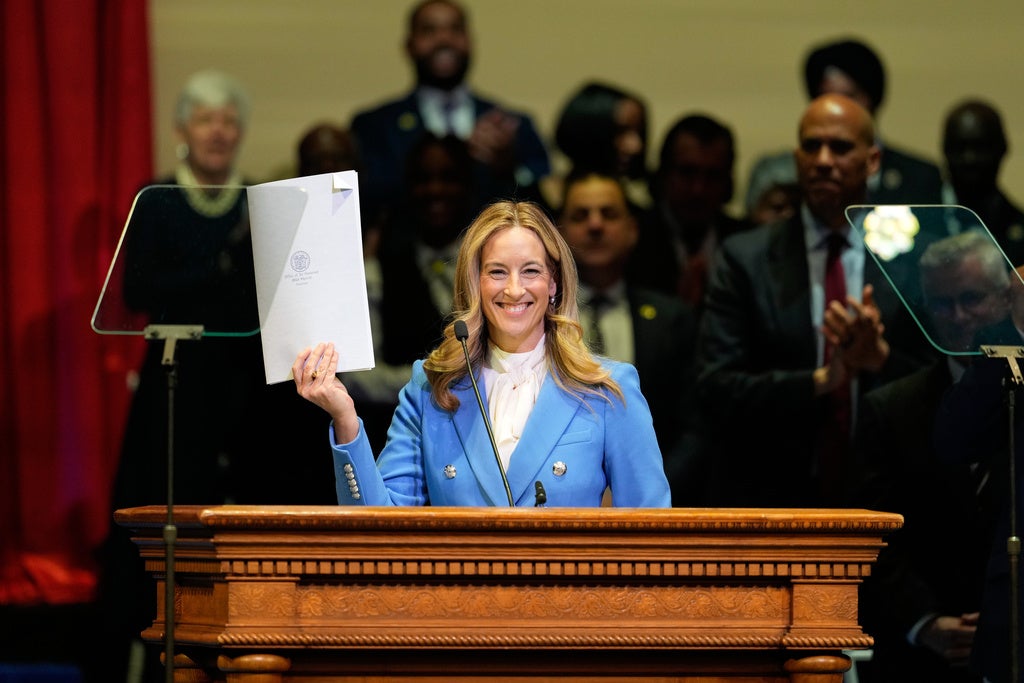
Lambasting efforts by the Trump administration to curb renewable energy development, New Jersey Gov. Mikie Sherrill signed an executive order this week aimed at expanding solar generation and battery storage in the state.
The order, one of two aimed at tackling rising electricity rates, made good on one of her campaign promises, and declared the shrinking gap between supply and demand and the resulting rate hikes a state of emergency. Sherrill also seeks to expand natural gas plants and study the potential for new nuclear power.
Currently, natural gas and nuclear generate the bulk of the state’s electricity, with nuclear producing 42% and natural gas 49%.
Clean energy advocates praised the move.
“The governor is really focusing on how can we build out as much renewable energy as possible … and how can we do it faster and cheaper by cutting red tape,” said Alex Ambrose, a policy analyst with the left-leaning think tank New Jersey Policy Perspective, which leads a coalition of groups advocating for renewable energy called Power Play NJ. “All of these will result in lower bills in the long term for everyone.”
But Ambrose stopped short of praise when it came to the expansion of natural gas generation.
“There is no reason, economical or otherwise, that we should build new natural gas plants in New Jersey,” she said.
The order points to current and future data centers driving up demand and shrinking supplies, causing the region’s grid operator, PJM Interconnection, to project the peak load growth in electricity to jump 20% by 2030. That could mean even higher electricity rates.
PJM conducts auctions among power suppliers to secure enough energy through peak demand, such as during heat waves. These auctions set an electricity price in return for generators promising to deliver a future supply. The price has soared to record-breaking heights in recent years. The most recent PJM auctions in December and July cost New Jersey ratepayers a combined $4 million in new costs, according to the governor’s order.
At December’s auction, PJM was unable to secure sufficient power supplies, which could lead to rolling brownouts or blackouts as early as June 2027. Exacerbating the problem is that much of the future increased demand from new customers, like data centers, are speculative and can inflate the actual need. Referred to as “ghost loads,” these projected demands can still drive up costs even if a project never gets built.
Although PJM has said it’s done much to speed up new power connections, critics say PJM has been slow to bring on new renewables to the grid.
“It is clear that the process from when a developer wants to build new energy to when it actually gets plugged into the grid has simply gone on far too long, and that’s part of the reason that we’re in this situation to begin with,” Ambrose said.
Sherrill recently told WHYY News that she would be working with other governors across the region to “force [PJM] to push more power into our grid so we can drive down costs over time.”
“What that will look like on the ground is immediately moving into things like solar and battery storage, which are the quickest ways to do that,” Sherrill said, adding that the state will also “be making sure we’re modernizing gas generation and then looking to the long term with things like nuclear power.”