
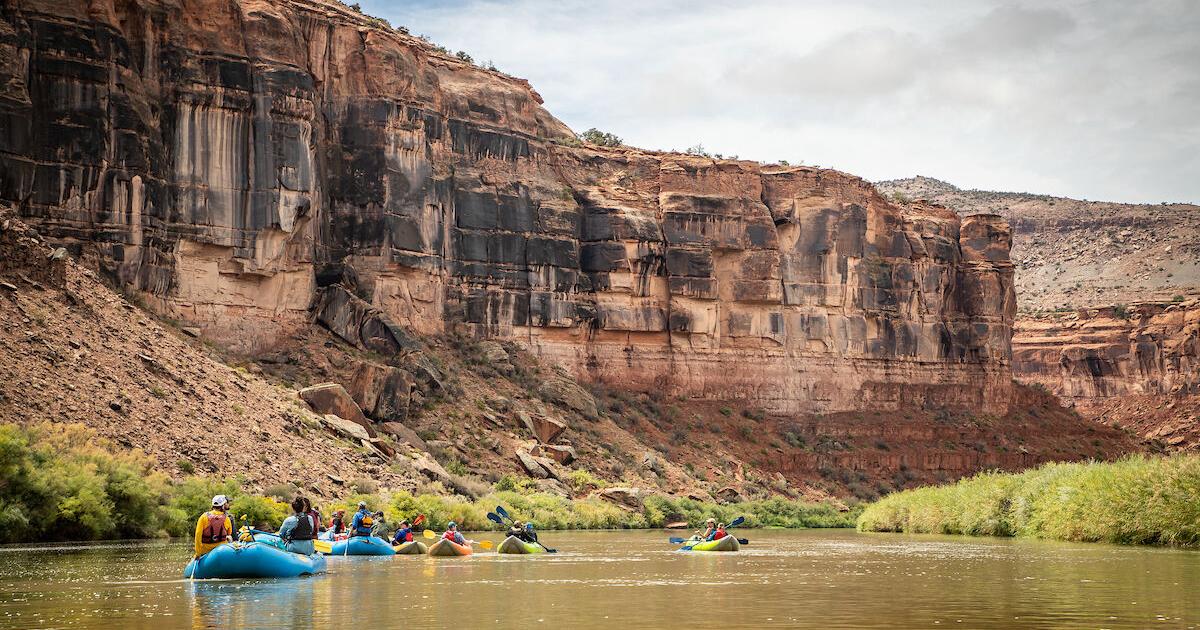
The Bureau of Land Management is close to acquiring more than 4,000 acres of private ranchland lying in numerous parcels within the boundary of the Dominguez-Escalante National Conservation Area.
The agency decided to go ahead with pursuing the purchase of the property from Escalante Ranch in 2024 and is in the final stages of trying to buy it from The Conservation Fund, a third-party BLM partner that bought the land with the intention of selling it to the BLM.
Local BLM spokesperson Heather Marsh said the agency hopes to close on the acquisition early this year.
“BLM Colorado is still completing required steps and coordinating details for the closing process,” she said.
The BLM plans to buy the land with funding from the federal Land and Water Conservation Fund, which receives revenues primarily from offshore oil and gas development.
Asked about the cost of the purchase, Marsh said the financial details won’t be available to the public until the BLM closes on the deal.
Brian Mason, a real estate agent in Delta, was involved with the ranch’s sale, to a private party, of a couple of thousand acres adjoining national forest but wasn’t involved with the sale of the land eyed by the BLM. He says he believes the ranch sold that property to The Conservation Fund for about $10 million or $10.5 million.

Photo by Todd Winslow Pierce/Special to the Sentinel
Fall colors adorn acreage the Bureau of Land Management hopes to add within the boundaries of the Dominguez-Escalante National Conservation Area.
Photo by Todd Winslow Pierce/Special to the Sentinel
“I know there were some struggles early on with the BLM having the funding available to do some of that,” he said.
Christine Quinlan, Colorado associate state director for The Conservation Fund, said it doesn’t disclose what it pays for properties out of respect for the sellers. She said the funding is available to complete the transfer to the BLM and she is confident that will occur.
“It’s a pretty substantial, I think, win for conservation in Colorado,” she said.
The BLM describes the acreage as consisting of an inholding of nonfederal parcels of private land and interests lying within the designated boundaries of the national conservation area along Escalante Creek and the Gunnison River. About 2,180 acres of the ranch are in Delta County and another 1,880 acres are within Mesa County.
A 2023 BLM scoping document seeking public comments on the proposals describes the land as “a conglomeration of discontiguous patented homestead tracts spread out along the bottom lands of the Gunnison River and Escalante Creek. The Ranch parcels have been used for cattle ranching for over 100 years and currently support a 1,400 head cow-calf operation which holds both BLM and National Forest grazing permits. Approximately 900 acres of the Ranch are irrigated for both hay production and pasture.”
The purchase includes water rights, partial mineral rights and residential structures. According to the BLM, The Conservation Fund intends to relinquish the BLM grazing permit to the BLM when the land is conveyed to the BLM.
The water rights include rights to flows of about 70 cubic feet per second between the Escalante Creek and the Gunnison River and a water storage right in the Beaver-Huffington Reservoir, a 405-acre-foot facility located in the Escalante Creek watershed headquarters, the BLM says.
Bureau of Land Management photo
Bighorn sheep are visible on acreage that the Bureau of Land Management hopes to buy and add to the Dominguez-Escalante National Conservation Area.
Bureau of Land Management photo
Quinlan said the land is the last remaining private land within the national conservation area’s boundary, and there had been a risk of the parcels being sold off to multiple owners.
“It was listed on the market for sale so anything could have happened,” she said. “But the landowner was happy to see us step up and was really in alignment that this ranch could be consolidated with the national conservation area and liked the idea of that.”
Mason called the planned acquisition by the BLM “a shame. That was one of the last big ranches in our back yard.”
He said the ranch was owned by Dick Miller until his death, after which his son, who lives on the Front Range and wasn’t interested in running a ranch, put it up for sale.
Mason said there already is a lot of public access all around that area, and the BLM doesn’t need the ranch.
“To me, it just really screwed up a wonderful ranch,” he said of the planned acquisition, adding that he worries about what will become of the water rights and about them potentially ending up supporting housing development rather than being used for agriculture.
Bureau of Land Management map
This Bureau of Land Management map shows parcels it hopes to purchase within the Dominguez-Escalante National Conservation Area boundary.
Bureau of Land Management map
Mesa County resident Brandon Siegfried, who is active in public land issues and alerted the Sentinel to the pending BLM acquisition, said 4,000 acres is a lot for the federal government to acquire. He said that with one-third of Colorado being federal land, private land ownership and tax revenues should be preserved on the other two-thirds.
“Not one more acre should be sold to the federal government unless they sell an equal portion back to private ownership and communities that need to room to grow,” he said.
According to the BLM 2023 scoping document, the purpose of the acquisition is to acquire nonfederal lands within the national conservation area’s boundaries.
“Acquiring parcels of non-Federal land located entirely within the boundaries of the (national conservation area) creates a more contiguous landscape and consolidates land ownership, increasing BLM’s ability to manage and protect natural and cultural resources, consolidate public lands, enhance stewardship goals, and increase outdoor recreation and environmental education opportunities, and may include opportunities to demonstrate sustainable agriculture and/or traditional farming techniques on a landscape scale,” the document says.
Quinlan said one thing her organization heard from local and state officials is the importance of maintaining the irrigated fields on the ranch, and their benefit to wildlife. She said The Conservation Trust has continued to irrigate those fields and she expects the BLM will ensure that continues, and one of the main goals “is to keep these water rights in this watershed.”
According to the BLM’s 2024 decision document approving pursuing the acquisition, Mesa and Delta counties and Colorado Parks and Wildlife had “identified grazing, water rights/uses and potential loss of agricultural acres as issues of concern. While BLM will not be addressing these issues in depth in this document, BLM is committed to engaging with the partners as cooperative agencies for the subsequent interim and long-term planning efforts associated with this project.”
The historic Smith cabin sits on some 4,000 acres that the Bureau of Land Management hopes to buy and add to the Dominguez-Escalante National Conservation Area.
Bureau of Land Management photo
Quinlan said that before The Conservation Trust got involved in the property acquisition, it and the BLM did thorough informal outreach with local counties and communities.
“We heard that there was strong interest and support for us to undertake this project,” she said.
The agency says if the lands are acquired, they will be managed consistent with the objectives of surrounding BLM-administered lands, according to the Dominguez-Escalante resource management plan.
If it buys the land, it plans to do environmental review and analysis that would touch on issues such as recreation and travel management, grazing, agricultural use and irrigation, aquatic species and habitat, cultural resource management, and wildlife, including desert bighorn sheep.
Quinlan said that conserving the parcels will safeguard about 15 miles of riverways, including about 8 miles along Escalante Creek and another 7 along the Gunnison River. Those private stretches of river are interspersed with BLM-managed stretches along the creek and river, so the conservation benefit actually spreads out along some 30 miles of riverways, she said.
“I think this project really has incredible conservation outcomes,” she said. “I guess the thing that’s most exciting for me is the fact that we have been able to, as I call it, meet the moment to make this chance to conserve it a reality and prevent that opportunity from being lost forever.”
Bureau of Land Management photo
This acreage along Escalante Creek is among some 4,000 acres the Bureau of Land Management hopes to buy and add to the Dominguez-Escalante National Conservation Area.
Bureau of Land Management photo
Wendell Koontz, a Delta County commissioner, said the county has been working on the Escalante Ranch matter for several years.
“Delta County highly values our public lands. We’re more than 50% public land as we stand now and the … NCA is very important to us both as individuals and quality of life but also an economic driver for us,” he said.
That said, he said the county would have preferred to see the property remain as an active, viable, ongoing ranch operation.
“But, given the circumstances, this is the next best thing,” he said.
He said the BLM has committed to keeping the agricultural operation going.
“Delta County highly values the ag production that comes from the Escalante Ranch and we’re very excited to see the BLM working with a plan that maintains that ag through a lessee to keep that in ag production” for as long as possible, he said.
He said wildlife like desert bighorn sheep, turkey and deer thrive in those irrigated bottomlands, and the late-season irrigation-related return flows to the river are important to fish habitat and river recreation.
“Maintaining the ag operations through the lessee is really important for us to see this land incorporated into the NCA, and it’s a stretch for the BLM to take this on but they’re certainly capable,” Koontz said.