
What were the tallest buildings in Hawaii from 1926-1964?
Two weeks ago, I wrote about Hawaii in 1926 — 100 years ago. Aloha Tower opened that year, and I said it was the tallest building in Hawaii from 1926 to 1964. It is 10 stories and 184 feet tall.
Bill Souza questioned that. “Wasn’t the Ala Moana Building with the revolving restaurant, La Ronde, the tallest building in Hawaii when it opened in 1961?
“Living in Makiki, about half a mile mauka, I watched it go up. The restaurant did a 360-degree revolution once per hour. It had breathtaking views.”
I searched the newspaper archives for “tallest building” and found that Souza is correct. The Ala Moana Building, aka the 1441 Kapiolani building, was the tallest in the state when it opened in 1961.
However, it is a little more complicated than that. Let’s take a closer look at the time period of 1926, when Aloha Tower was built, to 1964, when the Ilikai “condotel” opened.
Don’t miss out on what’s happening!
Stay in touch with breaking news, as it happens, conveniently in your email inbox. It’s FREE!
I certainly learned some interesting things in the process, and I think Rearview Mirror readers will enjoy a closer look.
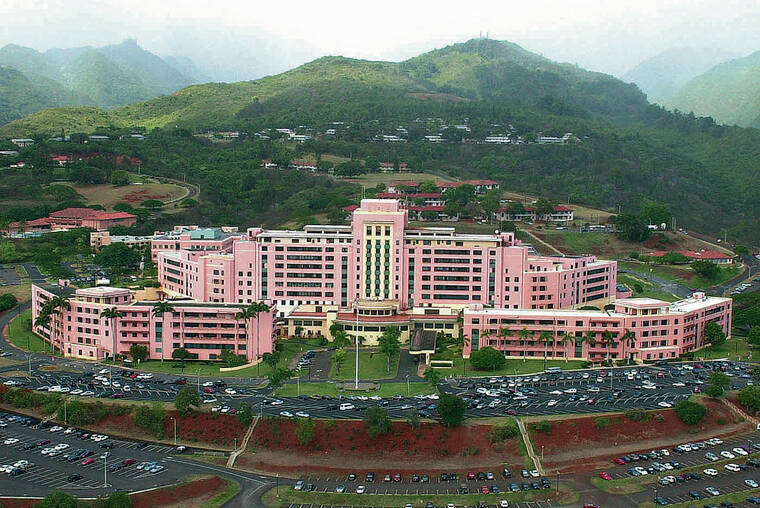
Tripler Army Medical Center
I was surprised to find that the new Tripler hospital claimed the title of tallest building in Hawaii and the Pacific when it opened in 1948 in its current location. It was 14 stories and 189 feet tall.
Its history is fascinating. It began as the Fort Shafter Hospital in 1907. It was located about where the H-1 Freeway passes the fort. In 1920, it was renamed for Brig. General Charles Stuart Tripler, who had been Medical Director of the Army of the Potomac during the Civil War.
When World War II began, plans were created for a larger hospital. The current Tripler Army Medical Center opened in 1948.
Hospitals are normally painted white, but the chief architect and chief engineer feared the red dirt from Moanalua Ridge would discolor it. They selected rose coral to match and hide Hawaii’s red dirt.
It looks like Tripler dethroned Aloha Tower as Hawaii’s tallest building by 5 feet.
I looked into the Princess Kaiulani Hotel, which opened its first 11-story tower in 1955 and Kaiser’s Hawaiian Village, where the first building in 1957 was 14 stories. Coming up with a height in feet eluded me but they appear to be less than Aloha Tower and Tripler.
Ala Moana Building
Next on our tour of tall edifices is the Ala Moana Building. It is 25 stories high, including the flying saucer- shaped revolving restaurant at its top, and is 300 feet tall.
Its history can be traced to Walter Dillingham purchasing 100 acres of swampland in 1912 from Bishop Estate. The price was $47,000, and Dillingham said he thought it “might be useful someday.”
Forty years later, his son Lowell decided to build a shopping center on some of the land and tasked Donald Graham with making it happen.
Graham thought a business building should be part of the mall, and his idea as a signature attraction was a UFO-shaped revolving restaurant at its top. It would be the first revolving restaurant in the United States.
Initially, the plan was for two 14-story twin buildings, one at 1441 Kapiolani Blvd. and the other mauka, across Keeaumoku Street. It opened in 1961 as a single, 25-story structure called the Ala Moana Building.
Famed restaurateur Peter Canlis was the first choice to own the unnamed cafe, but he backed out. He had his hands full with his Waikiki broiler, his Seattle restaurant and three Portland restaurants. Canlis was considering restaurants in London, Rome, Tokyo and Tel Aviv.
Batz
Donald Graham then turned to chef Alphonse Batz who managed a few Waikiki restaurants. Newspaper columnist William Drury said he and Chef Batz met to discuss possible names for the restaurant over coffee.
Drury recommended “Room at the Top” or “Pie in the Sky.”
“Ugh!” Batz replied. Drury noted it sounded better with a French accent.
“Smarting over this blow to my pride, I sulked for a while,” Drury continued, “then finally hit on a subtle method of revenge.
“Since the restaurant stands atop a tower,” I suggested, “why not call it The Belfry?” A belfry is the part of a steeple that houses bells. It’s also a place that bats might congregate.
“‘C’est magnifique!’ cried Monsieur Batz. He dashed off next day to register it, only to discover too late the full depth of my villainy. For, as I pointed out in a column: ‘Monsieur has not yet realized that, when his new restaurant opens, he will be known far and wide as Batz in the Belfry.’
“After being ribbed by his patrons, Batz decided to settle for a name that was less open to misinterpretation, such as La Ronde.
“In vain, I explained the advantages of calling it ‘The Belfry.’ A number of novel effects, I told him, were possible. The place could look like an eerie, haunted room with cobwebs hanging from old oaken rafters.
“There could be a cracked bell on every table to summon waiters. And the waiters should look like Boris Karloff, each in a shabby butler’s suit, with a dagger sticking out of his chest.
“Monsieur scoffed at this,” Drury concluded. “For some strange reason, he has little faith in my ideas. Which more or less proves my point that he is Batz in The Belfry.”
Felix and Felix
Batz joined forces with Henry Felix and his son John Henry Felix in December 1960 to open the restaurant. Batz imagined a circus- themed decor. The waiters could wear black top hats and ringmasters red tailcoats. John Henry Felix thought it should be more elegant.
Batz and the Felixes would manage three other restaurants operated by the La Ronde firm.
Drury’s “Belfry” suggestion was resurrected for a 20th floor restaurant that would be open to men only until 5 p.m. It was later renamed John Henry’s.
On the third floor of the Ala Moana Building would be L’omlette, a coffee shop, and the Roost, a cocktail lounge.
John Graham and Co. of Seattle (unrelated to Donald Graham) designed the Ala Moana Building’s revolving restaurant and then a year later, the Seattle Space Needle with its revolving restaurant.
Donald Graham’s UFO- looking restaurant was originally to be in the center of the shopping center. It was “moved all over the place,” Graham recalled, before finally landing atop the 1441 Kapiolani building on the mauka side of the shopping center.
Foster Tower
Many in Waikiki were upset when Foster Tower opened in January 1962 at Kalakaua Avenue and Kealohilani Street opposite Kuhio Beach. Its 26 stories reached 251 feet in height.
T. Jack Foster & Sons built it, changing the name from the Beach Park Apartments. They also built Foster Village near Aloha Stadium.
First Hawaiian Bank
In 1962, the First National Bank of Hawaii, as it was then called, rebuilt its main branch on King and Bishop streets. Its new edifice was 19 stories and 254 feet high, and was the first downtown structure taller than Aloha Tower.
Ilikai
The Ilikai “condotel” opened on Leap Day, Feb. 29, 1964. Dillingham hired John Graham to design an “Ala Moana Boulevard Hotel” but sold it to Chinn Ho to raise money to build Ala Moana Shopping Center.
It was 21 stories and 260 feet tall. It was called the largest condominium in the world at that time. It had a nonrevolving space at its top that housed restaurants and nightclubs.
The opening sequence of “Hawaii Five-0” zoomed in on actor Jack Lord atop the Ilikai from 1968 to 1980.
Summary
In sum, it looks like the buildings that could claim to be tallest in Hawaii from 1926 to 1964 were:
>> Aloha Tower (1926, 10 stories, 184 feet tall)
>> Tripler Army Medical Center (1948, 14 stories, 189 feet tall)
>> Ala Moana Building (1961, 25 stories, 300 feet tall)
Other tall buildings, such as the Hilton Hawaiian Village, Colony Surf, Rosalei Apartments and Reef Hotel, opened during that period but were not taller than the tallest at the time.
After 1964, many Hawaii buildings surpassed 300 feet in height, but I’ll leave those for another day.
Bob Sigall is the author of the five “The Companies We Keep” books. Contact him at Sigall@Yahoo.com or sign up for his free email newsletter at RearviewMirrorInsider.com.