
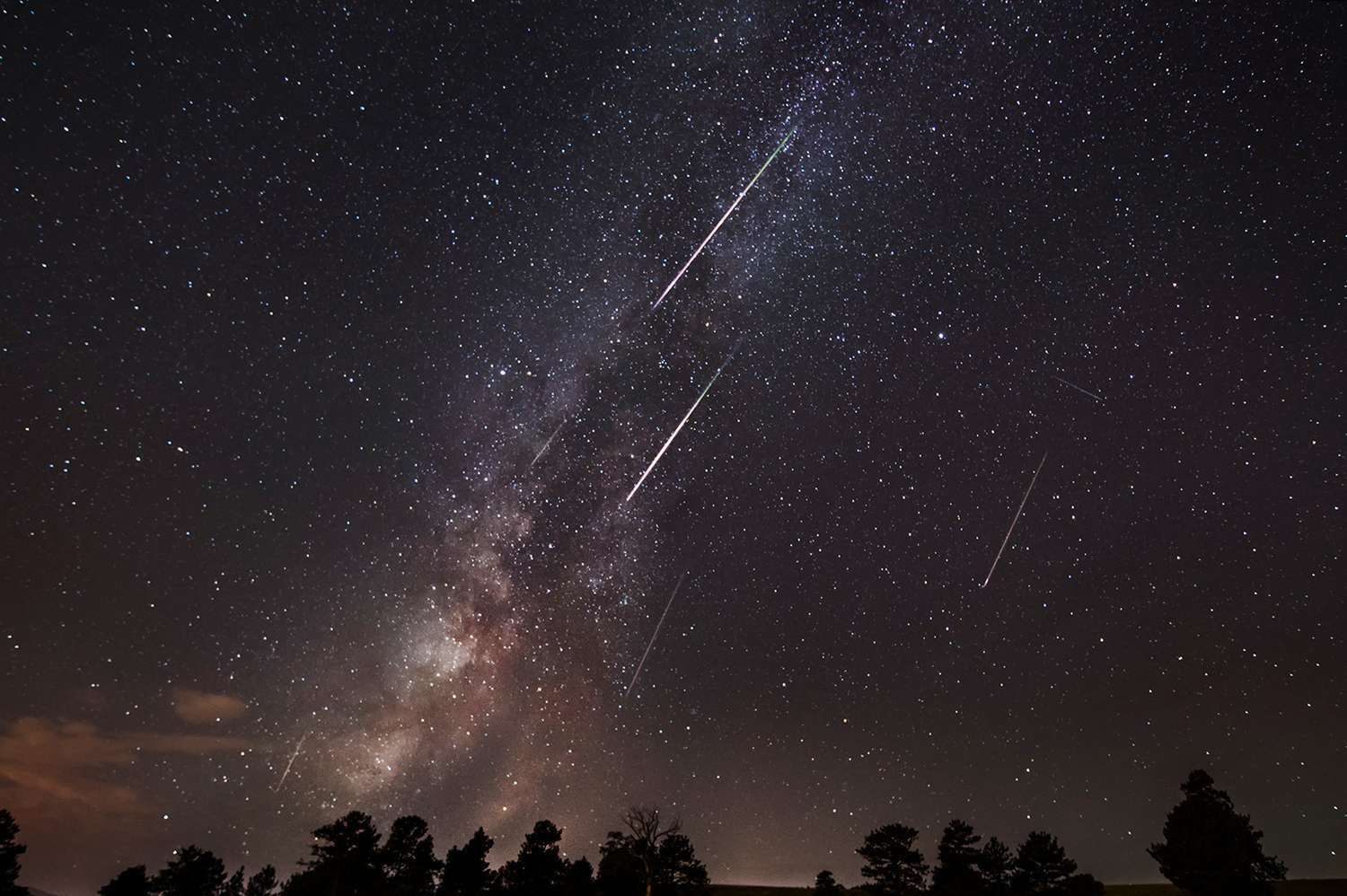
Perhaps nothing makes us feel smaller than witnessing a celestial event. It’s a reminder that we, and the Earth, are just a tiny speck in an immense universe.
Of all the celestial events—eclipses, supermoons, novas—one of the easiest to spot is a meteor shower, which happens regularly and is often visible to the naked eye. A meteor shower is often described as a flurry of “shooting stars,” but it is really the burning up of cosmic debris as it enters Earth’s atmosphere.
Witnessing the natural spectacle often requires only two elements: patience and clear, dark skies. The latter element can be the tricky part. Moonlight and light pollution can wash out the night sky, making it hard to see even the brightest meteor showers.
That’s not the case with the Perseids, expected to occur from July 14 to Sept. 1, and is predicted to be the brightest meteor shower of 2026. Not only does it have the “most bright meteors” according to Space.com, but it also peaks under a new moon, meaning that the skies will be absent of moonlight.
During the Perseids’ run, over 4,500 meteors are expected, and during its peak—the night of Aug. 12 and into dawn on Aug. 13—between 50 and 100 meteors an hour may be visible. In the Northern Hemisphere, the pre-dawn hours of Aug. 13 are expected to be particularly spectacular.
If you’re only going to make a point to see one meteor shower in 2026, this should be it. And if you happen to be traveling to Iceland, Greenland, or Spain during the peak of Perseids you may even be able to see the celestial event during the day. This year the Perseids coincides with a total solar eclipse on Aug. 12 that is visible in those countries.
Following the Perseids, Space.com highlights the Geminids (December) and Orionids (October) as showers with bright, often visible meteors expected in 2026. The Geminides, which peak Dec. 13–14, will fall under a waning crescent moon. That low moonlight is expected to offer an impressive display, with up to 120 meteors per hour in perfect dark sky conditions. Meanwhile, the Orionids peak Oct. 21–22 under a bright waxing gibbous moon. That means many of the fainter meteors might be washed out, so serious observers will need to travel to a dark-sky location to see the predicted 20 visible meteors per hour.
A full rundown of the year’s best meteor showers can be found here.