
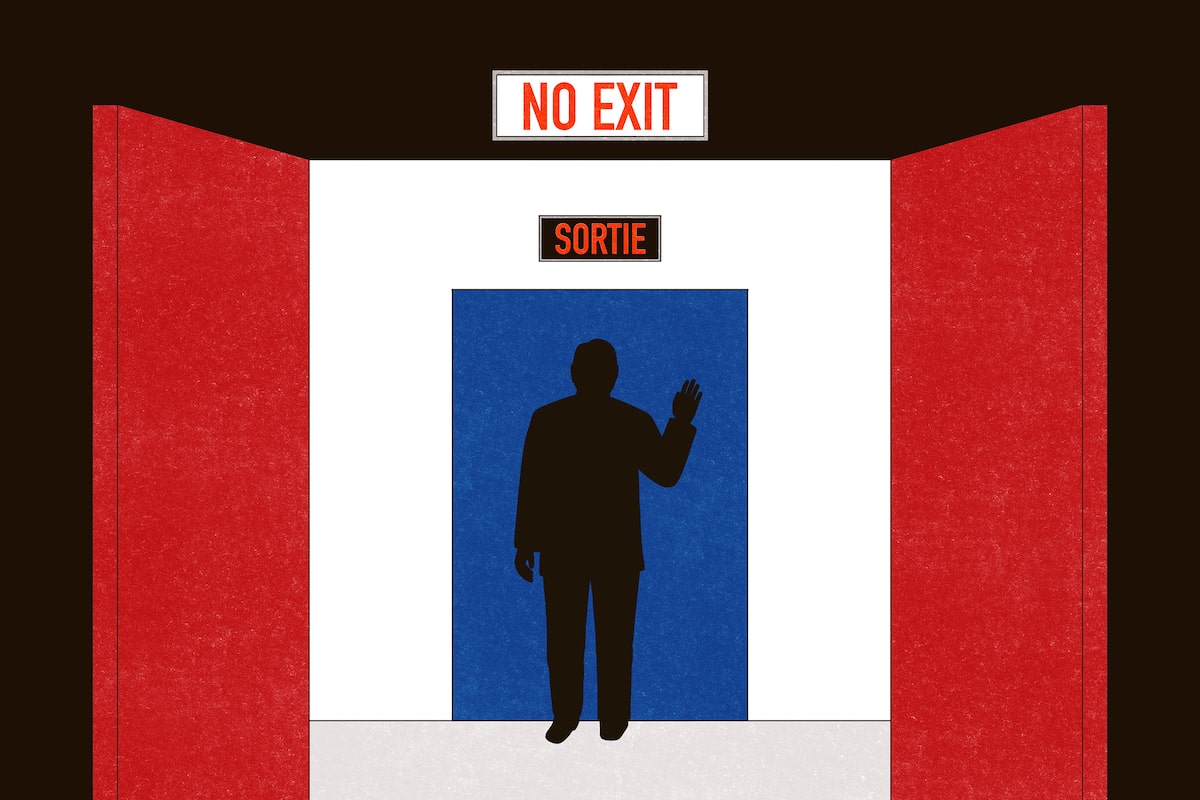
Did a premier of Quebec just do Canadian unity a favour?
The highly unpopular Coalition Avenir Québec Leader François Legault announced his resignation this month, giving his party the chance to distance itself from him and rebrand its image.
If Quebeckers can separate the party from the man who founded it, Mr. Legault’s departure may make the CAQ palatable again to voters before the provincial general election scheduled for no later than Oct. 5.
Parti Quebecois leader Paul St-Pierre Plamondon has pledged to hold a third independence referendum, despite low support for sovereignty in the province.Jacques Boissinot/The Canadian Press
That could give them a place to park their votes instead of supporting the poll-leading Parti Québécois, which is vowing to hold a third referendum on Quebec independence even though two-thirds of voters keep saying they don’t want that.
Canada is trying desperately to rebuild its economy and alliances in the face of U.S. President Donald Trump’s tariffs and threats. Preventing a PQ majority and taking separation off the table would be welcome.
But the relief brought by the lessening of a threat to Canada’s territorial unity has to be balanced against the fact that Mr. Legault irreparably weakened this country’s cultural and social unity by adopting laws that bolstered Quebec’s French language and culture at the expense of individual rights.
That the federal parties in Ottawa – with the Liberals the most to blame – were complicit in this, and that other provincial premiers have been emboldened to emulate Mr. Legault because of the federal government’s laxity, only makes things worse.
Mr. Legault, in short, has done Canada no favours at all.
François Legault, founder and leader of the Coalition Avenir Québec (CAQ), speaks to supporters after winning the provincial election on Oct. 1, 2018.Ryan Remiorz/The Canadian Press
On the plus side…
Mr. Legault is stepping down after having plunged his party to the bottom of the polls in an election year (he will stay on as leader until the CAQ names his successor). His fall from grace was precipitous.
Mr. Legault sailed into power in 2018 on the promise of leaving the separation debate in the past and focussing on Quebec’s economy. He was the most popular politician in Canada during the COVID-19 pandemic; one poll gave him a 90-per-cent approval rating.
Quebeckers loved his avuncular style, even as their province suffered through the highest death rates in the country, and he twice imposed province-wide curfews.
But by the end of 2023, his approval ratings had been cut in half. He decision to cancel the construction of a tunnel under the St. Lawrence River to ease traffic in the Quebec City, after having made it a key election promise in 2022, was seen as callous and deceptive.
His government went on to table a bill to increase the salaries of members of the National Assembly by 30 per cent, while asking civil servants to accept a much smaller 9-per-cent raise over five years.
These and other tone-deaf actions were the beginning of the end. By-election losses piled up and at least six CAQ members quit the party to sit as independents, most notably the health minister, Christian Dubé.
Open this photo in gallery:Open this photo in gallery:
Former Quebec Minister of Natural Resources Maïté Blanchette Vézina (top) and former Health Minister Christian Dubé are among at least six CAQ members to leave the party.Jacques Boissinot/The Canadian Press
The last polls taken before Mr. Legault announced his departure had the CAQ in fifth place, at less than 15 per cent of intended votes.
But now, with Mr. Legault gone, there is a chance the voters will give his party a second look under a new leader, the way the federal voters did after Justin Trudeau announced his resignation as federal Liberal leader in January, 2025.
There is no Mark Carney-like saviour waiting offstage for the CAQ as there was for the federal Liberals, who won the election in April, 2025, after badly trailing the Conservatives for many months.
But a similar dynamic is in play; that is, that voters are looking for someone who can offer sound management during uncertain times.
If there is one thing that does not qualify as sound management during uncertain times (pay attention, United Conservative Party in Alberta), it is the PQ’s obstinate vow to hold a referendum on separation if elected to power.
Polls consistently show that two-thirds of Quebec voters have no interest in undergoing the trauma of another referendum, but PQ Leader Paul St-Pierre Plamondon keeps insisting that he doesn’t care.
Unless the PQ changes its tune, a rebranded CAQ, as well as a provincial Liberal Party that will also name a new leader this year, could benefit.
At the very least, a PQ victory in the fall is no longer a given, thanks to Mr. Legault’s resignation.
Mr. Legault greets a supporter during an election campaign stop in Saint-Jerome, Que., in September, 2022. He went on to clinch a second election victory in October of that year.Graham Hughes/The Canadian Press
Notwithstanding all that…
That said, any gratitude extended to him for knowing when to leave should be tempered by the knowledge that he was the author of his own demise. The success of the party he founded, in particular its convincing second election victory in 2022, seems to have detached him from the people he governed.
More importantly, anything positive taken from his decision to leave is negated by his attack on the constitutional rights of religious minorities.
Mr. Legault’s government invoked the Constitution’s so-called notwithstanding clause to enact Bill 21, An Act respecting the laicity of the State, in 2019. That infamous law prohibits public-facing government employees – teachers, judges, police officers included – from wearing religious symbols or clothing, such as crucifixes and head coverings, on the job.
Though popular with voters, it’s a completely unnecessary law. Canada’s status as a secular country is not undercut by the fact a Mountie can wear a turban on patrol or a teacher can wear a hijab in class. To translate such quotidian expressions of religious freedom into an unacceptable violation of secularism has always been laughable.
Hundreds march through downtown Montreal during a demonstration opposing the CAQ’s controversial Bill 21 in April, 2019.Graham Hughes/The Canadian Press
Not to mention inhumane. The first Quebec court to hear a constitutional challenge to the law ruled in 2021 that forcing a person to choose between their employment and their religion “has a cruel consequence that dehumanizes those it targets.”
The judge was obliged to concede, however, that Bill 21 could stand because it was inoculated against the Charter of Rights and Freedoms by the Legault government’s pre-emptive invocation of the notwithstanding clause.
The Legault government went on to pre-emptively invoke the same clause in Bill 96, a 2022 law that toughens the province’ language laws at the expense of such basic freedoms as the right of a business not to be subjected to warrantless searches or arbitrary demands to turn over documents.
People take part in a protest in Montreal against Bill 96 and the CAQ government’s decision to pre-emptively invoke the notwithstanding clause to shield it from constitutional challenges, in May, 2022.Graham Hughes/The Canadian Press
And it did it again last fall with Bill 9, a law that, among other things, would prohibit day-care workers from wearing religious headgear and ban prayer in outdoor public places, such as parks. The bill is still being debated.
Mr. Legault was also a disappointment on the fiscal front. A founder of Air Transat, he campaigned as a successful businessman who would revitalize Quebec’s economy and, eventually, end the province’s dependence on federal equalization payments.
His record on both promises is middling. Quebec received 62 per cent of total federal equalization payments in fiscal 2018-19; this year, it will receive 52 per cent. In 2018, the province accounted for 20.7 per cent of national gross domestic product. Six years later, that had expanded — to 20.9 per cent.
As well, he inherited a surplus from his Liberal predecessor in 2018, but over the course of his tenure, his government twice tabled budgets with record-high projected deficits, both of them after the pandemic had receded – in fiscal 2024-25 ($11-billion) and fiscal 2025-26 ($13.6-billion).
Mr. Legault arrives for question period at the legislature in Quebec City, in October, 2025. The last polls taken before Mr. Legault announced his departure revealed the CAQ had dropped to fifth place.Jacques Boissinot/The Canadian Press
A terrible record, but he had help
Fiscal mismanagement is a garden-variety failing in government; it is Mr. Legault’s repeated violations of constitutional freedoms for the sake of populist pandering that make him stand out. Members of the province’s Jewish and Muslim communities, as well as many anglophones in general, feel estranged and marginalized in the Quebec that he built – a terrible legacy for a Canadian politician.
The bigger problem, though, is that federal politicians in Ottawa failed to stand up to laws that were popular precisely because they restricted the rights of vulnerable minorities.
The Liberals, Conservatives and NDP embarrassed themselves in the 2019 federal general election by refusing to condemn Bill 21 out of a fear of a backlash, preferring votes to the principle that democracies must protect minorities from the tyranny of the majority.
The federal parties also failed to raise an objection to Bill 96’s law’s pre-emptive use of the notwithstanding clause. They instead meekly came together to pass a unanimous motion in June, 2021 supporting the bill’s addition of clauses to Quebec’s constitution stating that, “Quebeckers form a nation, that French is the only official language of Quebec and that it is also the common language of the Quebec nation.”
The Liberal government of Justin Trudeau was particularly indulgent of Mr. Legault. Just prior to the 2021 federal election, it offered Quebec $6-billion to spend on its day-care programs any way it saw fit, while setting conditions on similar spending in other provinces.
Former Prime Minister Justin Trudeau, right, and Mr. Legault announce $6-billion in childcare funding from the federal government, in Montreal in August, 2021.Graham Hughes/The Canadian Press
Mr. Trudeau’s government also tabled a bill just before the same election to essentially extend Quebec’s Charter of the French Language (Bill 101) into federally registered private businesses in Quebec. The bill died when the election was called but was revived and adopted in the next Parliament.
Now that Bill 21 has finally reached the Supreme Court (the case is scheduled to be heard in March), Ottawa has found the courage to challenge it. But it’s an indirect challenge that questions the pre-emptive invocation of the notwithstanding clause and calls for limits on its use. The federal government is still not questioning the law itself or addressing its harms.
Mr. Legault’s assault on the Charter, and Ottawa’s weak response to it, has raised the spectre of a federation that has asymmetrical human-rights regimes; a country where your basic freedoms depend on which province you live in.
Worse yet, the other provinces have not been blind to what has happened. Instead, they’ve seen an opening. Mr. Legault’s actions have bled into a broader movement by some provincial governments to normalize the pre-emptive use of the notwithstanding clause.
Mr. Legault came to power promising to leave the separation debate in the past. He did that, but at the same time, and with the help of Ottawa, he has made Canada a more divided place, with disparate visions of the importance of basic freedoms.
It turns out that the desire for Quebec independence wasn’t the only threat to Canadian unity. That lesson will be Mr. Legault’s legacy.
The Sunday Editorial