
Follow The Athletic’s Australian Open coverage
Welcome to the Australian Open briefing, where The Athletic will explain the stories behind the stories on each day of the tournament.
On Day 9, a banner day for American women’s tennis, seeds holding strong and a player with a familiar quandary.
How have seeds sown a record in Melbourne?
Tennis fans may recall the heady days of Wimbledon 2025, when the first two rounds turned into a Hunger Games for the best players in the world.
That tournament, 23 seeds (13 men’s and 10 women’s) went out at the first hurdle. By the second round, four of the top five women’s seeds were done.
Ironically, a lot of that chaos came from Wimbledon being played on the only surface that needs seeds to grow. Grass still requires specialism, and it magnifies certain weaknesses that even the best can have.
Two majors on, the best players on both sides of the tournament have said: Not today.
For the first time in tennis’ Open Era — that’s 58 years, for those counting — the top six seeds in both the men’s and women’s singles draws have made the quarterfinals of a Grand Slam tournament.
The last time it happened in the women’s draw was the 1998 U.S. Open; in the men’s, the 2024 Australian Open.
After two of the women’s top six and three of the men’s top six won Sunday, the remaining four of the women’s and two of the men’s did the business Monday. Novak Djokovic, the men’s No. 4 seed, completes the set, because Jakub Menšík withdrew ahead of their planned fourth-round match at the end of the first weekend.
Why is this so rare, in a sport in which seeding so often bears out when it comes to trophies won and in which favorites tend to do their job? It only takes one peaking opponent, one injury, or one off-day for things to go sideways.
This is the tradeoff that every major goes through. Upsets in the early rounds are exciting, shocking and fun, but when the tournament ticks over into the second week, matches that are supposed to be big can feel small.
When the opposite happens, the first week can feel a little flat, but the blockbuster matches in the second week reward fans’ patience. With not just so many seeds in the quarterfinals, but so many top ones, the matches to finish off the first Grand Slam of the year are set to be phenomenal.
— James Hansen
What decision will Taylor Fritz make?
Taylor Fritz has some problems. For the second consecutive year, he is banged up just weeks into the season.
He came into the tournament talking about managing chronic tendonitis in his knee, the same one he had meniscus surgery on in 2021. Then his oblique flared up, the same muscle that caused him so much trouble for the first half of last year.
There’s an obvious initial solution to some of this – rest. But Fritz doesn’t do rest all that well.
After losing to Lorenzo Musetti in straight sets in the fourth round Monday, Fritz was already talking about getting healthy enough to play the ATP Tour event in Dallas in February.
Really? Dallas? What’s a tennis addict like Fritz to do when his body is asking him for recovery time? There are rankings points to be won and mandatory event penalties to consider, but the ATP Tour recently reduced the number of mandatory 500-level tournaments for top-30 players from six to four. He can take a break. If he wants.
He’s got to figure that out.
“It’s exactly the same as last year, and I kind of made a mess of this thing last year trying to play through it a bit too much,” he said in his post-match news conference. “I don’t think it’s as bad as it was last year, so I think I can recover from it fairly, fairly quickly if I just take some time off.”
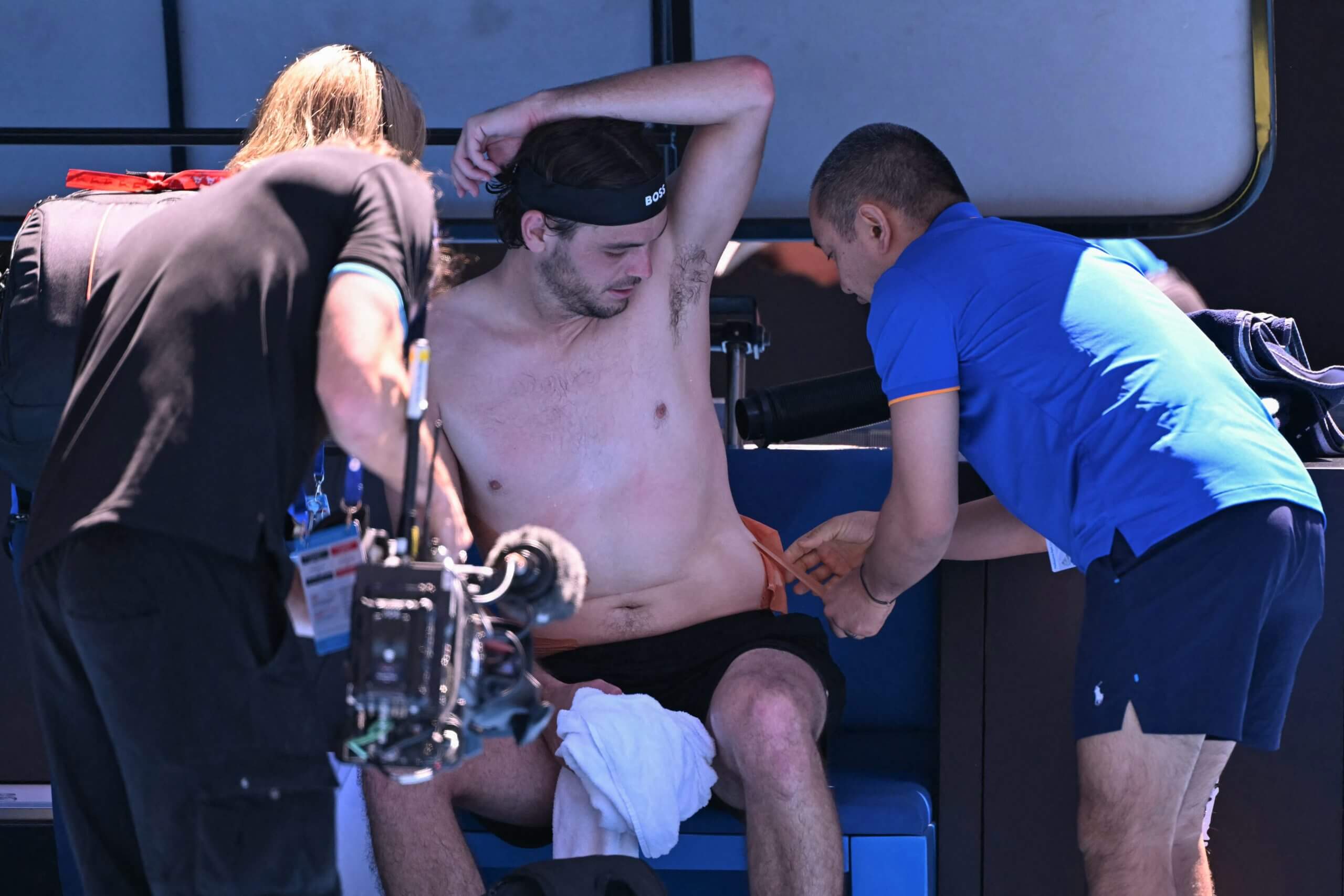
Taylor Fritz has been managing several injuries to start the new tennis season. (William West / AFP via Getty Images)
Hindsight is 20-20 and of course no one knows his body as well as Fritz does. But as he leaves Australia worried about his body more than his tennis, it’s only natural to wonder if Fritz should have rested more during the off-season.
He hustled to Australia in late December to play for the U.S. in the United Cup, just as he did last year. Could he have skipped that, rested more, and tried to play himself into form at the year’s first Grand Slam, like Carlos Alcaraz, Jannik Sinner and Novak Djokovic do?
Fritz said he wouldn’t feel comfortable doing that. As it is, he said, his focus on rehabbing his injuries in the gym during the off-season cost him court time and fitness training. He said he felt undercooked in Melbourne, unable to go the distance if a match lasted five sets.
From the sounds of it, Fritz is planning to play more tennis, even though the way his knee was feeling earlier this month, he was ready “to shut it down for a couple months.”
At the moment, that’s on hold. He said his physio thinks he can get enough rest between tournaments. “He thinks that it’s plausible to get it better while playing. So we said let’s try that and see how it goes,” he said. “Up until three days ago, I thought it was going pretty well. So I think that’s still the plan moving forward.”
— Matt Futterman
How did American women make another milestone?
For the first time since 2001, there are four American women in the Australian Open quarterfinals.
That year, the Williams sisters, Lindsay Davenport and Jennifer Capriati made up the quartet, with Capriati winning the title in the end. This year’s four will hope for a similar outcome Saturday, but they have seriously tough draws to navigate first — as well as the prospect of facing each other.
Three of them have matched their seedings in doing so, with Jessica Pegula, Amanda Anisimova and Coco Gauff seeded No. 6, No. 4 and No. 3 respectively. At least one of those three will be in the semifinals, with Pegula and Anisimova up against one another Wednesday. Pegula knocked out another American, defending champion Madison Keys, to face Anisimova.
The fourth player is more of a surprise, though her strong form going into the tournament means it’s not a total shock. Iva Jović, the No. 29 seed from California, is only 18 but plays with exceptional poise and maturity, and on Tuesday has the ultimate test up against the world No. 1, Aryna Sabalenka. Jović’s counterpunching skills, rapid movement and controlled aggression have been a big-stage revelation in Melbourne.
The fact that the U.S. has four players even without Keys speaks to the nation’s exceptional strength in depth on the women’s side, which has been outperforming the men’s for some time.
— Charlie Eccleshare
Is there an under-the-radar title contender in one draw?
Elena Rybakina moving into the quarterfinals should be about the least-surprising thing at the Australian Open. She won the last big tournament of the season, the WTA Tour Finals, pocketing more than $5 million for her straight-sets win over Sabalenka in the final.
Because tennis does have new seasons, runs of momentum can sometimes get lost across their datelines. But with a 6-1, 6-3 win over No. 21 seed Elise Mertens Monday, Rybakina moved to 17 wins in 18 matches, with 8 of 8 sets won in Melbourne. She made the final of this tournament in 2023. She is getting more efficient by the round, winning so languidly that it’s hard to see her coming until she arrives.
She smacked 10 aces while double-faulting just once against Mertens, raising her tournament ace total to 24. She had 32 winners, against just 22 unforced errors. That’s a dreamy ratio for a player who attacks as relentlessly as she does.
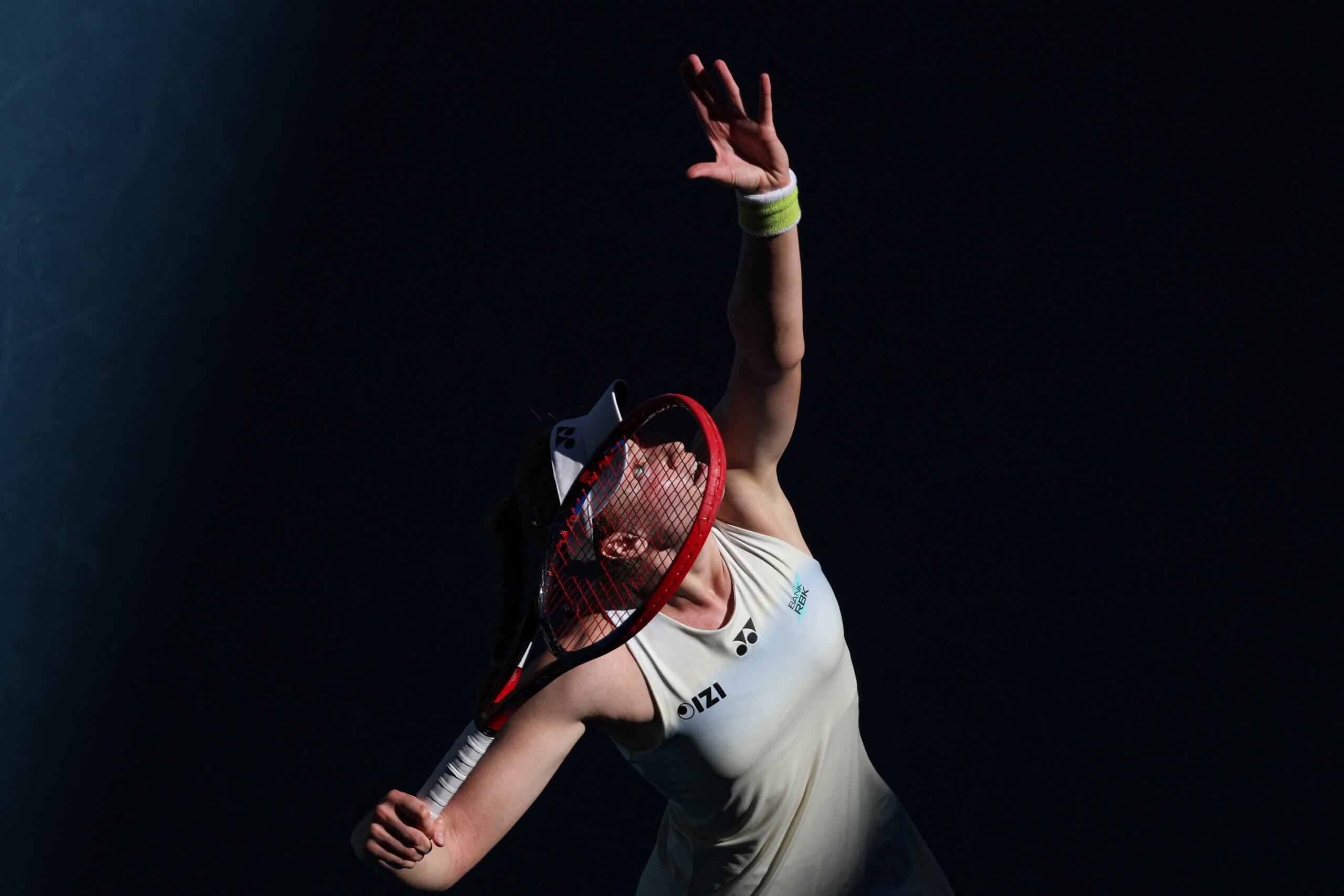
(David Gray / AFP via Getty Images)
She says she’s trying not to think about the streaks.
“I’m focusing every day on my practices, on what I need to improve, how I feel, what we need to adjust maybe,” she said in her news conference. “It’s not really about the wins I had. It’s great to remember, but we just need to work and, yeah, do the things each day.”
She next faces Iga Świątek, the six-time Grand Slam champion. She’s beaten her here before. On the fast hard courts of Melbourne Park, she could be the low-key favorite — maybe even for the title.
— Matt Futterman
Other notable results on Day 9:
Amanda Anisimova (4) keeps winning despite showing signs of tension in her game. She beat Wang Xinyu 7-6(4), 6-4.
Jannik Sinner (1) came through an all-Italian contest with Luciano Darderi (22) 6-1, 6-3, 7-6(2).
Iga Świątek (2) had Maddison Inglis (Q) celebrating winning a game in a dominant 6-0, 6-3 win that never saw her get out of second gear.
Ben Shelton (8) found his night moves to beat Casper Ruud (12) 3-6, 6-4, 6-3, 6-4.
Shot of the day
With apologies to Madison Keys, a day of largely routine wins can sometimes bring fewer highlights — and sometimes a missed shot is a highlight in itself. She can blame the sun for this overhead.

Drop Shots
🛠️ Carlos Alcaraz is world No. 1. He is on a remarkable Grand Slam streak. Still, he won’t stop tinkering with his tennis.
🌡️ With 105-degree weather coming to Melbourne Tuesday, a reminder of the Australian Open’s heat rules.
🇺🇸 Learner Tien and Ben Shelton are the last American men standing. The future of the country’s tennis is coming for the present.
🏃 With Alex de Minaur part of the chasing pack behind Carlos Alcaraz and Jannik Sinner, this is how they don’t lose hope.
Up next: Quarterfinals begin
🎾 Women’s singles: Aryna Sabalenka (1) vs. Iva Jović (29)
7:30 p.m. ET on ESPN, ESPN Unlimited
World No. 1 Sabalenka continued her sequence of largely imperious performances undercut by periods of indifference in the previous round, when Victoria Mboko, 19, unsettled her out of a 4-0 lead and into a tiebreak. Sabalenka won it because that is what she does at Grand Slams. Now comes another teenager in Iva Jović, whose footwork, controlled aggression and rock-solid defense are reminiscent of Iga Świątek, just with different stroke production. Her serve, also like Świątek’s, can be attackable, which is where Sabalenka may see an edge.
🎾 Men’s singles: Alexander Zverev (3) vs. Learner Tien (25)
9:30 p.m. ET on ESPN, ESPN Unlimited
Learner Tien’s reward for turning what was expected to be a five-set grind-fest against Daniil Medvedev into a tennis clinic is a third meeting with Alexander Zverev, last year’s beaten Australian Open finalist. Their head-to-head is 1-1, with Tien winning a hard-court match at last year’s Mexican Open in Acapulco, but both the young American and Zverev have acknowledged that the German did not turn up that day, one more forcefully than the other.
🎾 Women’s singles: Coco Gauff (3) vs. Elina Svitolina (12)
3 a.m. ET on ESPN, ESPN Unlimited
A lot of baseline tussling awaits in this match between Gauff, who has slowly grown into the tournament, and Svitolina, who stunned an in-form Mirra Andreeva in the previous round. Gauff has been using drop shots well so far and will be looking to exploit Svitolina’s forward movement, which is less fluent than her lateral movement. Svitolina will aim to break down Gauff’s forehand, as well as attacking it with her backhand down the line to get out of backhand-to-backhand rallies.
🎾 Men’s singles: Carlos Alcaraz (1) vs. Alex de Minaur (6)
5 a.m. ET (estimated) on ESPN, ESPN Unlimited
Alex de Minaur has played an unbelievable tournament, never retreating from the baseline and covering every blue speck of the court on Rod Laver Arena. His ball retrieval skills and ability to redirect pace turned Frances Tiafoe and then Alexander Bublik to dust, as he dug forehands out of the corners again and again. His next opponent will also be hitting forehands in the corners — just much, much harder. Alcaraz has not played the “perfect” tennis he produced en route to winning the U.S. Open, but he has not really had to do so — and having so many levels to ramp up even in the last eight is ominous for everybody, not just home hope de Minaur.
Australian Open men’s draw 2026Australian Open women’s draw 2026
Tell us what you noticed on the ninth day…