
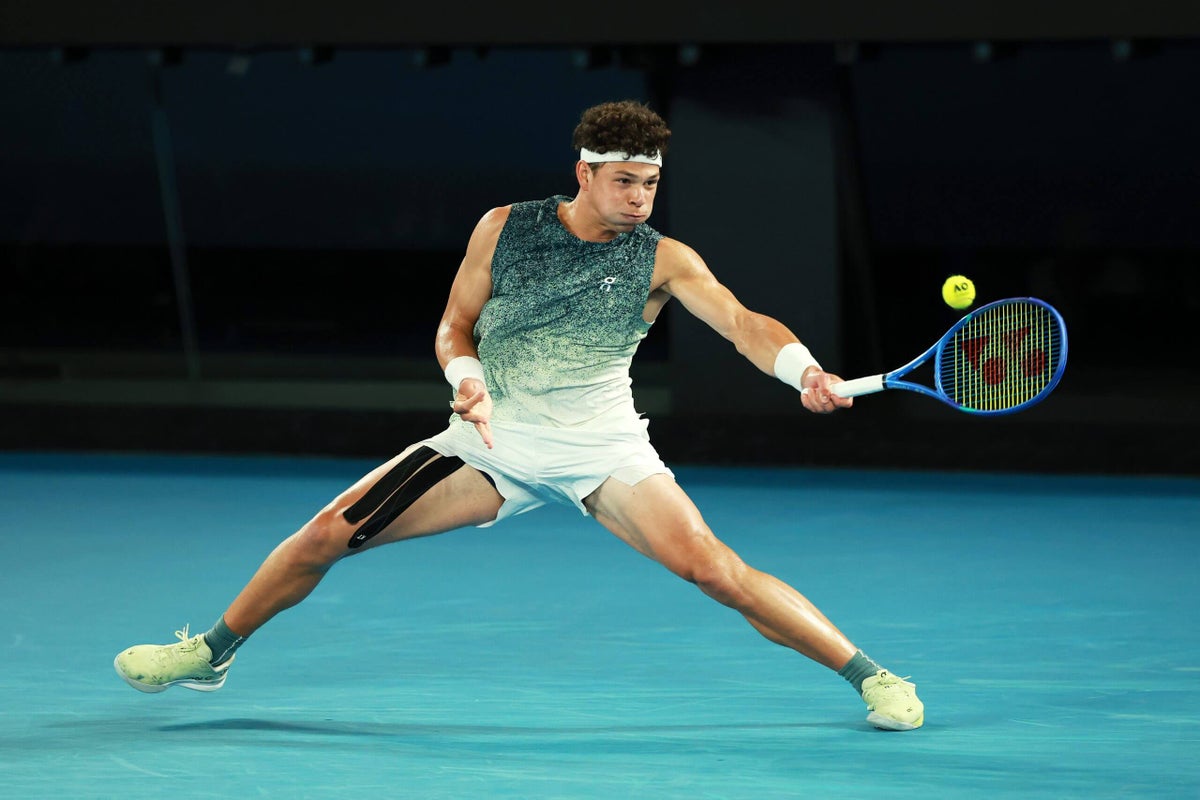
MELBOURNE, Australia — If Ben Shelton wants to win a Grand Slam, he is going to have to win tight, big matches at night, when the air cools and takes some of the pop out of his power game. This is especially pronounced in Melbourne, as wind blows in off the city’s bay and turns searing days into sometimes frigid nights.
He took a step in that direction under the lights and in front of 15,000 fans in Rod Laver Arena Monday, taking out Casper Ruud of Norway, the three-time Grand Slam finalist with a dangerous forehand crafted in the fashion of his boyhood idol, Rafael Nadal, to reach the Australian Open quarterfinals.
After a sloppy and slow start, Shelton forced his way into his groove as he clawed back a one-set deficit. His father and coach, Bryan, sat on the court in Shelton’s box, trying to coax quality out of him on a night when he didn’t have his best and the conditions didn’t give him much help.
When it was over, Shelton had muscled through a 3-6, 6-4, 6-3, 6-4 win to set up another Grand Slam duel with Jannik Sinner. Sinner beat him here in last year’s semifinal, and in the quarterfinals of Wimbledon six months later.
That match will likely take place at night, just as much of last year’s semifinal loss did, and just as Shelton’s loss to Novak Djokovic did in the U.S. Open semifinal in 2023.
Truth be told, Shelton likely would have lost those matches regardless. Just past midnight Tuesday, Shelton was already on his way to convincing himself that Wednesday could be different. He said his game is improved, especially at the net, where he lost just one point in four sets against Ruud.
“I struggled to find my rhythm tonight,” Shelton said. “It was my first time playing at night since I’ve been here, and the conditions were completely different.
“But I got through a tough four-set win, and for the most part since I’ve been here, I’ve never hit my forehand this good. I feel like I have great control. I feel like I’m hitting it bigger than I’ve ever hit it.”
Shelton has always been proficient in hitting big. But the night version of this sport requires players to really play tennis, rather than simply smacking the ball.
He can do that. But so often, the difference-makers in his matches come in the form of running forehand blasts, and backhand drives he rifles on a line across the court. Those haymakers don’t generally fly through the court at night the way they do during the heat of the day. Hence the grinding, for long stretches, against a feisty Ruud.
In the night conditions, Shelton said, he struggled at first to adjust to balls that got big and fluffy in the heavier air.
“I had a completely different feeling of the ball coming off the racquet,” he said. “Certainly different conditions playing at night. I’m glad that I have that match under my belt now, because I was able to find a good rhythm.”
This was classic lefty-righty tennis, with both players trying to use their big forehands to attack the opponent’s backhand to induce errors or open the court. Ruud did it better in the first set, an ugly opener for Shelton who double-faulted three times and had 15 unforced errors against 11 winners.
Then Shelton dug in, his father rising and pumping his fist and clapping his hands as he does when he knows his son needs a little extra belief. That, and Shelton’s cleaner play, were enough keep him even until Ruud served to stay in the set at 4-5.
That’s when Ruud got sloppy and Shelton pounced. A double-fault made it 30-30, shifting the pressure onto Ruud’s racquet. Then Ruud sent a backhand long. On set point, Shelton perfectly read Ruud’s attack to his backhand. He ripped the ball across the court. Ruud shanked the ball. And Shelton was even.
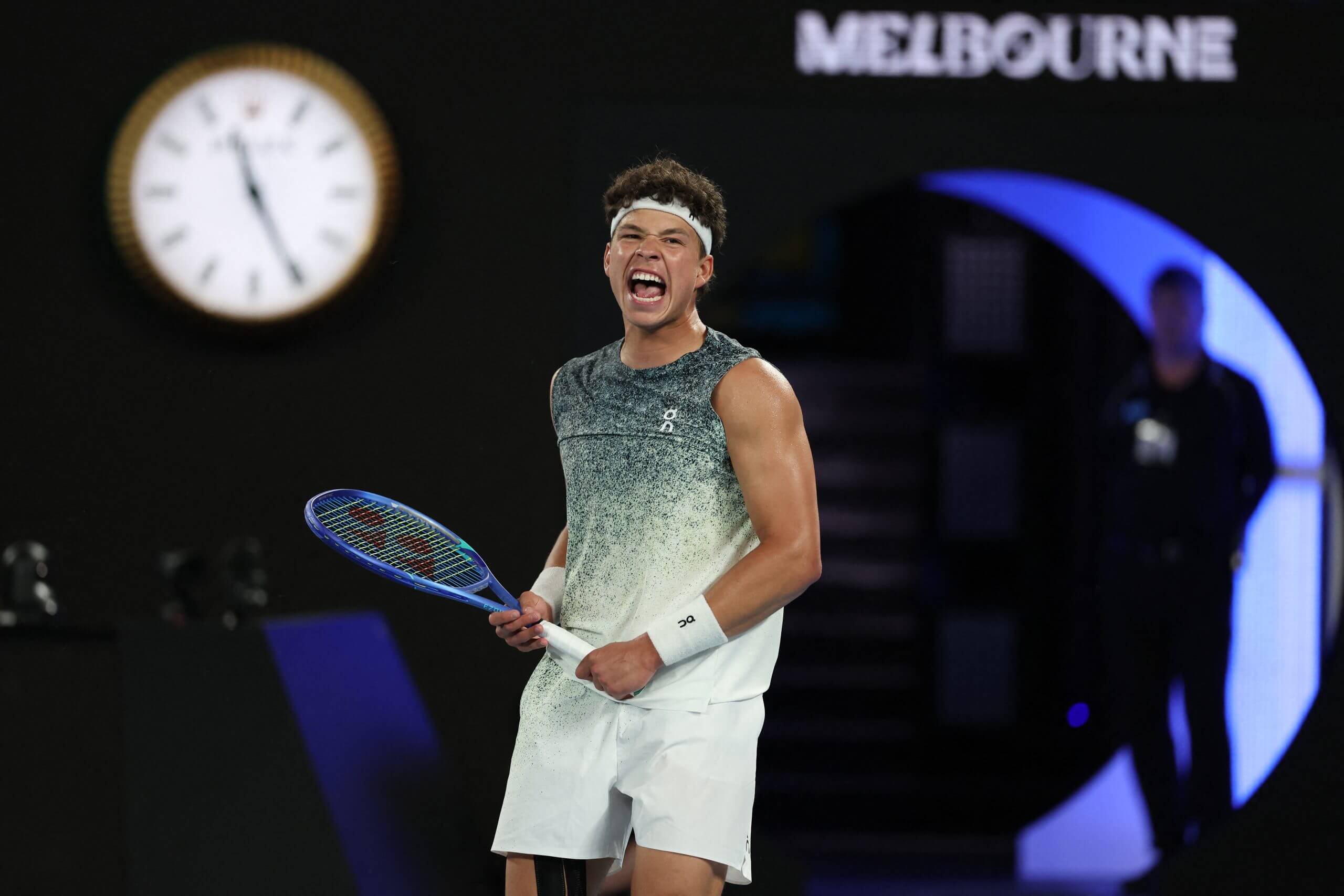
Ben Shelton is back in the Australian Open quarterfinals. He has to get past Jannik Sinner next. (Martin Keep / AFP via Getty Images)
It was more of the same the rest of the way. Tight baseline battles, pressure from Shelton and counterattacks from Ruud, using the violent topspin of those big looping forehands. And then Shelton would find his opening, and enough power and guile to make a tiring Ruud crack. The Norwegian will regret a disastrous game when serving at *3-4 in the third, when he donated Shelton the break and did not make him earn it.
A little more than two-and-a-half hours after he started, Shelton grooved an inside-out forehand through the left sideline and Ruud was out.
Shelton’s prize is Sinner, which happens these days deep into a Grand Slam. Sinner, or Carlos Alcaraz, or Novak Djokovic is waiting. Shelton is yet to beat either of them.
Until he injured his shoulder against Adrian Mannarino in the third round of the 2025 U.S. Open, Shelton hadn’t lost a Grand Slam match to anyone not named Sinner or Alcaraz that year. It was the best and worst of outcomes.
He didn’t win a set against either of them, despite having set points in the first set of all three matches. Somehow, despite having one of the sport’s most potent serves, he couldn’t send himself over the line.
The slip-ups gnawed at Shelton, who sees himself as a player made for the big moments under the brightest of lights. But he’d been tight and passive when it counted most instead of loose and aggressive, the velocity of his serve dropping instead of rising to carry him through the crucible.
He had arrived in New York last summer playing what he believed was the best tennis of his career. He thought he could be enough. Then his shoulder went, sidelining him for more than a month, sapping him of his explosiveness for the rest of the year.
He arrived in Australia proclaiming himself healthy and ready to go, but the question of how that shoulder might hold up under the stress of five-set tennis loomed. So far, it has held just fine.
He’s leading the field of quarterfinalists with 63 aces for the tournament. He’s held 95 percent of his service games, tied for the top spot with Alex de Minaur. He’s won 82 percent of his points on first serve. He’s lost one set in four matches and is 3-0 in tiebreaks.
Sinner, the two-time defending champion and four-time Grand Slam champion, provides a test of a whole different sort. He professed himself lucky to still be in the tournament after the Australian Open heat rules forced the roof to close as he wobbled with cramps and fell behind in his third round match with Eliot Spizzirri.
If past is a prelude, Sinner will take that break and ride it all the way to the title. Shelton will have to be far better than he was against Ruud to pass the test, and probably just to keep the match competitive. To do any of that, he has to win matches like Monday night’s, in which he saw signs of encouragement anywhere he looked.
“I wanted to give myself another shot,” Shelton said on the court after disposing of Ruud.
“I have a lot more that I want to do here and a lot more to prove.”
And once more, he will likely have prove he can do it at night.