
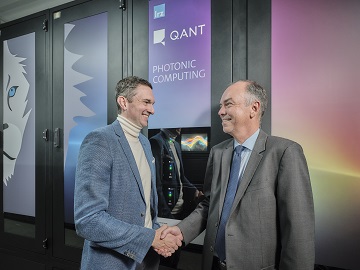
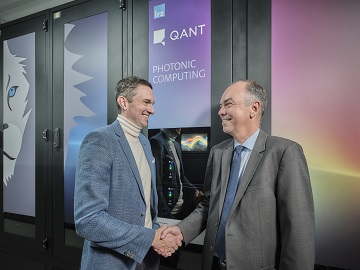
Michael Förtsch, CEO of Q.ANT, and Dieter Kranzlmüller, Chairman of the Board of Directors of LRZ, in front of the Q.ANT NPS Servers at the Leibniz Supercomputing Centre, Germany. [Image: Q.ANT GmbH]
In a world-first for high-performance computing, the Leibniz Supercomputing Centre (LRZ) in Garching, Germany, has switched on a photonic co-processor built to tackle real-world AI and simulation workloads using light instead of electricity. Developed by Q.ANT, a deep-tech company based in Stuttgart, the new native processing server (NPS) brings analog photonic computing into a live high-performance computing (HPC) environment for the first time.
At the heart of the system is Q.ANT’s proprietary Light Empowered Native Arithmetics (LENA) architecture, which is designed to handle complex AI inference, image recognition, and scientific simulations using analog light-based calculations. Unlike traditional digital systems, which rely on electronic signals and generate substantial heat, the photonic processor performs operations without producing heat, enabling ultra-low power consumption and high computational density.
Early tests at LRZ suggest dramatic gains in energy efficiency and speed. According to Q.ANT, the system can achieve up to 90 times lower power consumption per workload for the same job and a 100-fold increase in computational density compared with conventional processors. The NPS supports 16-bit floating point precision with nearly 100% computational accuracy. Another big advantage is that it integrates seamlessly into standard computer setups and works with widely used software such as PyTorch and TensorFlow.
“For the first time, light-based processors are being evaluated in a real HPC environment under practical workloads.”
“This is a decisive step toward integrating photonic computing into the mainstream of next-generation computer architecture by 2030,” said Q.ANT CEO Michael Förtsch. “For the first time, light-based processors are being evaluated in a real HPC environment under practical workloads.”
The deployment of the photonic processor is part of a broader initiative funded by the German Federal Ministry of Research, Technology and Space to explore hybrid digital-analog architectures for future computing systems. As computing demands skyrocket driven by AI, climate modeling, medical imaging, and materials science, energy-efficient alternatives are increasingly vital.
“Photonic processors offer a novel and promising path to accelerate workloads while sharply reducing our environmental footprint,” said Dieter Kranzlmüller, Chairman of the LRZ Board. “This deployment marks a milestone in our future computing mission to advance energy-efficient AI and high-performance computing.”
The project has also received strong backing from both federal and Bavarian governments, with policymakers emphasizing the strategic importance of photonics in maintaining technological sovereignty and scientific competitiveness for the country.
As LRZ moves into the next phase, it will install additional NPS units and establish a benchmark for performance across a range of applications. This will pave the way for light-powered computing to take center stage in the AI and HPC ecosystems of the future.