
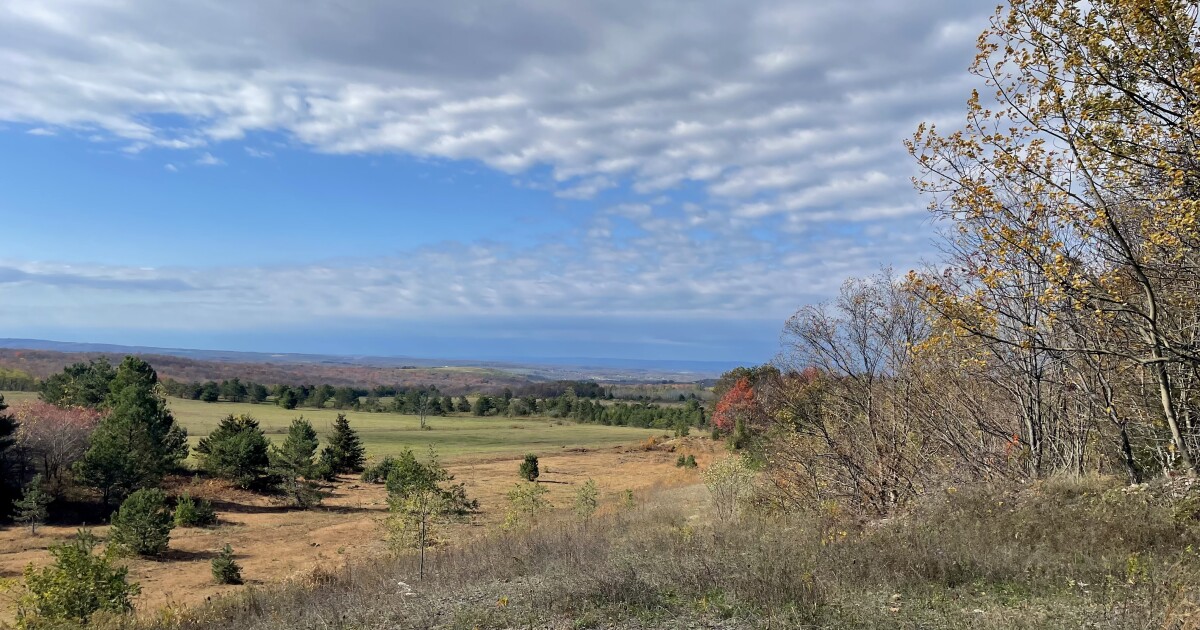
As climate change reshapes where wildlife can survive, The Nature Conservancy (TNC) is racing to create spaces for species with shifting habitats. To that end, a new 279-acre acquisition in Cambria County represents a critical rest stop along an important migratory route stretching 200 miles through the Appalachians.
TNC has purchased the acreage in Adams Township, Cambria County, and transferred the land to the state’s Bureau of Forestry for management as rare grassland bird habitat and public recreation space.
Named Paint Creek after the cold-water fish species inhabiting its stream, the property fills a critical gap within Gallitzin State Forest, surrounded on three sides by existing protected land.
TNC has been pursuing the Paint Creek acquisition for nearly two years.
“It is an incredible property in itself with very unique habitat,” said Nicole Wooten, a director of land protection at TNC. “It’s essentially a story of revitalization and connection.”
Situated along the Allegheny Front in Cambria County, the property occupies a strategic position on the “connectivity corridor” — a pathway linking West Virginia’s Monongahela National Forest to the Pennsylvania Wilds. This stretch forms a crucial link in the Appalachian mountain chain. Experts call it a superhighway for biodiversity.
The property’s diversity of habitat types makes it especially valuable. Expansive grasslands reclaim former mine lands, creating ideal conditions for numerous grassland species — increasingly important as these habitats grow scarce across the region.
The grasslands covering Paint Creek face mounting threats. Development pressure and fire suppression policies have steadily eradicated these habitats across the region, making them increasingly rare. That scarcity takes on added urgency in the context of climate-driven migration.
As temperatures shift and species search for viable territory, Paint Creek is able to offer a diverse and sustainable home for these critters. Its mix of grasslands, forests, and waterways provides exactly the kind of varied terrain that wildlife requires to adapt and relocate in a changing world.
“The grasslands, the forest, and the water act as a home, hotel, and buffet for various species,” Wooten explained.
The land supports an array of wildlife, from butterflies and bees to white-tailed deer and cottontail rabbits. Most crucially, it offers sanctuary to several rare and endangered bird species — the very travelers this corridor was designed to protect as they navigate a landscape increasingly inhospitable to grassland dwellers.