
By Seth Emerson, Bruce Feldman, Ralph D. Russo and David Ubben
When Curt Cignetti took the Indiana job a couple of years ago, staff members at another power-conference school looked at the James Madison roster to see if they should pillage Cignetti’s now-former team. An assistant coach on that staff said they decided not to pursue any of Cignetti’s players.
“We’re like, ah, he’s not big enough, he’s not tall enough, he’s not this, he’s not that,” the assistant said. “Then they went with him to Indiana.”
Telling the story two years later, with the benefit of history, the coach shook his head and smiled.
“Like he said: ‘Google me,’” the coach said.
Indiana’s national championship, after being the losingest program at the power-conference level, has been a paradigm shift in the sport. And Cignetti’s coaching peers are as awed by it as anybody.
The Athletic reached out to other FBS coaches to ask whether and how Indiana’s championship has changed their thinking. The coaches, including power-conference head coaches and assistants, and Group of 6 head coaches, were given anonymity in order to be candid.
Coaches universally respected Indiana and Cignetti and saw it as no fluke.
“It’s changed the game,” said a Group of 6 head coach. “It’s not Michigan. It’s not Ohio State. … It’s super inspiring. If you can do it at Indiana, you can do it anywhere.”
In the conversations with coaches, some themes emerged on how Indiana’s championship happened and what it means for the sport.
Age isn’t just a number
When one power-conference head coach was asked his thoughts on Indiana, he replied with a screenshot of this post:
Experience matters! Starting lineups of the last three College Football Playoff National Champions, all from the Big Ten.
2025 Indiana
0 freshmen
3 second-years
2 third-years
10 fourth-years
4 fifth-years
4 sixth-years
2024 Ohio State
1 freshman (Jeremiah Smith)
3…
— Stan Becton (@stan_becton) January 20, 2026
The head coach then added his own analysis: The common denominator among the last three champions — Michigan, Ohio State and Indiana — was all had very experienced, talented quarterbacks and “very old” rosters.
So what Indiana pulled off didn’t change this coach’s thinking. It just reinforced it.
“Curt is a damn good coach. His teams don’t beat themselves. He wins close games. Combine that with an elite QB and smattering of transfers — lethal combination in my opinion. You can’t really make changes to get to that,” the head coach said.
“Everyone is already trying to get older and more experienced and everyone is trying to get the best QB — Indiana just did it better.”
So how did Indiana do it better? Another power-conference head coach pointed to the Hoosiers combining good evaluations and development with resources — money — to keep those older players.
“(Indiana) had an older team, but you can’t just go out and get a bunch of senior mercenaries, sign them up and let’s try to go out with the oldest team we can. That doesn’t win football games,” this head coach said. “But they also got money. The lesson to be learned is you can get better players if you get more money. And keep them.”
Of course, before you keep good players, you have to get them. Indiana had money, but it didn’t outspend everyone, and definitely not when Cignetti first arrived two years ago. Therein lies another lesson.
Don’t chase stars
It’s no secret that when Alabama, Georgia and Ohio State were winning national titles, they were also annually near the top of the high school recruiting rankings. When Michigan won two years ago, it had 13 players picked in the next NFL Draft.
Indiana, of course, was not a recruiting behemoth. But Cignetti brought in players he knew from James Madison, plus other transfers and high school players he and his staff identified as good fits.
As one of the power-conference head coaches put it: “I’m looking for guys that love football. And that’s what Indiana’s got. They love the team aspect. Especially with this NIL and rev share stuff going on.”
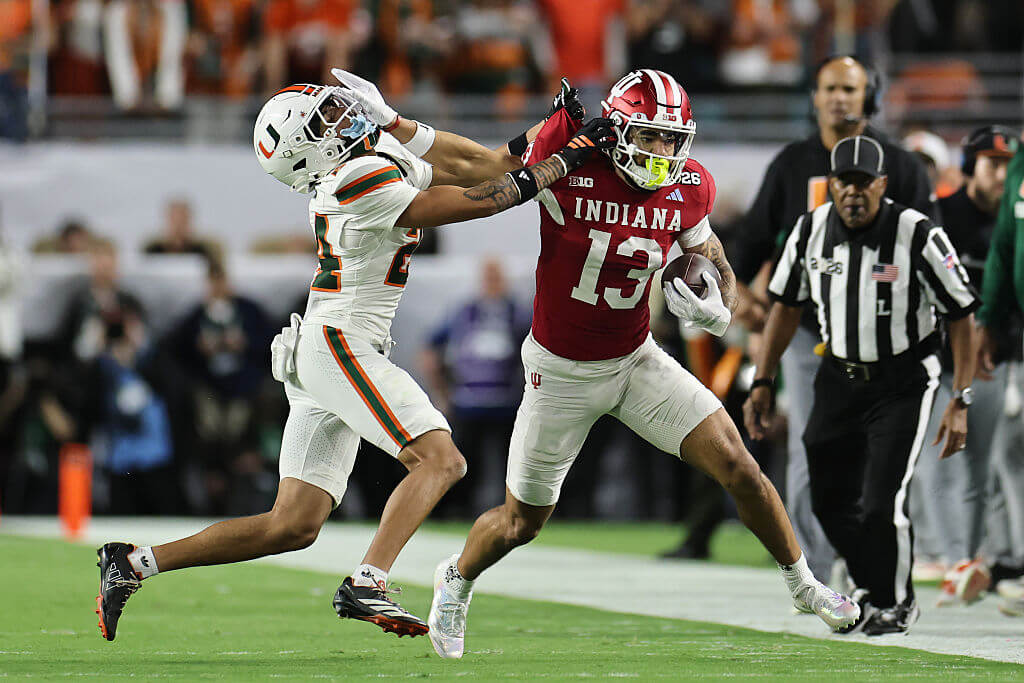
Wide receiver Elijah Sarratt was one of the success stories who came over with Curt Cignetti from James Madison. (Carmen Mandato / Getty Images)
That’s not to say the Alabamas, Georgias and Ohio States were just living off the blue-chip ratings. They also identified which blue chips were the best fits and developed a decent number of three-star players. Cignetti, who coached under Nick Saban at Alabama from 2009 to 2012, knew something about evaluating high school recruits.
In the transfer portal, recruiting is about looking at production at a player’s previous school, even if it’s a lower level. And looking at player intangibles, rather than just pure skill.
One head coach at the Group of 6 level thought Cignetti might have benefited from not feeling pressure to pull in a top-ranked recruiting class.
“Cignetti wasn’t worried about riding the up-and-down of the recruiting cycle, where sometimes you’ve gotta deal with the fan base,” the coach said. “Social media gets really loud if you’re not getting four- and five-star ranked guys. I don’t know if pressure is the right word, but sometimes people feel they have to try and create that momentum or ride that momentum. He wasn’t concerned about that at all. I don’t think he dealt with that, worrying about what guys might be ranked. He just ignored it. They just trusted their evaluations. That’s a learning point.”
Evaluation was also a key point made by a power-conference assistant, especially on the portal. This coach also spent time in the NFL, and said that experience — when he was evaluating college players for the draft — has become a useful skill for college coaches.
“More than anything, what makes a good head football coach looks really different than it did 10 years ago,” this coach said. “It used to be that you needed to be a great high school evaluator, relationship builder, and good ol’ boy with donors. Now, you better be really good at evaluating college tape and knowing how to price it, all while building relationships with players to help them not leave.”
Fundamentals still matter
One of the power-conference head coaches marveled at Indiana’s turnover margin going into the national title game:
“They’re plus-21 going into the championship game,” he said. “I don’t care if you’re Indiana (or) Bucknell. If you’re plus-21, you’re going to win a lot of games. Just the discipline they have with the ball. (Fernando) Mendoza obviously got coached up pretty good.”
But it wasn’t just Mendoza, the Heisman Trophy-winning quarterback who is likely to be the No. 1 pick in April’s NFL Draft.
One of the power-conference assistants said he has coached against teams with overwhelming talent, for which they had no answers. In Indiana’s case, the frustration was more technical. The Hoosiers just never messed up.
“They’re never in the wrong gap. They always seem like they’re in the right spot,” he said. “So it really puts coaching in perspective. Get the right guys you can coach who will buy into what you want them to do, and let them play.”
That was the takeaway for many coaches: Fundamentals are more important now because of how pieced-together teams are. And Indiana jumped out for its fundamentals.
“Watch their O-line’s footwork. Watch how their D-line uses their hands and sheds blocks,” said one of the Group of 6 head coaches. “It’s the little things.”
This coach pointed to one little thing in the national championship game: an outside zone run when the receiver, assigned to come inside to block a safety, first pretended he was running a route to keep the cornerback from defending the run. The Miami safety ran hard at the play, and this coach said “nine times out of 10” the receiver would just run right, leaving the cornerback to tackle the runner. But the Indiana receiver kept selling the route, keeping the cornerback at bay, then blocked the safety, and the result was a big play.
“It’s those little nuances that show up,” the coach said. “I don’t think they’re doing anything schematically that is cutting-edge, but they’re really sound in all they do and they’re fundamentally as well coached as anybody in the country, and they’re consistent.”
Another power-conference head coach said Indiana’s success ultimately confirmed for him that it’s still a fundamental game. But he tied that back into the importance of experience:
“With people and players moving around at a greater clip, the lack of consistency at programs and not being able to train a team like you used to (i.e., two-a-days), when you have a more old-school approach like what Cignetti has done, I think it beats (talent) margins,” he said. “I think that’s what they’re a testament to.”
And not just experience, but experience with the system, even if it was at another school. A Group of 6 head coach with power-conference experience pointed to the players that Cignetti brought with him from James Madison.
“I would say that culture probably played a bigger part than some people realize,” the coach said. “When you’re dealing with a significant roster turnover on a yearly basis, there’s something to be said for a large number of guys sitting in a team room who have heard the message before and understand the methodology and the process that it takes in coach Cignetti’s vision.”
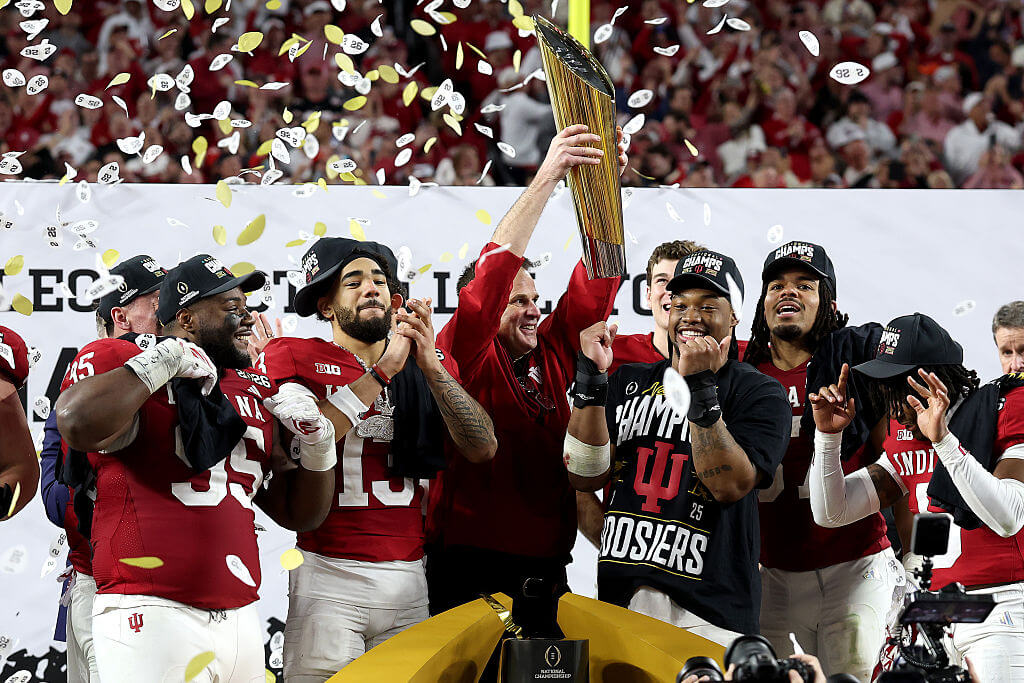
Curt Cignetti’s teams have finished with winning records in all 15 seasons he has worked as a head coach. (Jamie Squire / Getty Images)
The guy can coach
One power-conference head coach had a simple takeaway of Indiana’s success: As talent spreads more around college football, creating more parity …
“Coaching still matters,” he said. “If you look at them, they’re one of the finest coached teams of the last decade. That team (Miami) was obviously a more talented team than Indiana. He found a way to win.”
One of the Group of 6 head coaches noted how Cignetti led his team — both in games and in practice. Indiana doesn’t practice long — about 90 minutes — to protect its best players from injury and be more efficient.
“Cignetti has taken a different approach than Saban or Les Miles or other guys. He’s been a less-is-more guy,” the coach said. “It’s more of an NFL approach. He’s very detailed.”
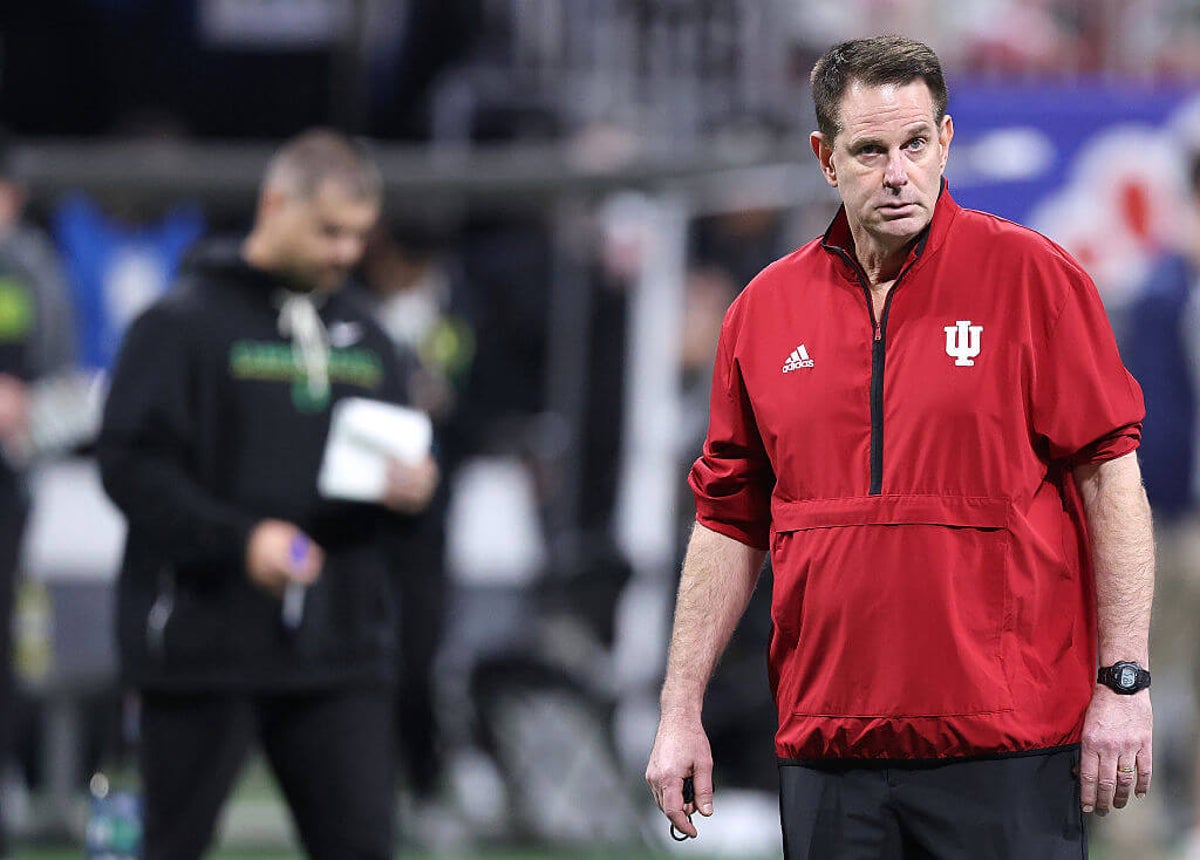
During games, Cignetti’s sideline demeanor and expressions have become memes. But this coach saw it as the 64-year-old Cignetti being in charge and managing the game.
“He never gets emotional. He doesn’t make emotional decisions,” the coach said. “Everything is calculated. The coaches coach during the game more so than any game I’ve watched.”
That was an important point for this coach, watching Indiana’s sideline during games: Always be doing something, or get out of the way.
“If you’re on defense and the offense is out there, you’re not watching it. You’re coaching,” the coach said. “I saw that from afar. That’s the biggest thing that stood out. The coaches are coaching during the game and he’s very, very adamant about that.”
The big picture
For years, programs were trying to replicate Saban, sometimes with success (see: Kirby Smart at Georgia) but often not. Cignetti was a former Saban assistant, but a long time ago, and was known more for his head-coaching success at smaller schools, like Indiana University of Pennsylvania at the Division II level.
Will this lead to programs looking for the next Cignetti? One power-conference assistant theorized it should, because small-school coaches who win have done it on a more even financial playing field.
“I think hiring coaches who have proven success in FCS football (for the next couple years) will have meaningful carryover because they’ve operated on a budget in recruiting (similar to NIL) and that will help,” he said.
One power-conference head coach, asked how this changed how he saw college football, said it will only hasten the timeline in which coaches are expected to win.
“Unfortunately, the component of patience and development is being strained by a lot of us. Can you wait?” the head coach said. “I had a Big Ten coach tell me it’s basically 18 months for skill players and 24-plus for linemen to develop. You’ve gotta be able to move your roster along.”
Another power-conference head coach pointed to the preseason polls being so off in both directions as a sign the sport is more unpredictable: You can be Indiana in 2025 — or Florida State in 2024. The Seminoles, No. 10 in the preseason, went 2-10.
“No one knows what anyone is. Which is cool for a sport but for coaches, players and a program perspective, it’s interesting,” the head coach said.
“Everyone will now ask the question, why not us? But that’s the wrong question. It has to be, are you willing to pay the price and do what it takes the get there? The teams that can do it. Everybody thinks they have a chance. But that’s not the reality. Because there’s a factor of what you’re willing to do and do you know what to do to get yourself there.”