
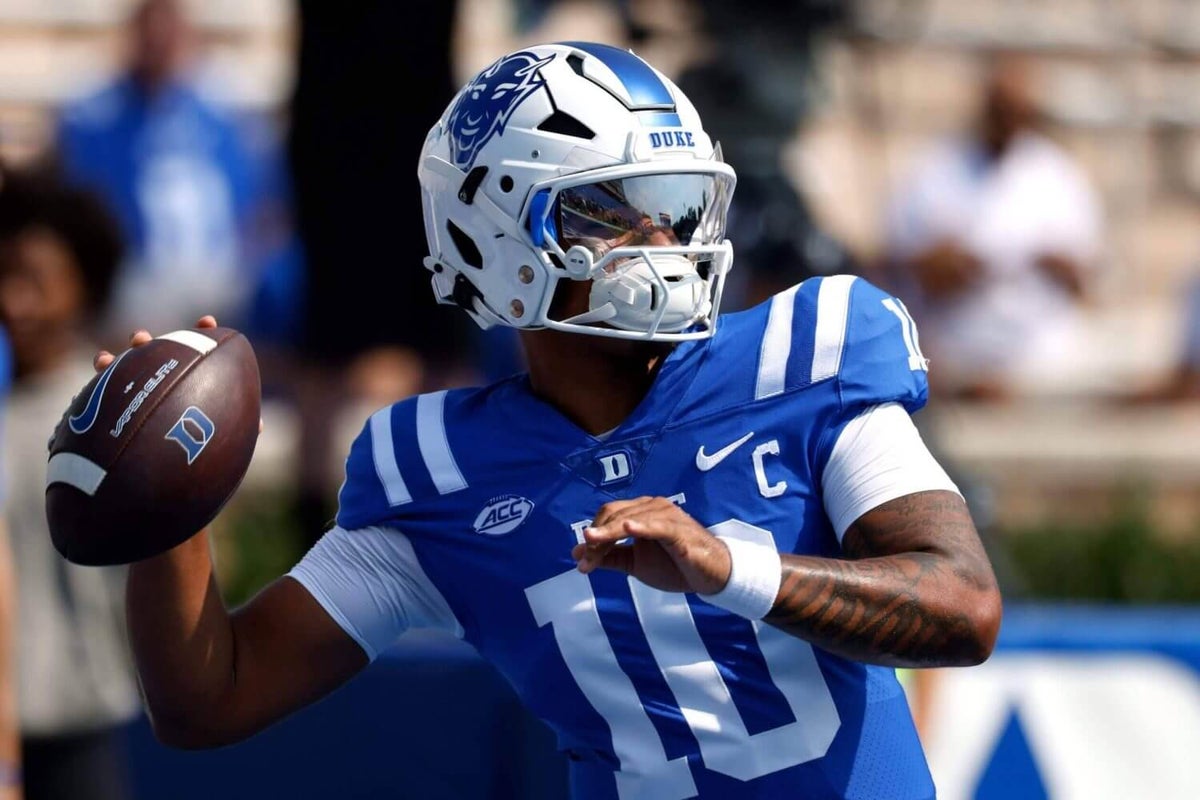
Quarterback Darian Mensah and Duke University have resolved one of the biggest contract disputes of college sports’ revenue-sharing era.
Young Money APAA Sports, which represents Mensah, put out a statement Tuesday morning announcing the agreement, which appears to have effectively settled an open lawsuit by Duke against its former quarterback. Duke confirmed that a settlement has been reached in its own social media post. Both parties filed a joint motion Tuesday morning to end the case and dismiss the temporary restraining order that prevented Mensah from changing schools. The court filing said the agreement was confidential.
“We commend Darian for his extraordinary professionalism, maturity, and unwavering commitment to making the decision that best serves his future and his family,” the agency’s statement read.
#YMAPAA pic.twitter.com/BNlKicWCt0
— YM APAA Sports (@YMAPAAsports) January 27, 2026
Last week, Duke filed suit against Mensah in Superior Court in Durham County, seeking to prevent Mensah from transferring while the university pursued arbitration over a revenue sharing contract that ran through 2026, which included exclusive rights to Mensah’s name, image and likeness “with respect to higher education and football,” according to the complaint.
A judge granted Duke’s temporary restraining order (TRO), momentarily preventing Mensah from enrolling at and playing football for another school. However, the judge also ruled Duke could not prevent Mensah from entering the portal, which he did on Jan. 21.
The next hearing in the case was scheduled for Thursday, Jan. 29, but it seems the two parties were able to resolve the issue outside of court. Settling the lawsuit would allow Mensah to transfer to and participate in football activities with another school immediately, if he’s able to enroll at a different university for spring semester.
Mensah has been linked to a transfer to Miami since he first announced his intentions to enter the transfer portal.
Duke said in a statement on social media that the settlement allows both parties to move forward:
“We are committed to fulfilling all promises and obligations Duke makes to our student-athletes when we enter into contractual agreements with them, and we expect the same in return. Enforcing those agreements is a necessary element of ensuring predictability and structure for athletic programs. It is nonetheless a difficult choice to pursue legal action against a student and teammate; for this reason we sought to resolve the matter fairly and quickly.”
The dispute drew widespread attention as a potential precedent-setting case. It was the first time a school filed a lawsuit against a player to try to prevent or pause his exit. A final ruling would have provided insight into whether NIL contracts are enforceable and how much players can be tied to programs (and vice versa) — significant issues in an era of roster fluidity.
Even with a settlement, the case exposed holes in the system, from contracts without clear exit clauses to the possibility of one school preventing a non-employee from enrolling at another.
“When there’s nobody in charge, this is what happens,” said Matt Fenton, a founder of the Tampa-based employment law firm Wenzel Fenton Cabassa, P.A.
According to legal experts, Duke seemed to have a strong case for a breach of contract and monetary damages of some kind, but the university may have had a difficult time preventing Mensah from transferring to and playing for a new school via the lawsuit.
“Mensah signed an NIL deal. He’s leaving before that deal is up. The school probably has some form of financial damages,” said employment lawyer Michael Elkins. “But I think the school has a tougher road to hoe, so to speak, with trying to stop him from playing somewhere else. That’s a different story.”
Mensah announced his intention to enter the portal on Jan. 16, the last day of college football’s 15-day transfer window. The decision came as a surprise, revealed less than a month after Mensah announced in a video that he would return to Duke for the 2026 season. He was a second-team All-ACC honoree in 2025, leading the Blue Devils to their first outright conference championship since 1962.
Mensah transferred from Tulane to Duke ahead of the 2025 season, signing a multi-year deal worth more than $3 million annually. The deal, which began as a third-party NIL agreement, transitioned to a revenue sharing contract with Duke last summer under the terms of a multi-billion-dollar antitrust settlement known as the House settlement.
Miami has been in the market for a new starting quarterback for the 2026 season to replace Carson Beck, who exhausted his college eligibility. The Hurricanes lost to Indiana in the national championship last week. Miami will host Duke on Nov. 14 according to the ACC schedule released Monday.