
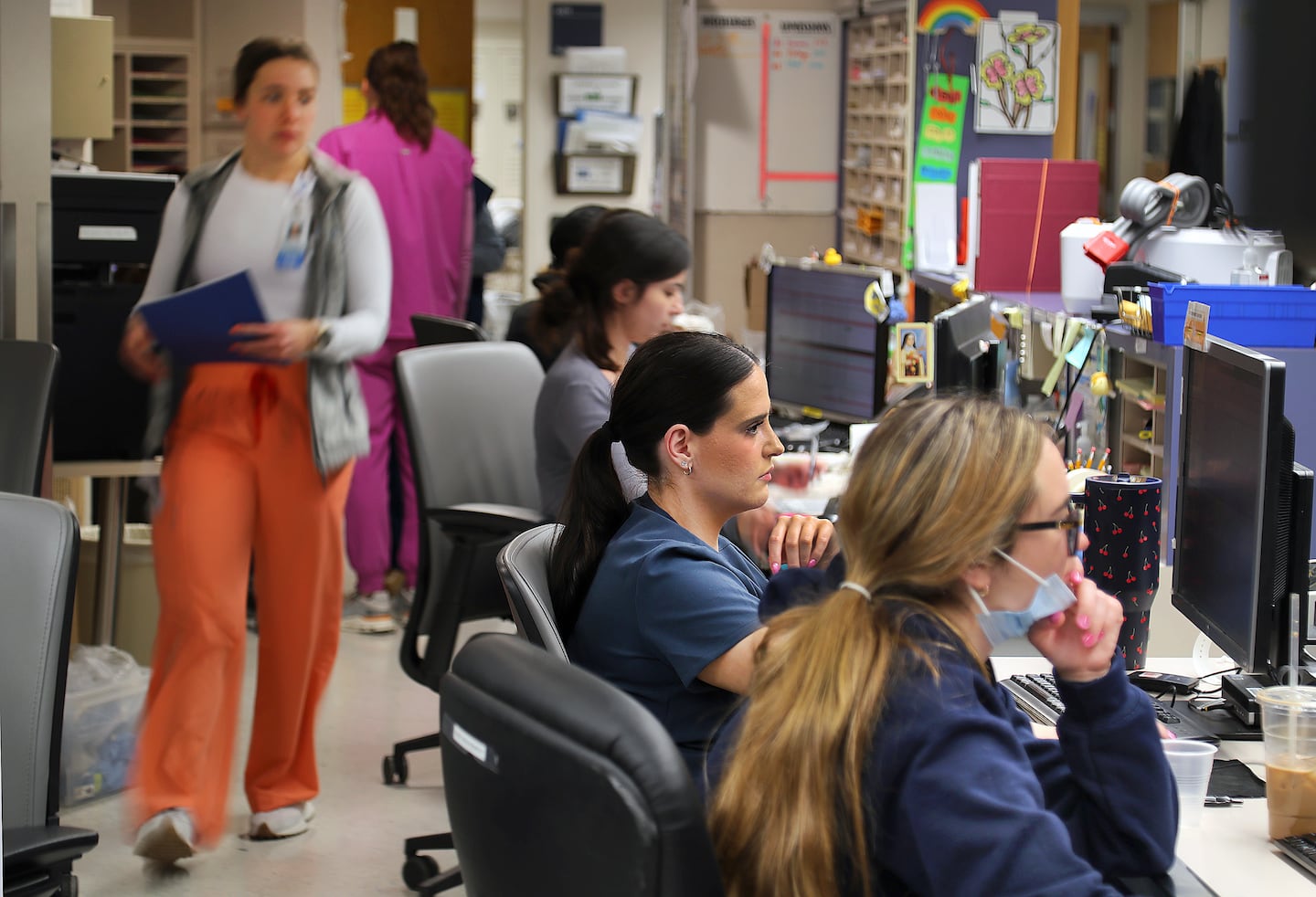
Patients who have no one — neither friend nor family member — to take responsibility for their care require state-appointed guardians to make decisions for them. But the process of obtaining a guardian can be long and cumbersome, leaving patients to wait, sometimes for months, in area hospitals, taking up beds sorely needed for sicker people coming into the ER, such as now when the Massachusetts health department says there is a “very high” level of flu illnesses.
At Cambridge Health Alliance’s three hospitals, the number of such “stuck” patient days has doubled since 2023.
Baystate Medical Center in Springfield has seen the number of these patients increase by 46 percent over the past three years.
Mass General Brigham’s dozen hospitals over the last two years experienced an estimated 550 days per month when patients who could be discharged were stranded because of a lack of a guardian.
Stuck patients are “a significant challenge for our hospitals, and it backs up their ability to take in more patients who are sick” in emergency departments, said Adam Delmolino, senior director of virtual care and clinical affairs at the Massachusetts Health & Hospital Association.
And the problem is growing worse.
The small pool of lawyers willing to act as guardians, who are largely unpaid in Massachusetts, has shrunk dramatically in recent years, said Brandon Saunders, whose law firm handles many of the new guardianship petitions in Eastern Massachusetts.
Meanwhile, demand for guardians is rising. An aging population has spawned more cases, as older patients are hospitalized and lack family or friends willing to step forward.
Last year, Saunders’ office filed 970 petitions, up from about 850 in 2022.
Among the lawyers who help Saunders with such cases is Leah Weinrich, a Gloucester attorney who is juggling 25 guardianships.
“It’s overwhelming right now, the number of people who need help,” she said.
Weinrich often is called by hospitals in the middle of the night, on holidays, and weekends.
“Nothing is easy these days, and it’s only gotten worse,” she said. Weinrich accepted her first guardianship case eight years ago as a favor to another attorney and found it rewarding. But now, she said, she is approaching burnout.
In September 2024, Governor Maura Healey signed legislation aimed at improving access to high quality care, especially for older adults. It requires the Department of Public Health to consider the feasibility of a professional guardianship program, potentially funded by MassHealth (the state’s Medicaid program) to help stuck patients get discharged more quickly from hospitals to appropriate care and free up more hospital beds.
A professional guardianship program would pay certified guardians, helping to retain a more robust pool of qualified candidates, Saunders said.
“Right now, the people we are appointing are volunteers of any background who get a criminal background check, but they don’t have any training,” he said.
The state health department was required by law to complete its report on a professional guardianship program by last July, but a spokesperson from the department said the agency is still reviewing its findings. The department was unable to say when the report might be released.
Hospital administrators say that too often patients, before they become incapacitated, fail to complete a health care proxy form, a simple document available online that designates a representative to make health care decisions for the patient if they can’t.
Without that form, incapacitated patients, most often older people with dementia, or younger patients who’ve had a brain injury, get stuck in the hospital as administrators embark on a legal maze seeking a court-appointed guardian. That guardian will have the authority to sign off on transferring the patient to more appropriate post-acute care.
Hospital administrators said it’s important that everyone with a completed health care proxy form has their doctor enter it into their medical records, so in an emergency, other doctors can easily find it.
As the guardianship crisis deepens, Massachusetts legislators are considering a couple of bills aimed at easing the problem. One would create a state payment system for professional guardians. Another proposes an initiative to recruit more volunteer professionals — retired attorneys, doctors, nurses, and social workers — to serve as guardians.
“Having folks being stuck in hospitals doesn’t make any sense at all when it’s more expensive to keep people in hospitals and space is limited,” said Representative Thomas Stanley, a Waltham Democrat who is sponsoring the bill to recruit more volunteers.
Joshua Abrams, MGB’s associate general counsel, would welcome more state involvement.
“It is becoming increasingly difficult to find people who are willing to play that role [of guardian] and the ones who do and are good are oversubscribed because most of their cases are unpaid,” he said. “So having some role of the state in paying for guardianships, whether MassHealth or something else, is really, really important.”
In addition to finding a court-appointed guardian, some hospital administrators are facing long waits to get their cases heard.
“We are seeing, on average, two to three weeks for a court date. Sometimes it takes much longer,” said Karen Plante, director of care management and patient care flow at Baystate Health’s four hospitals in Western Massachusetts.
To help ease the logjam in some areas, the state’s Probate and Family Court system has dedicated one day a week in Suffolk, Norfolk, and Worcester counties just to hear these guardianship cases because these are the busiest counties.
Chief Justice Brian Dunn said he’d hoped to free up one day a week in other busy counties, including Essex, Middlesex, and Plymouth, but a hiring freeze has stymied that priority.
“We don’t have the ability to expand, to be able to do it beyond the counties we’ve already established,” he said.
But Dunn said, thanks to a new federal grant, the court’s new Office of Adult Guardianship and Conservatorship Oversight is able to better track the number and activities of guardians, as well as conservators, who are appointed to handle finances for a person who is unable to do that.
At Sturdy Memorial Hospital in Attleboro, where stuck patients each averaged about 68 extra “delay days” in the hospital last year, a related challenge is getting MassHealth to approve coverage for guardianship patients ready to move to a nursing home or other care setting.
“This process, depending on availability and access to financial information, can take months, delaying discharge,” the hospital said in a statement.
Back at Cambridge Health Alliance, Dr. Rachel Kester, medical director of inpatient geriatric psychiatry, said one patient has been stuck in her department for three months, and another one, an elderly woman with dementia, has been there more than five months. Just waiting.
“She shouldn’t be living the last days of her life on the geriatric unit,” Kester said. “It hurts to see people who don’t need to be here, or have a diagnosis of dementia, living and declining like this.”
Kay Lazar can be reached at kay.lazar@globe.com Follow her @GlobeKayLazar.