
In Dawn Porter’s powerful documentary “When A Witness Recants,” Ta-Nehisi Coates presents — both as an executive producer and occasional subject — a stirring tale of American injustice, which he remembers from his high school days. The story of three Black teenage boys falsely convicted of murdering their classmate (and subsequently sentenced to life), the movie spans several decades, functioning as both an archival portrait of Baltimore in the 1980s and a retroactive true-crime investigation. However, its conclusions are entirely unexpected, and entirely devastating.
The film is based on Jennifer Gonnerman’s 2021 New Yorker article of the same name, which opens with the harrowing details of a shooting in the hallways of Harlem Park Junior High, in which 14-year-old DeWitt Duckett was killed in a robbery gone wrong. Porter, on the other hand, expands her view of the case by having Coates set the cultural stage from the top down, through his memories of growing up in Maryland and his recollections of community. This also serves as an introduction to several of the movie’s key players, including the aggrieved trio of wrongful suspects — Alfred Chestnut, Andrew Stewart and Ransom Watkins — now men in their 50s, finally out from behind bars.
The movie doesn’t play coy about this outcome, nor does it allow Coates to overstay his welcome as a distant observer to their case. Instead, Coates and Porter hand the trio the reins of the story. They’re allowed to finally take control of their own narratives through the movie’s skillfully cross-cut interviews (one of which begins with the stirring image of an empty seat; Duckett’s absence looms large over all their lives).
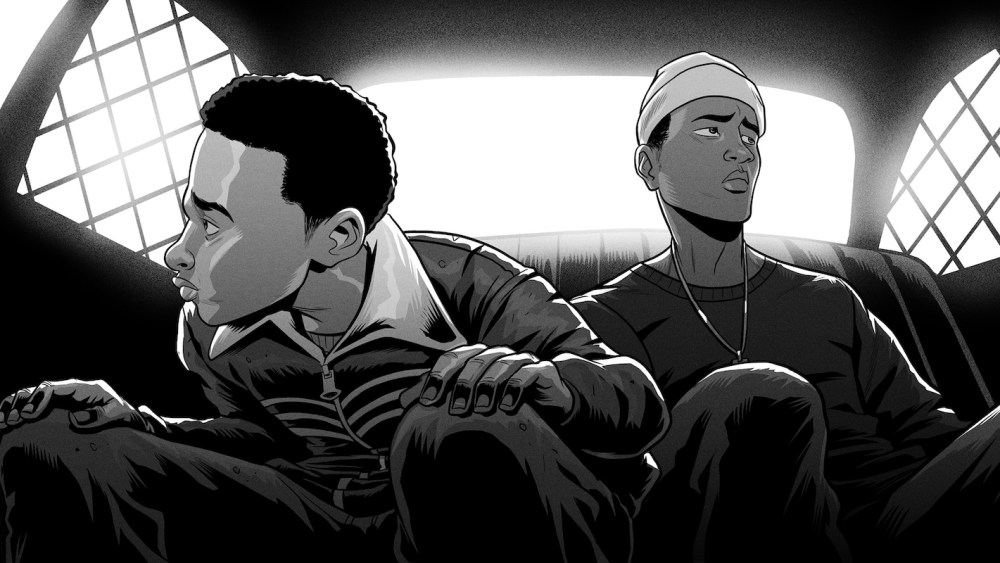
In the meantime, legal depositions from 2022, both with Black witnesses to the crime and its white key investigator, function as secondary interview sources and also allow those involved to either confess their roles in this miscarriage of justice or deny it outright. Eventually, this bifurcated structure, focused on the recent present, gives way to a story of time and place, rendered with moods both wistful and agonizing, as news footage and archival videos from 1983 gradually become the film’s new lingua franca. For every bit of story that isn’t readily available, Porter employs (en lieu of live-action reenactments) the talents of Philadelphia comic book artist Dawud Anyabwile, whose stark black-and-white motion comics depict the accused trio — and the teens manipulated to testify against them — as young boys placed in impossible predicaments, their respective futures hanging in the balance.
As one might gauge from these descriptions, Porter takes a multitude of visual approaches, but they each end up justified, given the sheer temporal and emotional expanse the movie has to cover. One recollection at a time, “When a Witness Recants” reverse-engineers its subjects’ present predicaments by revisiting enraging details of the case and the way Chestnut, Stewart and Watkins first came under the police’s microscope (which is to say: all but randomly). There’s barely any mystery to all the wrongdoings and witness tampering, and no factual gray area in which the movie can dabble. It isn’t interested in relitigating a case that has already been reopened and closed, albeit several decades too late.
Instead, Porter’s interests lie in the enormous emotional toll of these events, both on the trio themselves — dubbed the “Harlem Park Three,” like the similarly wrongfully convicted “Central Park Five” — and on one of the witnesses forced to testify falsely against them at the time, their classmate Ron Bishop. These ripple effects are captured with dramatic rigor, from the anguish of their families in the aftermath, to their own survival mechanisms in the years that followed (both in prison and outside its walls). However, just as intriguing as what each man readily shares is that which they hold close to the chest, and the many visual details that go unremarked upon by the film and its narrations.
We as viewers are left to draw our own conclusions from the trio’s matching “HP3” necklaces (are they bonded, in some manner, by their shared trauma, perhaps in ways they may not recognize?) and from the fleeting courtroom sketches from their trials, which depict them as hulking, dangerous adults, despite being 16 years of age, and meek of stature. The framing and trying of young Black boys as adults in the United States is a continued iniquity and may have even contributed to their conviction at the time. No one in the film comes right out and says it, but Anyabwile’s sketches practically work to rehumanize them in the face of a society and systems that once robbed them of everything from their youth to the benefit of doubt to the promise of their respective futures.
What is perhaps the movie’s narrative masterstroke is that even once it approaches the temporary catharsis of the men’s case being overturned, it doesn’t stop there. Instead, its extended final act follows not only their lives in the aftermath of decades behind bars, but the shattering lack of closure over what was done to them, in the form of a filmed confrontation that allows them much-needed release. To contextualize this story as justice delayed, or finally delivered, would be a betrayal of what the trio was forced to endure. Even the most joyful moments of “When a Witness Recants” are framed within its larger tale of justice denied, making it a thorough and affecting work of nonfiction cinema.