
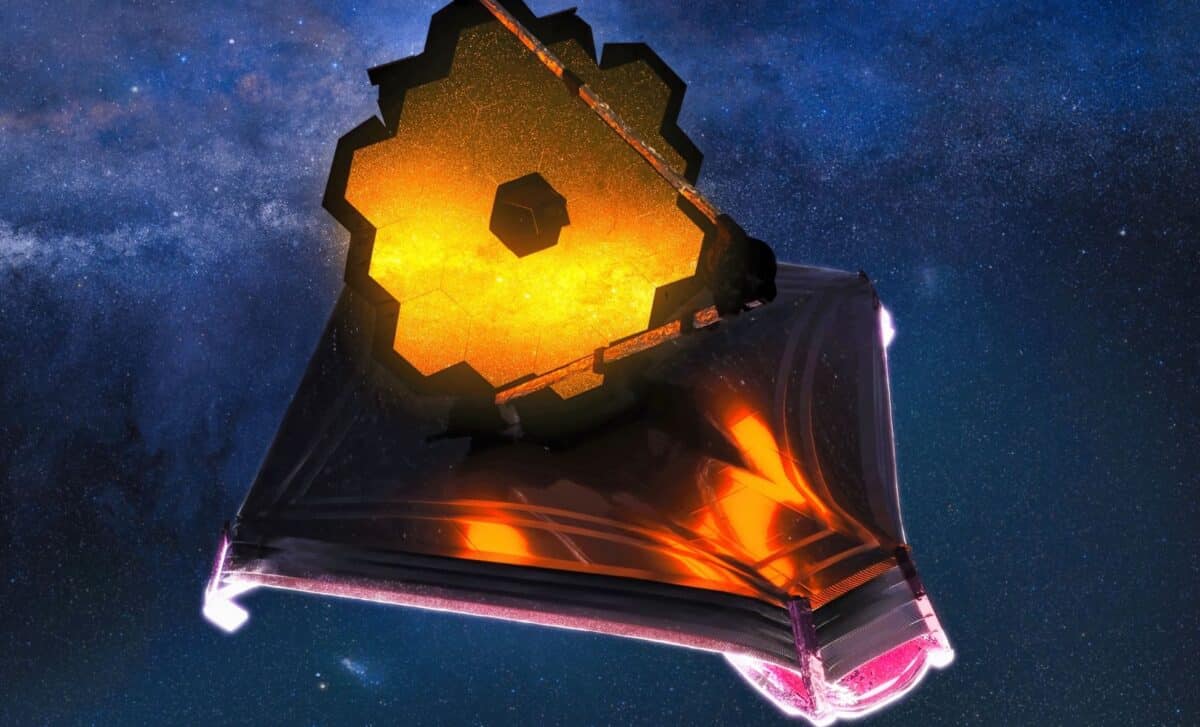
Astronomers have created the most precise dark matter map ever made using data from the James Webb Space Telescope. The map reveals previously undetected structures that do not correspond to any visible matter, offering a sharper view of the universe’s hidden framework.
Covering a patch of sky slightly larger than the Moon, the map is based on the shapes of roughly 250,000 distant galaxies. The resolution is nearly twice that of earlier maps produced with the Hubble Space Telescope, providing new insight into how invisible matter connects the cosmos.
The research was led by Jacqueline McCleary and her team at Northeastern University. Since dark matter does not emit or reflect light, its presence can only be inferred by how it bends light from objects behind it.
Mapping Gravity’s Subtle Fingerprint
To build the map, researchers studied the distortions in the appearance of background galaxies caused by dark matter’s gravitational pull. The more warped the light, the more mass lies between the observer and those galaxies. This method, known as gravitational lensing, is one of the few tools available for identifying dark matter.
“Those galaxies are basically the cosmic wallpaper,” said Liliya Williams of the University of Minnesota, who was not involved in the project. What matters is not their true shape but how they appear stretched or bent by the gravity of dark matter in the foreground.
This approach revealed filaments and clusters of mass that did not match any visible structures. This discrepancy confirms that these areas are likely dominated by dark matter. Williams added that:
“To identify many of these structures over a wide field, gravitational lensing is one of very, very few techniques, and definitely the best.”
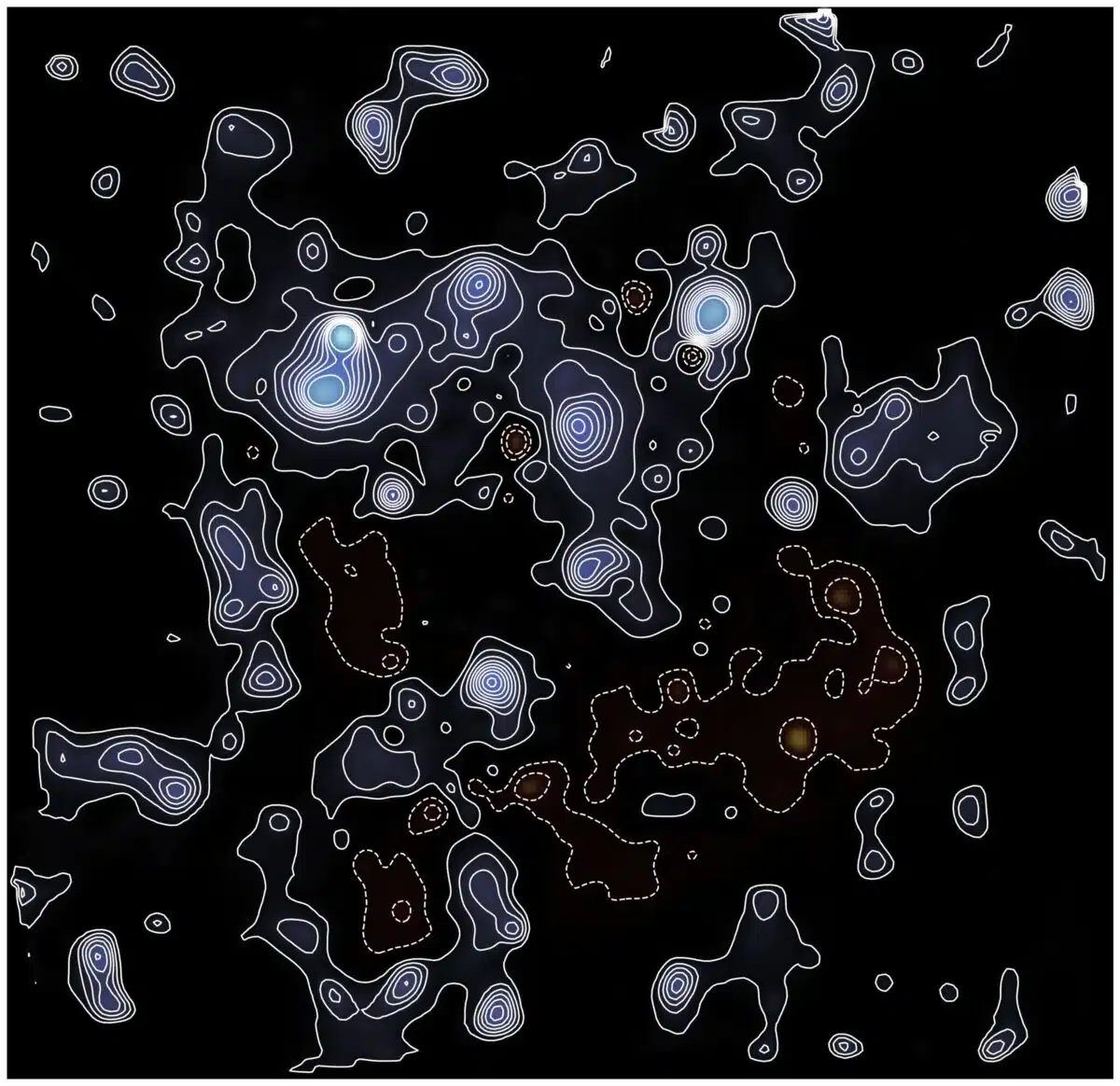 Contour map of dark matter distribution derived from James Webb Space Telescope data. Credit: Dr Gavin Leroy / Professor Richard Massey / COSMOS-Webb collaboration
Clarity That Exposes The Cosmic Web
The new map shows the cosmic web in greater detail than ever before. Using the advanced instruments of the James Webb Space Telescope, researchers could see fainter galaxies at greater distances and identify finer distortions in their shape. The result is a clear image of how dark matter threads across space.
“It is a very high-resolution picture of the scaffolding of this little corner of the universe,” said Jacqueline McCleary, referring to the dense and interconnected structures that emerged in the data.
The improved field of view and sensitivity helped scientists trace these filaments much farther than earlier surveys could reach. The study publsihed in Nature Astronomy reported that some of the observed structures had no counterpart in luminous matter.
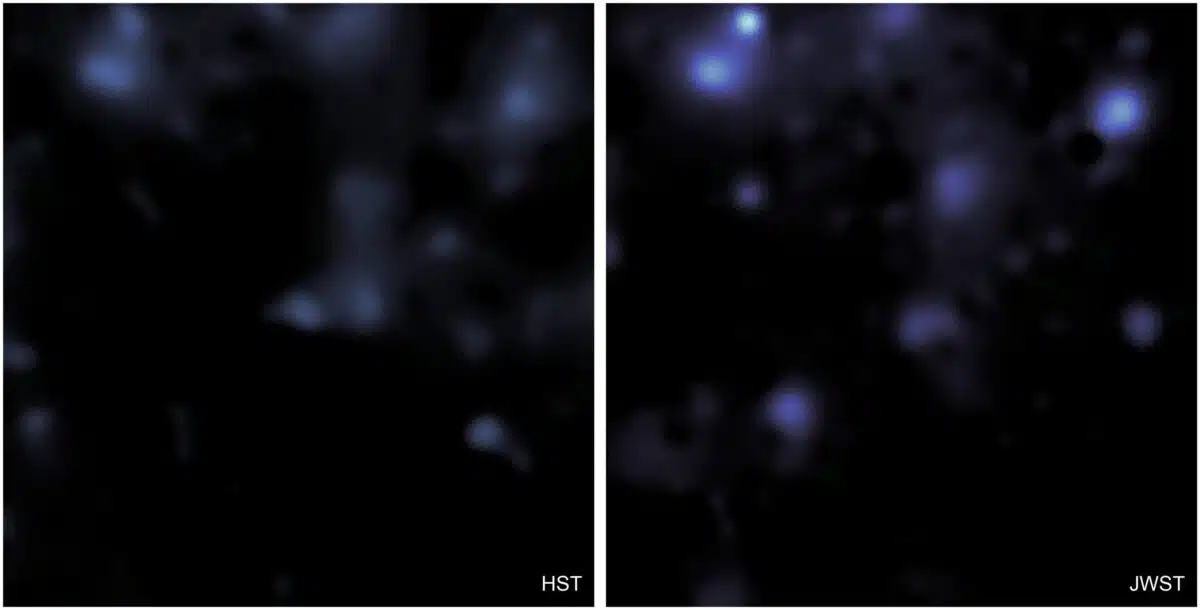 Side-by-side comparison of dark matter mapping from the Hubble Space Telescope (left) and the James Webb Space Telescope (right). Credit: Dr Gavin Leroy / Professor Richard Massey / COSMOS-Webb collaboration
Without gravitational lensing, they would remain invisible. The discovery suggests that dark matter may form larger and more complex networks than previously confirmed through optical observations alone.
Reactions Are Already Pouring In
So far, the map appears to match predictions from the lambda-CDM model, the widely accepted framework describing how the universe evolved. This model assumes the presence of both dark matter and dark energy, with the latter responsible for the universe’s accelerating expansion.
According to McCleary, the current analysis is still underway. While the map supports the model on the surface, she stated:
“Although at a glance it’s a match for lambda-CDM, I’m not giving up yet – I’m withholding judgment until our analysis is finished.”
The dataset could uncover subtle variations or underlying tensions within the current cosmological model once it has been fully examined and analyzed in detail.