
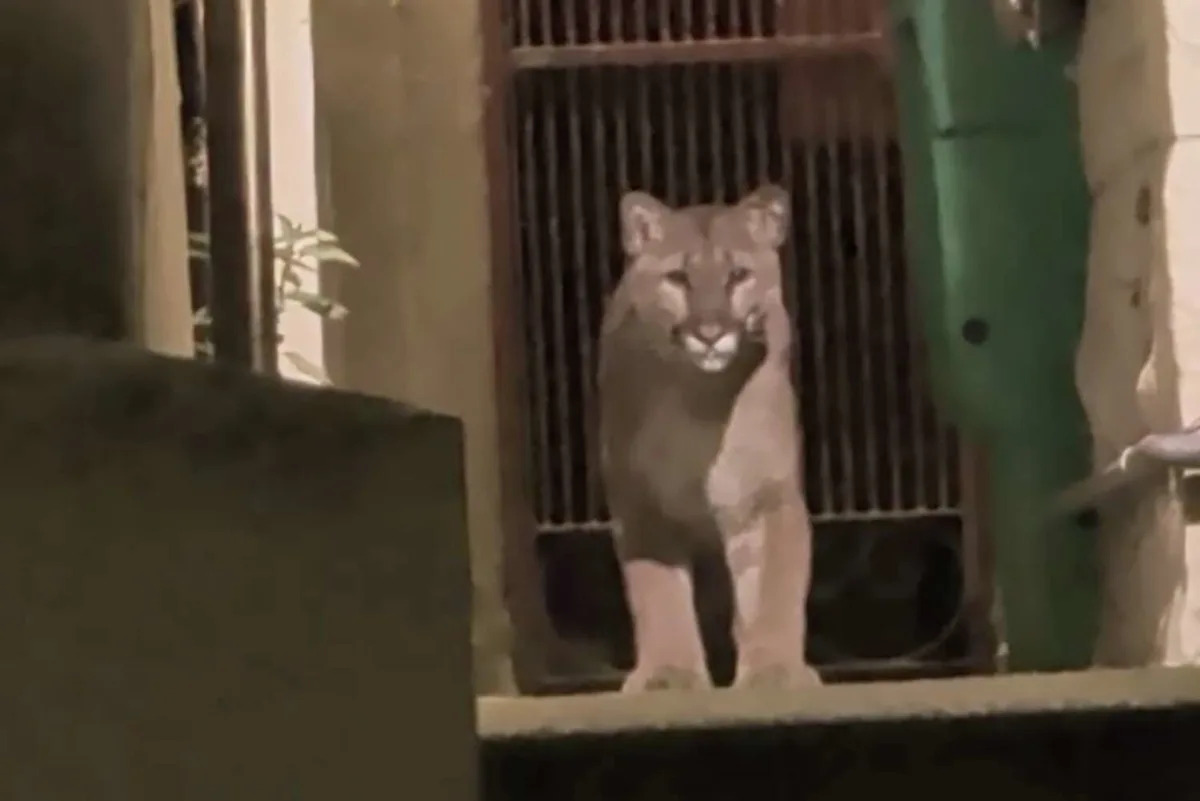
San Francisco’s mountain lion has a name – and a past.
After a 30-hour search for the animal seen lurking around Lafayette Park, city and wildlife officials finally tracked it down to a slim green space between two Pacific Heights apartment complexes. It was there that wildlife researchers realized it was the same animal they had once lost track of as a kitten.
157M, as he was originally named, was born in April 2024 near Rancho San Antonio County Park and Open Preserve on the Peninsula, according to Chris Wilmers, a professor in UC Santa Cruz’s Environmental Studies Department. Wilmers is the principal investigator on the Santa Cruz Puma Project, a collaboration between UC Santa Cruz and the California Department of Fish and Wildlife to track and study mountain lions, also known as pumas. The group has been tracking the animals since 2008.
The Puma Project first encountered 157M when he was a kitten and placed a collar on him to track his movement. But because these kitten collars are designed to be lightweight and expandable, they often fall off, Wilmers said.
That’s what happened to 157M, leaving researchers without the ability to say exactly how the mountain lion got from his forested habitat on the Peninsula to a park on the north side of the city.
At just under 2 years old, 157M is in his “dispersal phase,” Wilmers said – the period at which a young mountain lion leaves his mother and seeks out new territory of his own. That’s likely what led him to venture far north.
“Males will often travel far out. They’re essentially trying to find a vacant territory, and the Santa Cruz Mountains are pretty trapped in by development on all sides,” Wilmers said. “They wander, and they keep going, and they end up in one of those places – San Francisco, Silicon Valley, Highway 101.”
Wilmers said the Puma Project has previously tracked collared mountain lions that have wandered all the way to the San Francisco Zoo. Assuming 157M took the same route, he might have then followed along the coast, passing by Ocean Beach before detouring into Golden Gate Park and then the Presidio, Wilmers speculated. There have been reports of uncollared pumas reaching the Presidio, he said.
From there, the hunt for more green space could have led 157M to end up in Lafayette Park, where residents spotted him Monday morning.
“They’re tending to look for things that feel comfortable, vegetative cover being the main thing,” Wilmers said.
On Tuesday, officials with the California Department of Fish and Wildlife, the San Francisco fire and police departments and the San Francisco Zoo finally located 157M not far from where he was originally spotted. There he was tranquilized and placed in a cage to be taken out of the city. A tag on his ear helped researchers identify that this wasn’t the first time they’d come across this particular cat.
Wilmers confirmed that 157M will be re-collared and released back into the wild in the Peninsula where he was born.
After that, the lion’s future is unknown. Wilmers said it’s possible that he may find himself wandering back into an urban area or a highway.
This time, 157M was lucky. But the next time he could find himself being struck and killed by a car, as are many mountain lions who wander outside of their habitat.
In 2022, Caltrans constructed a wildlife crossing pathway underneath Highway 17 at Laurel Curve in Santa Cruz County. The location was partially informed by the Puma Project’s research on mountain lions’ pathways. The project took more than $20 million in combined funding from Caltrans, a local tax measure and the Land Trust of Santa Cruz County. In 2024, the Peninsula Open Space Trust paid $15.65 million to preserve an open space southwest of Gilroy to protect it as a corridor for local wildlife – including mountain lions.
More wildlife crossings like this could help mountain lions and other animals safely navigate around human development, Wilmers noted.
Once 157M is re-released, San Franciscans will be able to keep up with his movements on the Puma Project website. Wilmers noted that the location data lags eight weeks for animal safety.
If all goes well, he’ll find a new territory for himself far from human development, and his location data will help researchers at the Puma Project further their understanding of mountain lions’ movement and behavior.
Or it may turn out that 157M was never lost at all – just seeking a shady spot in a beautiful park, as all San Franciscans are wont to do.
This article originally published at San Francisco’s mountain lion was already known to authorities. Here’s his name – and history.