

Dr. Peter Yu, physician-in-chief at the Hartford HealthCare Cancer Institute, clearly does not rest on his laurels.
While Hartford HealthCare Cancer Institute has achieved what it terms a historic milestone by becoming the first health care system in the U.S to be designated as a Care Partner of Memorial Sloan Kettering Cancer Center, Yu is already looking to the future.
And that, Yu said, means always seeking new breakthroughs, new standards of care, making them become available to patients, and always innovating.
The designation as a Care Partner of Memorial Sloan Kettering Cancer Center means all of those things, and more, are now baked in to how the Hartford HealthCare Cancer Institute works, he said.
It took a lot of work to get there.
While Hartford HealthCare has had a 10-year relationship with Memorial Sloan Kettering Cancer Center, a decision was made to lay the groundwork for accelerating breakthroughs and progress.
”We decided that we could come together,” Yu said.

Hartford HealthCare
Dr. Peter Yu, medical director of the Hartford HealthCare Cancer Institute
So, for the last six months Hartford HealthCare has looked at more than 500 measures of quality and “what have we accomplished … are we delivering the quality” and “where we want to go,” and whether that meets the standard of Memorial Sloan Kettering Cancer Center, Yu said. Hartford Healthcare and MSK both did scoring, he said.
“We achieved concordance in our quality,” Yu said. “We are publicly stating we have completed this quality assessment.”
In terms of achieving concordance, Yu said an example is looking at how Hartford Healthcare is doing cancer services, or oncology. It’s an operational assessment of how the system is doing in the different departments, he said.
“We looked at how are we doing in the most common cancers, among five most common, how are we doing in these five major areas, we found our quality, our delivery of cancer care was equal to MSK,” he said.
The deep dive looked at all seven Hartford Healthcare hospitals, in pathology, pharmacy, radiology, nursing and more, he said. The health system has 45,000 employees and it “involved engaging the front lines troops… thinking about how we can do better.” (Manchester and Rockville locations are not yet included, as they are new to the system).
“It really was an all hands on deck,” effort, Yu said.
Hartford HealthCare noted that its first location to complete this process and fully align with MSK Standards of Care™ was in Fairfield County, and that set the stage for the systemwide adoption.
 Hartford HealthCare Cancer Institute Fairlfield Cancer Center, A Care Partner of Memorial Sloan-Kettering Cancer Center
“This is a transformative moment for cancer care in Connecticut,” said Jeffrey A. Flaks, president and CEO of Hartford HealthCare. “Through this expanded partnership, patients across our entire health system will have easier access to groundbreaking treatments, clinical trials, and pioneering research. This is about delivering world-class cancer care close to home.”
Delivery of care to patients
Yu, again looking to the future, said “We are now able to set the course for the next 10 years; our relationship with MSK is renewed for the next 10 years.”
This is significant as things are “moving even faster now in terms of cancer breakthroughs,” and the relationship with MSK means “greater coordination of new breakthroughs and research for our patients,” he said.
“Cancer deaths have been decreasing by 1 to 2% a year,” Yu said. “It could be even better than that, it could be even faster than that.”
One of the ways to achieve this is having doctors with sub specialization, or doctors focused on particular cancers, which will allow Hartford Healthcare experts to talk with MSK doctors who are also sub specialists about what they know, he said.
 A view of Hartford HealthCare in downtown Hartford. (Aaron Flaum/Hartford Courant)
“What we are trying to do here is make it immediate if there has been something that has been discovered or learned,” Yu said. “So that there isn’t this gap, there isn’t this delay.”
This is a critical question across the entire country, and “we are working to create the model that addresses this problem,” he said.
Yu noted that it takes about 10 years for medicine in general from when a breakthrough happens to when it becomes available for patient care.
Yu calls this “the last mile,” noting that means knowing “you have the answer, but how do you bring it to the patient?”
“I think it is really remarkable how two very different organizations have been able to come together and build a relationship over the last 10 years,” Yu said. “Concordance is a milestone in that partnership. It is about the patients, it is about improving their health…
Further, he said, it also is aimed at reducing the anxiety cancer brings, and supporting the patients and their families.
Yu noted that many patients feel the need to seek a second opinion, which can delay treatment due to waiting, and the opinions can differ.
“We are trying to remove a barrier so patients don’t have to go get a second opinion,” he said. “It is baked into our system that the recommendations are the same.”
Shelly Anderson, MPM, hospital president of Memorial Sloan Kettering Cancer Center, said, “As the first MSK Care Partner, Hartford HealthCare’s proven commitment to advancing MSK-level cancer care will have significant impact on patients and their families throughout Connecticut.”
“We are so pleased with Hartford HealthCare’s ongoing adoption of MSK’s globally recognized care standards, clinical pathways, and expertise,” Anderson said.
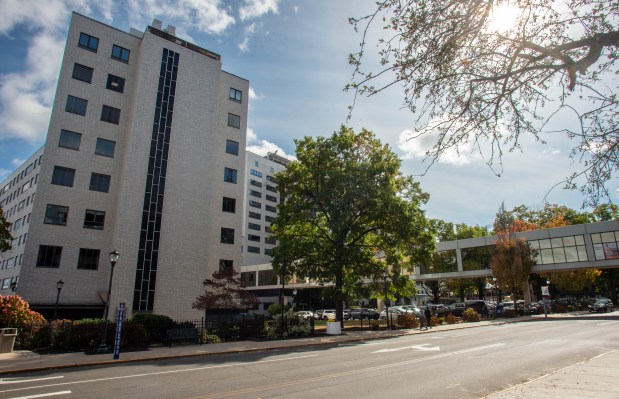 Hartford HealthCare. Hospital (File photo)
Dr. Elizabeth Jewell, of MSK and a surgeon, said Connecticut patients will “benefit from care that is aligned with Memorial Sloan Kettering Cancer Center’s Standards of Care, grounded in the latest evidence and advances in cancer treatment, access to clinical trials, and treatment plans supported by close collaboration with MSK experts. At the same time, patients continue to receive care from their trusted Hartford Healthcare Cancer Institute oncology teams.”
Jewell also noted Hartford Healthcare Cancer Institute is the first in the nation to be designated as an MSK Care Partner, and only after the “intensive review of their clinical infrastructure, care processes, and clinical outcomes.”
In addition to the sub specialization model Yu spoke of, the partner designation means Hartford HealthCare patients benefit from:
Increasing access to the latest clinical trials
Integration of tumor boards for complex cases. The most complex cancer cases are reviewed by multidisciplinary teams in conferences known as tumor boards.
Rapid adoption of leading-edge treatments
Enhancement in quality of care through aligned clinical practice
Leadership in artificial intelligence and clinical trial innovation
Shared commitment to improving patient care. “At the heart of the Care Partner relationship is to enhance the care of every patient across the Hartford HealthCare Cancer Institute through collaboration, shared learning, and seamless access to MSK expertise.”
Adopting a world-class standard of care
Collaboration with MSK physicians.
“We know from the data that patients treated at NCI-designated cancer centers like MSK often have better outcomes, but too many people simply don’t have easy access to that level of care,” Jewell said.
“MSK Care Partners represents a closure of access gaps and is central to MSK’s mission of ending cancer for life,” she said. “By working closely with health systems, like Hartford, that share our commitment to excellence, MSK can help such systems bring integrated, subspecialized cancer care and the latest, most effective treatments directly into communities.”