
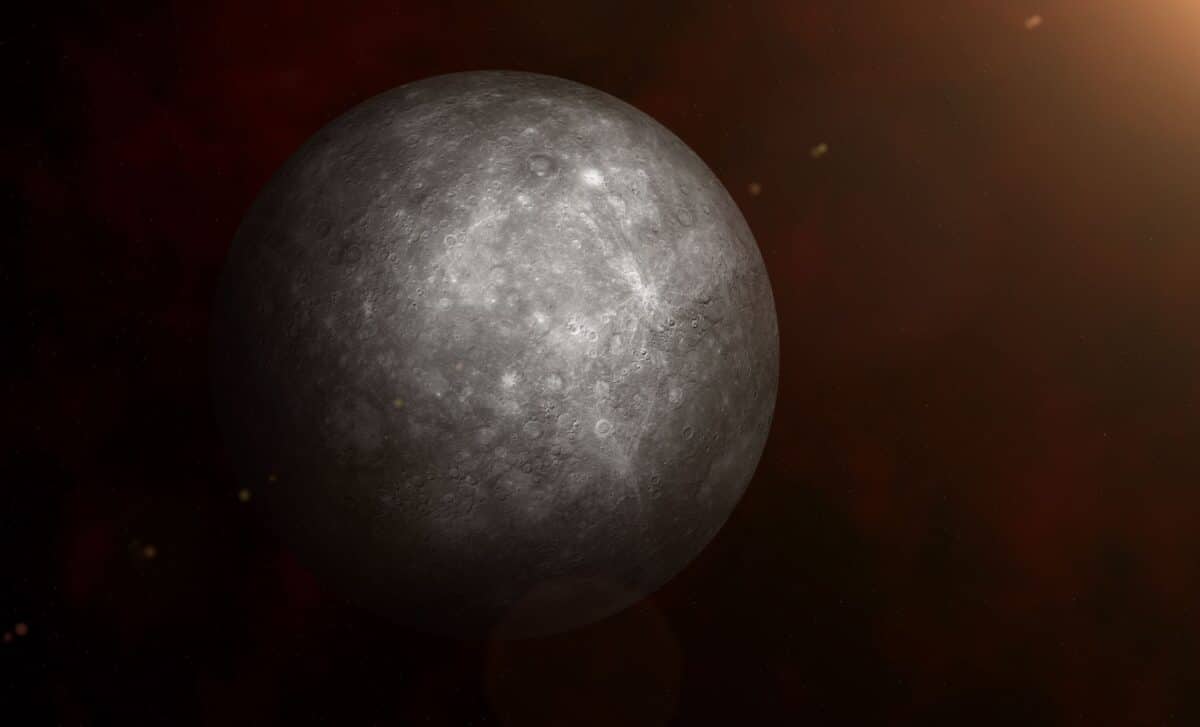
For decades, Mercury has been seen as a static, heavily cratered planet, a relic of early Solar System history. Its surface, scorched by the Sun and seemingly untouched by change, gave every appearance of a world whose geological clock had stopped billions of years ago. This image is now being reevaluated following discoveries made through detailed image analysis and new machine learning techniques.
Scientists analyzing images from NASA’s Messenger spacecraft have identified linear features that appear to be the result of volatile materials venting through the crust.
At the center of this shift is a team led by Dr. Valentin Bickel of the University of Bern, which has brought fresh attention to the planet’s surface using a vast archive of images captured during Messenger’s mission from 2011 to 2015.
Signs of Gas Escape Written Across Mercury’s Surface
Around 400 bright streaks, known as lineae, have been mapped on Mercury’s surface. These features appear mostly on sun-facing slopes of relatively young impact craters, areas where the crust was broken open, exposing underlying layers.
According to the latest research, published in Communications earth & environment, the lineae often originate from features called hollows, which are thought to form when volatile elements sublimate and escape into space.
The correlation between solar exposure and the location of these streaks has led researchers to propose a link between solar heating and outgassing. Volatile elements such as sulfur may be released when sunlight warms regions where impacts have cracked the surface. The streaks left behind mark the paths where material escaped, leaving visible traces of interior processes on the planet’s face.
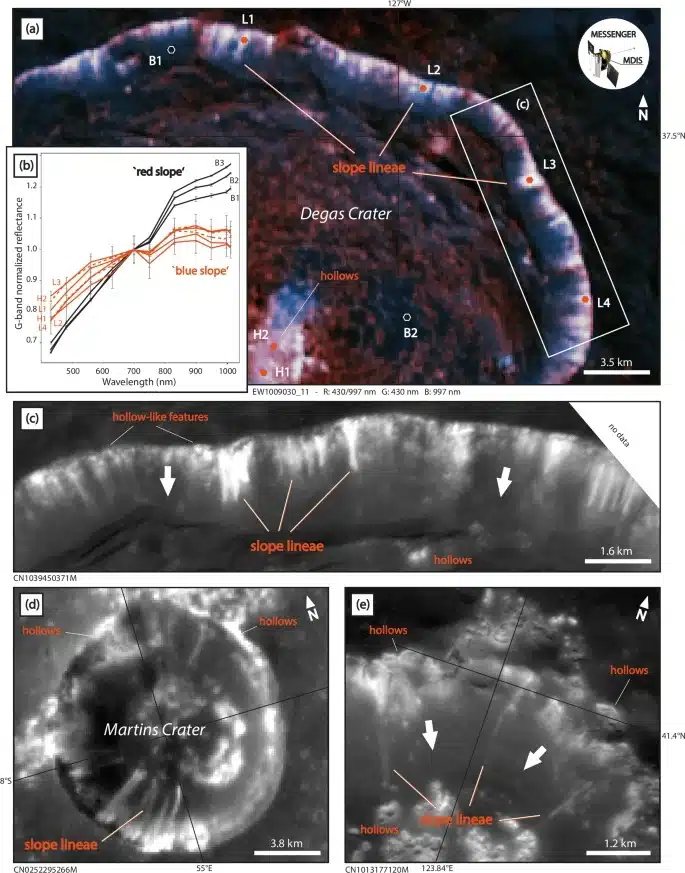 Visual examples of slope lineae emerging from hollow or hollow-like depressions on Mercury’s surface. Credit: Communications earth & environment
New Eyes on Old Data
The research draws on a massive dataset of nearly 100,000 high-resolution images from Messenger, which orbited Mercury for four years. By applying machine learning to this trove of visual data, the team was able to identify patterns and features that had previously gone unnoticed. The technique allowed for a more systematic mapping of Mercury’s surface than had been possible during the mission itself.
“Our findings paint a completely different, dynamic picture of the supposedly dead, dry and boring planet Mercury,” said Bickel.
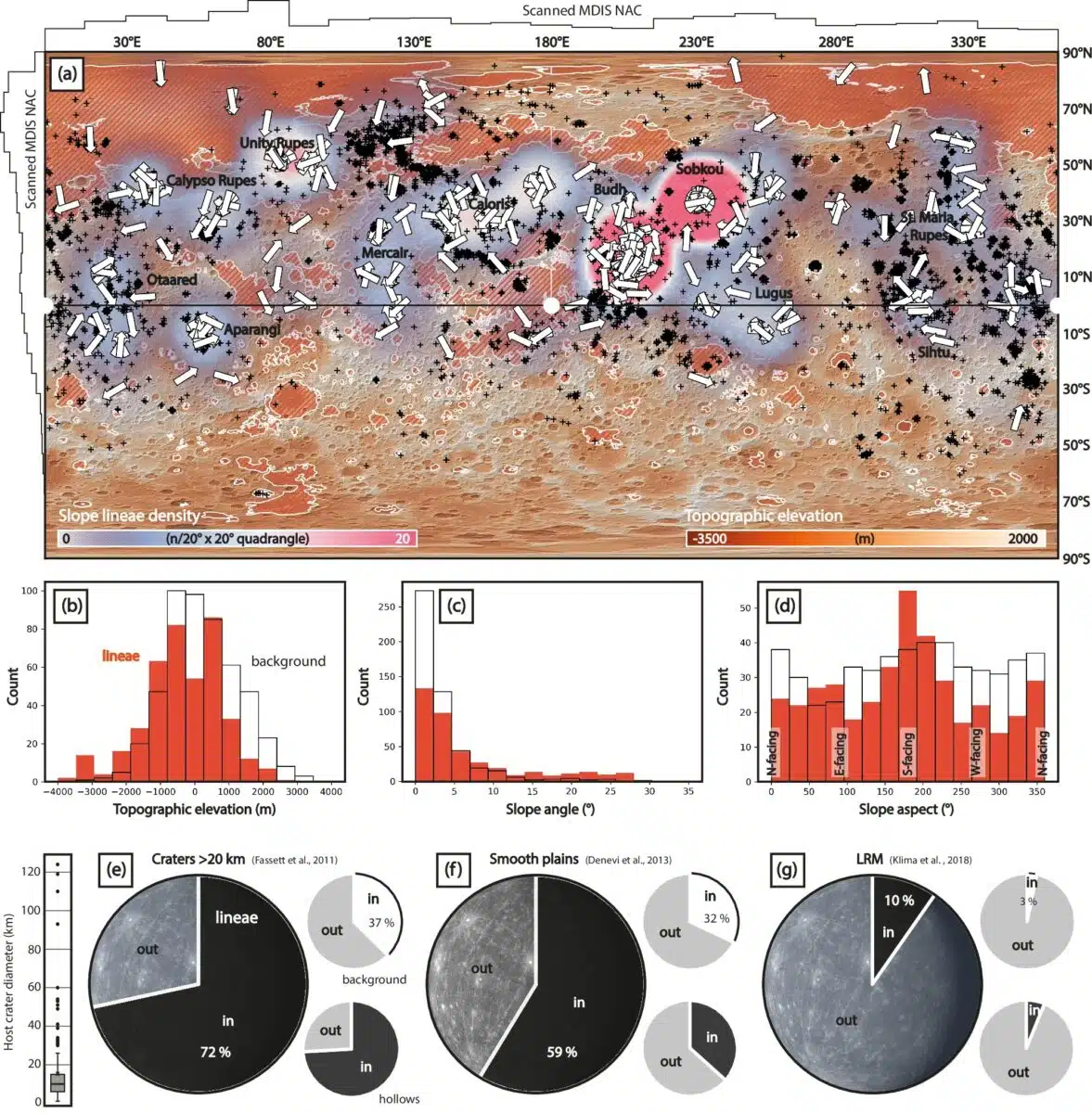 Overview of the location, properties, and geostatistical patterns of slope lineae on Mercury. Credit: Communications earth & environment
BepiColombo Set to Confirm Recent Surface Changes
The discovery arrives as the European Space Agency’s BepiColombo mission continues its journey toward Mercury. Its payload includes imaging instruments built in part at the University of Bern, which are capable of capturing high-resolution views of the same regions Messenger once photographed.
“With these investigations, we want to better understand the formation mechanisms and the temporal development of these structures and thus gain further indications of the role of volatiles in driving geological activity on Mercury,” Bickel added.
Once the spacecraft arrives, scientists plan to compare new images to those taken years earlier. If fresh lineae are found in areas that were previously unchanged, it would provide direct evidence of ongoing geological activity.