
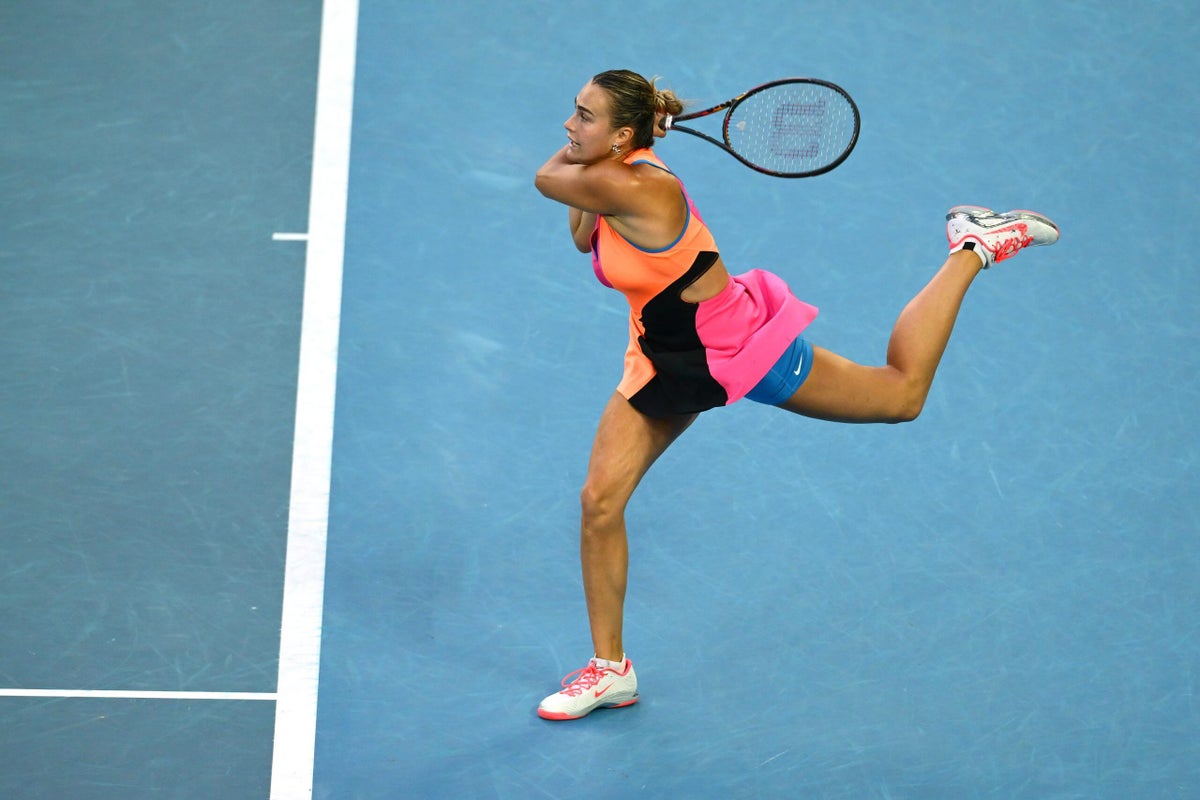
MELBOURNE, Australia — Aryna Sabalenka was always going to end up in the final of another Grand Slam.
Thursday night in Melbourne, Sabalenka, the world No. 1 from Belarus, cruised through Elina Svitolina of Ukraine in the Australian Open semifinal, spoiling Svitolina’s quest to boost morale back home with a 6-2, 6-3 win that was as emphatic as it was predictable.
That is no slight on Svitolina, even if she was off her best form in the cool, still air of the Melbourne Park evening. With the win, Sabalenka made her 11th final since last January. That includes five of the last six biggest events in the sport: The Grand Slams and the WTA Tour Finals.
Her patterns in this part of the world have also become familiar. For a second consecutive year, she will head into the Australian final undefeated on the year, having won the lead-up WTA tournament in Brisbane. This is her fourth consecutive Australian Open final; the first three brought two wins and one, devastating loss, last year to Madison Keys.
At the most important events, her familiar efficiency goes back even further. At majors, her first week’s matches often have one close set and another that’s a wipeout. The back end brings a few tighter contests, including some three-setters, but the stumble doesn’t come until the final test.
That’s how it’s been this year in Australia, with a couple of frightening pivots for the two players hoping to put an end to this relentless winning. The match with Svitolina was never in doubt.
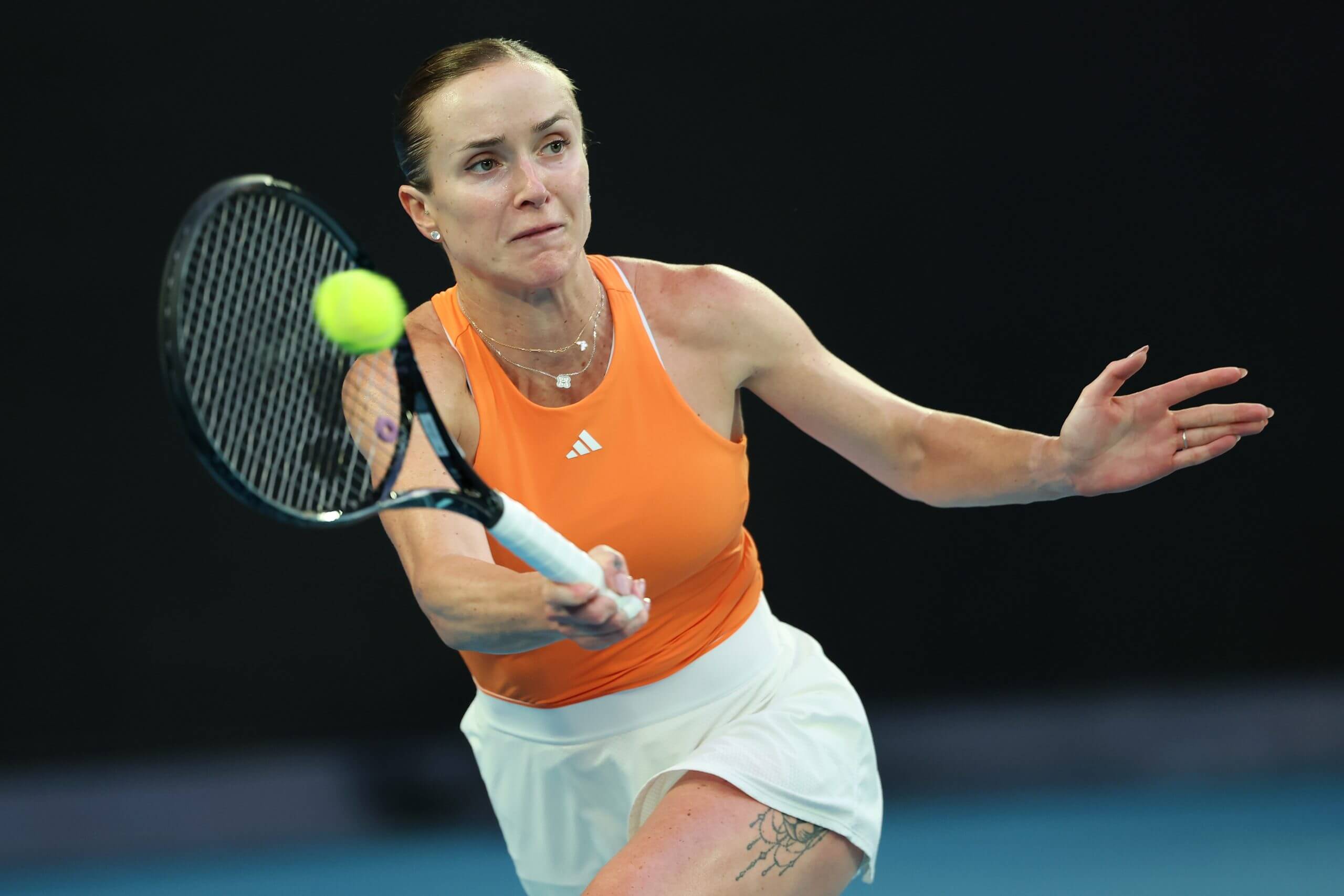
Elina Svitolina managed to attack and flip points when she should, but Aryna Sabalenka did not let her get on top of the match. (Lintao Zhang / Getty Images)
But for a slight stumble early in the second set, when Sabalenka opened with a sloppy game and gave an early service break to Svitolina, this was close to perfect, high-octane tennis. The world No. 1 grabbed the lead by landing 71 percent of her first serves in the first set, a frightening number given how hard she hits the ball and how often she shoots at the lines.
And while that translated into winning just 61 percent of her first-serve points, thanks to some outstanding retrieving from Svitolina and some errors from Sabalenka on her first shot after the serve, Sabalenka more than made up for it with what has become maybe the best second serve in the women’s game. She won 75 percent of her second-serve points, an absurdly high number. She kicked the ball out of Svitolina’s strike zone even in the cool conditions, and the Ukrainian’s knowledge that she had to jump on chances to attack whenever she could led to errors from her racket.
But this is mostly finding small details in something that unfolded evenly throughout. Sabalenka spent the match blasting away while mixing in just enough variety to keep her opponent guessing, finishing points at the net to prevent Svitolina from flipping them as she had done in beating Coco Gauff so comprehensively two nights earlier.
“Gutted to not make it through tonight,” Svitolina said in her news conference. “It’s very difficult when you’re playing world No. 1, who is really on fire.”
On this occasion, Svitolina was unable to find a way into a match, like a rock climber whose fingertips keep slipping out of the small cracks that might provide some stability.
Sabalenka is never flawless. She doesn’t have to be, as long as she accepts the inevitable errors that her game produces.
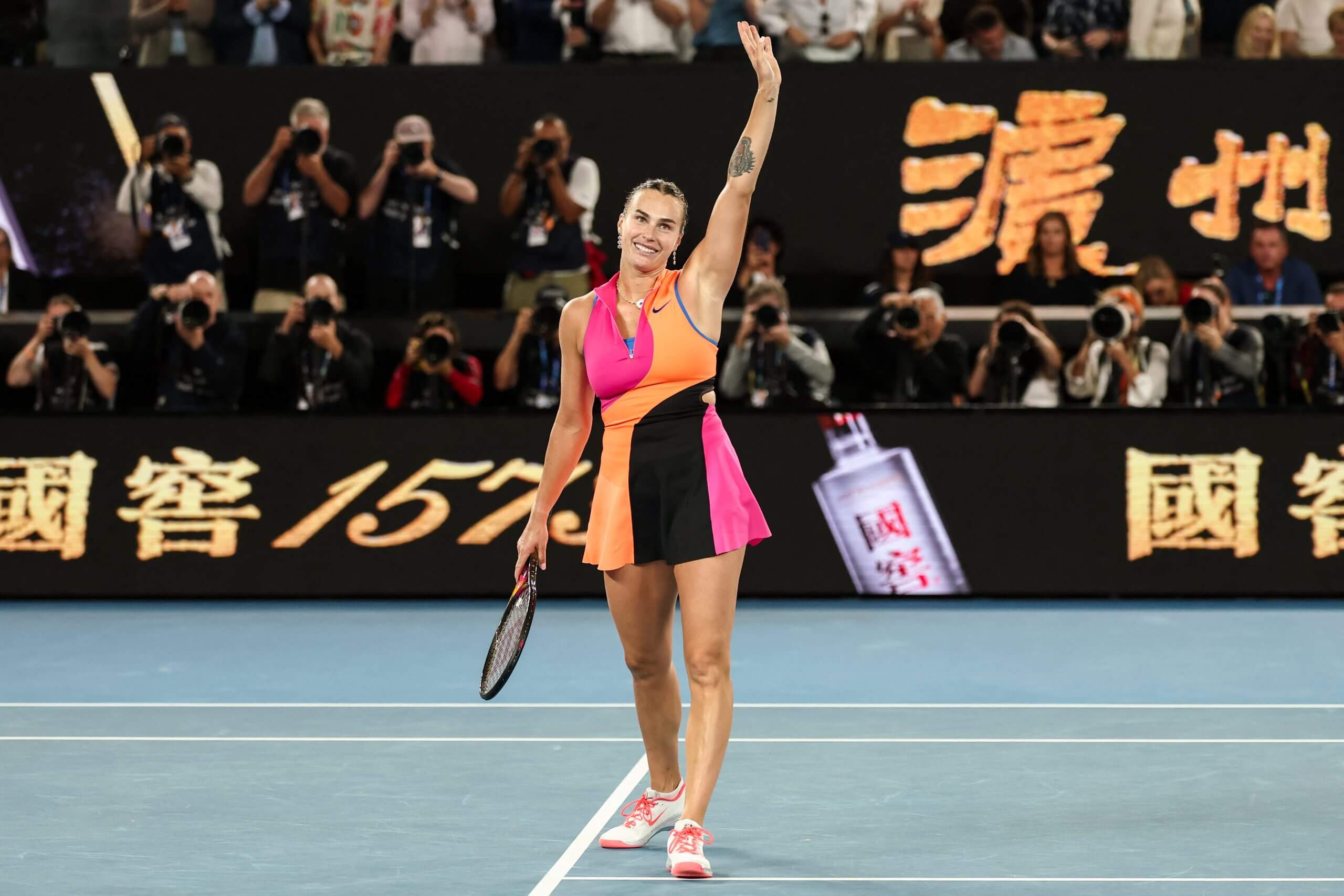
Sabalenka cruised into a fourth consecutive final in Melbourne. (Izhar Khan / AFP via Getty Images)
That was how the second set went, as she got broken to start it but ended it by winning six of the last seven games. The last point was like so many others. A big serve, a big plus-one forehand down the line into the open court, and a big forehand across the court into the open space, before Svitolina had even barely started to run in that direction.
“I was returning good, but then her second shot was unbelievable,” Svitolina said. “She had another punch coming, the second shot after her serve. So, I mean, that’s why she’s world No. 1.”
When it was over, a muted fist pump greeted the result, even though it made her the first woman to reach four consecutive Melbourne finals since Martina Hingis in the 1990s.
“The job is not done yet,” Sabalenka said on the court when it was over. No, it is not. She knows that the real test comes Saturday.
This is where it gets interesting for Sabalenka.
Even the best players lose a healthy number of the finals they play. Serena Williams won 23 Grand Slams. She also lost 10 Grand Slam finals.
Still, what has irked Sabalenka isn’t that she lost five of nine finals last year, and three of the four big ones. It’s how she showed up on those days. She only lost one of those matches, last year’s French Open final, to the world No. 2. At the time, that was Coco Gauff. Aside from Gauff, Sabalenka lost finals last year to players who were ranked No. 14, 11 24, and 6.
And even the match against Gauff was a winnable one, especially after Sabalenka won the first set in a tiebreak, which has become her specialty: She has now won 20 of them in a row at Grand Slams.
But then in Paris, as the wind kicked up, Sabalenka panicked and her game deteriorated in the second and third sets.
If Sabalenka’s wins in Grand Slams have a familiar pattern, her losses in finals have one, too. Rarely does she have a loss where she is matching her opponent shot-for-shot, and the other player is just a little better that day.
Rather, there are long stretches where her forehand becomes wild and she can’t find the court, beating the ball into the middle of the net or well beyond the lines, even when she gets those golden opportunities to feast on an opponent’s second serve.
Last year at the Australian Open, it was in the first set of the final against Keys. Sabalenka, the clinical killer, was nowhere in sight. Six weeks later in Indian Wells, her game disappeared in the second and third sets against Mirra Andreeva.
She was a shadow of herself in the Stuttgart final against Jelena Ostapenko. At the WTA Tour Finals, Elena Rybakina, her opponent Saturday, had her on the back foot from the beginning until the end.
Heading into the off-season, Jason Stacy, Sabalenka’s mind and body guru, said there was little mystery about the top item on the agenda: Figure out how to play better in finals. It’s the sort of problem that is a privilege to have, because it assumes, fairly, that when a big tournament rolls around, Sabalenka is going to be there in the end.
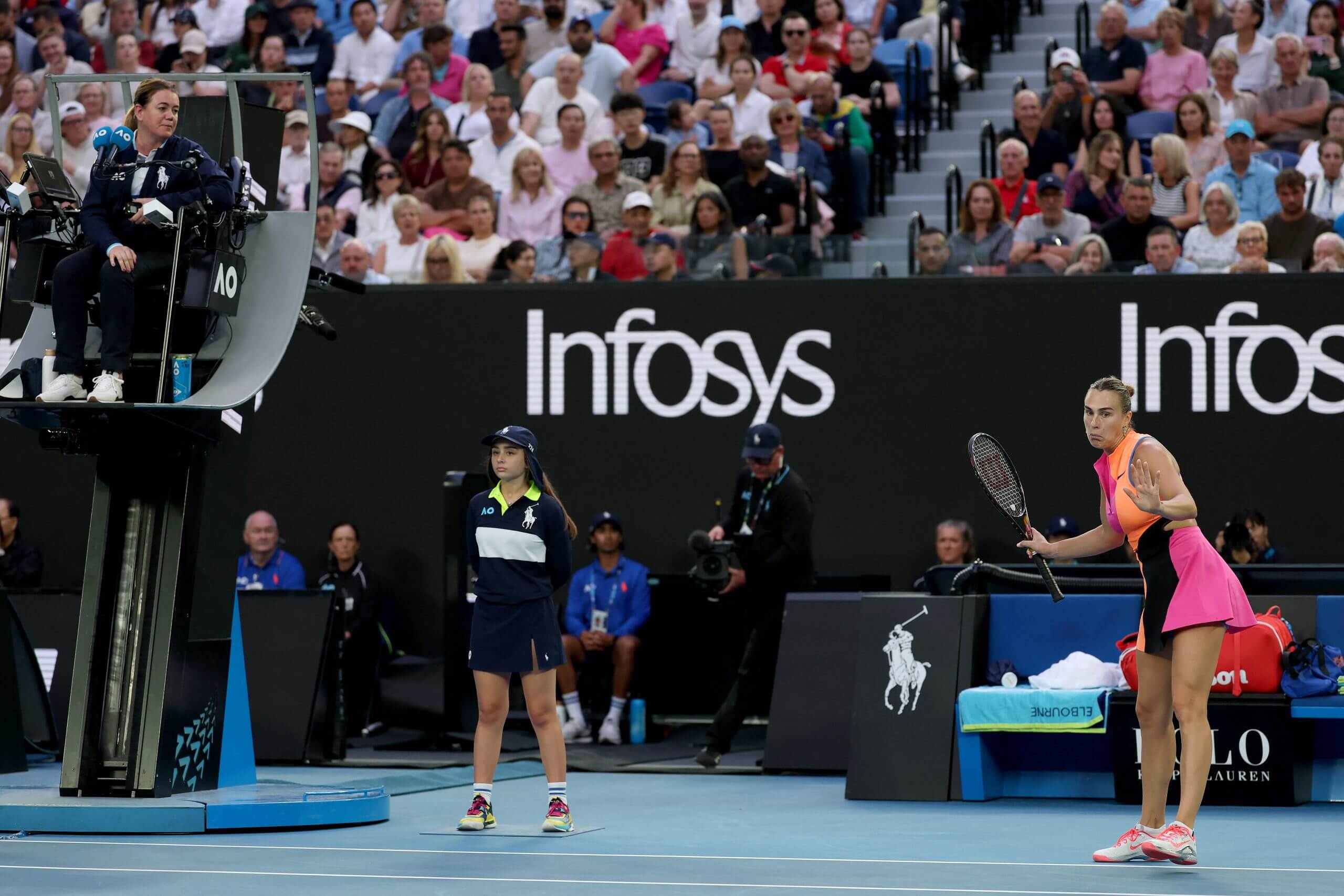
Aryna Sabalenka debates a hindrance call with chair umpire Louise Engzell. (Martin Keep / AFP via Getty Images)
After Thursday night’s win, Sabalenka said she understands what went wrong in those finals losses last year. In every one of them, she found herself disagreeing with what was unfolding on the court, whether it was Keys’ stellar play, Andreeva having the nerve to stage a comeback against her, Ostapenko redlining in Germany to prevent her from winning that coveted Porsche in Stuttgart, the wind and Gauff’s neverending defense in Paris, and not having her best game at the last match of the year in Saudi Arabia. She wasted energy and headspace.
No longer, she said.
“My mentality is like I’m ready to do whatever, whatever is going to be in that finals, I’m ready to go out there and fight with what I have and do everything I can,” she said.
She gave a hint of that against Svitolina early in the match, when the chair umpire, Louise Engzell, called her for a hindrance after she let out two noises of frustration after a mishit that landed in the court. Engzell ruled that Sabalenka had made the noise while Svitolina was in the middle of her swing.
Sabalenka was furious. She approached Engzell and asked for a video review, which did not change the call.
“She really pissed me off,” Sabalenka said of Engzell.
And yet it didn’t rattle her at all. Quite the opposite, in fact. “It actually helped,” she said. “I was more aggressive.” she’s almost always in finals. The only question now is whether she can win more of them.