
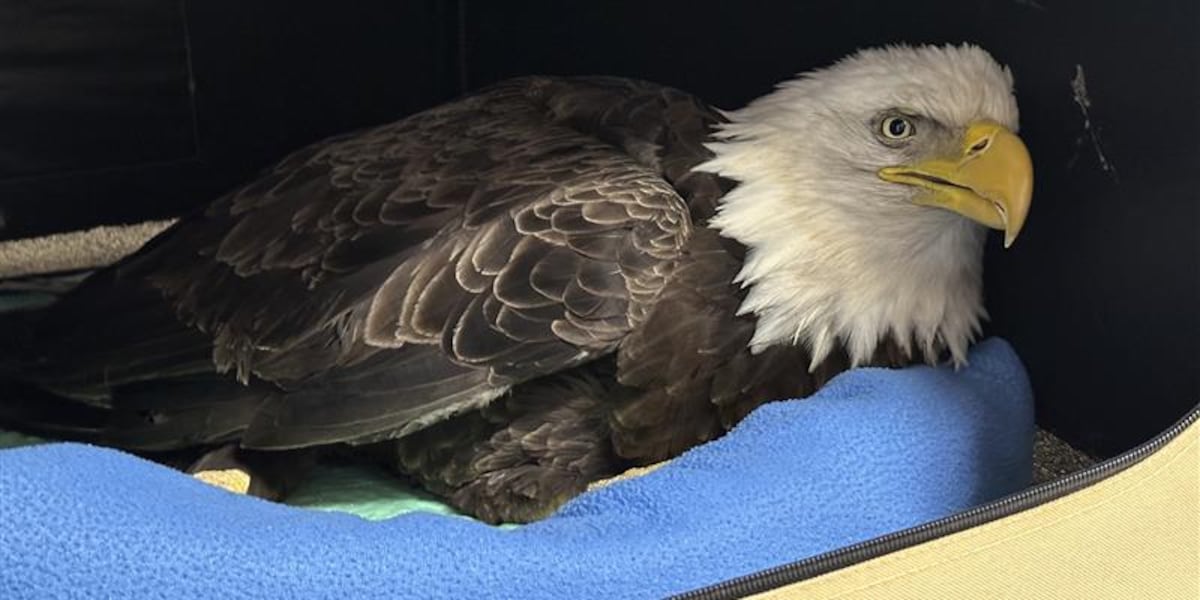
EATON RAPIDS, Mich. (WILX) – A bald eagle is fighting for its life at a mid-Michigan wildlife rehabilitation center after suffering from severe lead poisoning.
Staff at the Wildside Rehabilitation and Education Center in Eaton Rapids say the eagle, now called Armstrong, was brought in after being found in distress. When he arrived, his condition was critical.
“He was seizing when he came in. He was gasping for air when he came in,” said Louise Sagaert, who is the founder of the rehabilitation center. “I really considered euthanasia immediately, but you look into an eagle’s eyes, and they just have the fight. And it looked like he wanted to live, so we’re giving him that chance.”
You can find a video and pictures of the emergency response here.
Rehabbers say lead has saturated the eagle’s bloodstream, preventing oxygen from reaching his brain and affecting his ability to breathe. Lead test results were so extreme that initial readings could not be measured by testing equipment.
Emergency treatment began immediately, including oxygen support, fluids, and medication designed to remove heavy metals from the blood. Armstrong now receives injections twice a day as part of a long and uncertain recovery process.
Wildlife experts say bald eagles are particularly vulnerable to lead poisoning because they are scavengers. They often feed on gut piles left behind after deer are harvested or on animals that have been shot but not recovered. Even small fragments of lead ammunition can be deadly.
“This is a class example of bioaccumulation,” said Ben Borashko, an environmental studies expert at Michigan State University. “Any sort of contaminants that come from human activity can make their way up the food chain.”
Sagaert said birds often show clear signs of recovery or decline by the third day of treatment.
“Usually after day three, we either see, like, ‘I’m going to try to make this,’ or we see more depression, and then we see death,” she said.
Even if Armstrong survives, release into the wild is not guaranteed. He will need to demonstrate the ability to fly, socialize with other birds, eat independently, and gain weight. Rehabbers say he must successfully fly repeated laps and bank corners inside a 120-foot flight cage before being considered for release back into the area where he was found.
Staff at Wildside say cases like Armstrong’s highlight the importance of switching to non-lead ammunition and fishing gear.
Stream News 10 on your favorite devices! Here’s how to download the WILX app on Roku, Fire TV or Apple TV.
Be the first to see the Mid-Michigan headlines you care about – download the News 10 mobile app and subscribe to our News 10 newsletter and YouTube page to receive the latest local news and weather.
Copyright 2026 WILX. All rights reserved.