
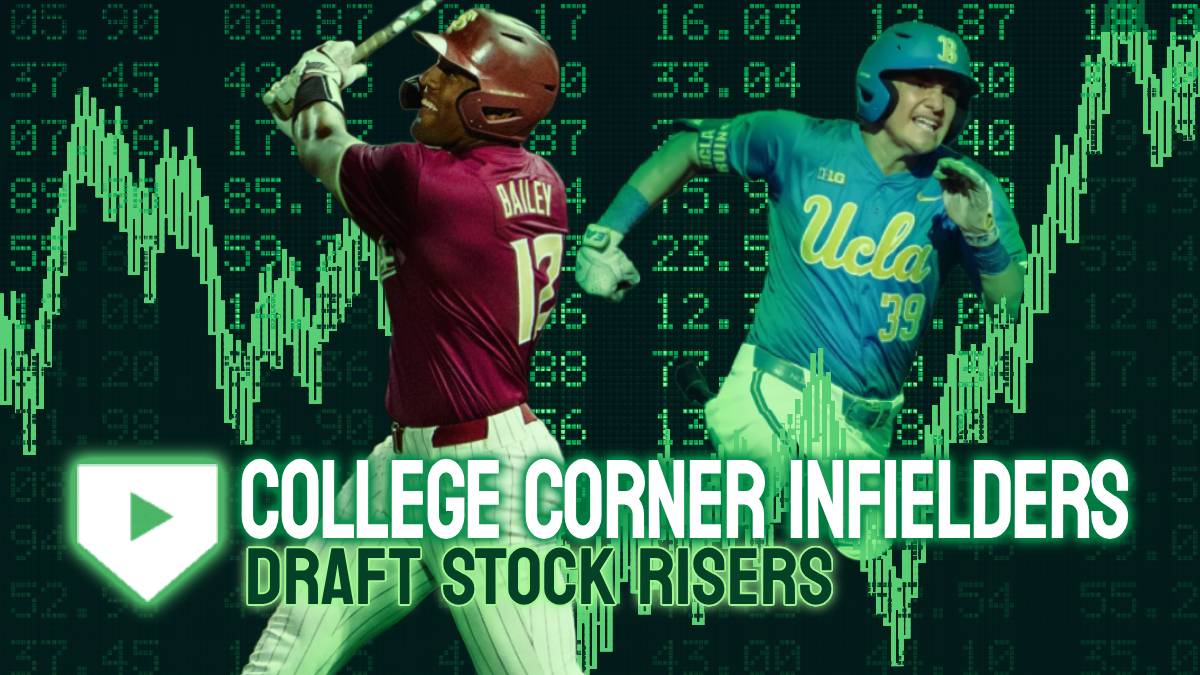
The next edition of the Prospects Live College Stock Risers Series rounds out the last position group we have left to cover: corner infielders. All of these players have shown impact at the plate at some point in their careers but are a small tweak away from taking off and launching their value up multiple rounds.
We’ll begin with two players who are measurable monsters that have flashed, but not sustained capacity for huge power.
1B Myles Bailey, Florida State, 6’4 / 260lbs (#60 on the College T100)
First of the duo is Florida State First baseman Myles Bailey, who brings ridiculous measureables. With metal bat exit velocities up to 118 mph, he’ll bring the strongest tool for raw power to the entire draft class. As a freshman, Bailey slashed .327/.441/.663 while also showing numerous tape shots. He was able to put a consistent charge in the ball, as one of the nation’s leaders in average exit velocity last year. On the surface, Bailey looks like he’d be one of the top players in the class; however, his current draft projection is an early-to-mid Day 2 pick. One of the areas he could improve on is cutting down on the strikeouts.
One of the unfortunate results of carrying the size that Bailey does as a hitter is that his swing runs very long in bat length, and despite possessing top-rail bat speed, Bailey still whiffs at among the highest rates in the nation. Despite a visual shortening of his swing in 2-strike counts, Bailey held a K% in the 30s on the year and was elevated in conference play. While the “just make contact” critique sounds like a simple way to elevate his stock, it’s an issue that’s not that easy, given his size. Luckily, Bailey could do a better job putting himself into better counts and overall situations to produce more consistent power.
A trio of key areas that proved to be a larger trend was his reduced power output against breaking balls, elevated GB%, and aggressive approach. Bailey destroyed FBs, but his elevated extreme rate against them also got him into counts where he had to face put-away breakers from some of the nation’s top pitchers. A downstream effect of that is Bailey ran a high GB% and obviously was not able to produce as much SLG output as he could. If he were to be a little more selective, the effortless power could really take off and show itself more in-game.
Myles Bailey will simply always have a lowered draft value ceiling by virtue of his position and a lack of sample size for all-around offensive performance, but there are other ways he can prove himself as a more complete player. His defensive ability at 1B is below-average, which goes along with overall below-average athleticism. Still, if he were able to showcase a more consistent defensive skillset, there would be less of a reliance on the offensive game to carry the profile, and he could thus lift himself into the Day 1 range. Bailey will be exactly 21 on draft day, which gives him an added boost.
This post is for paying subscribers only
Become a subscriber now and gain access to articles, tools, and stay updated with Prospects Live.
Already have an account? Sign in