
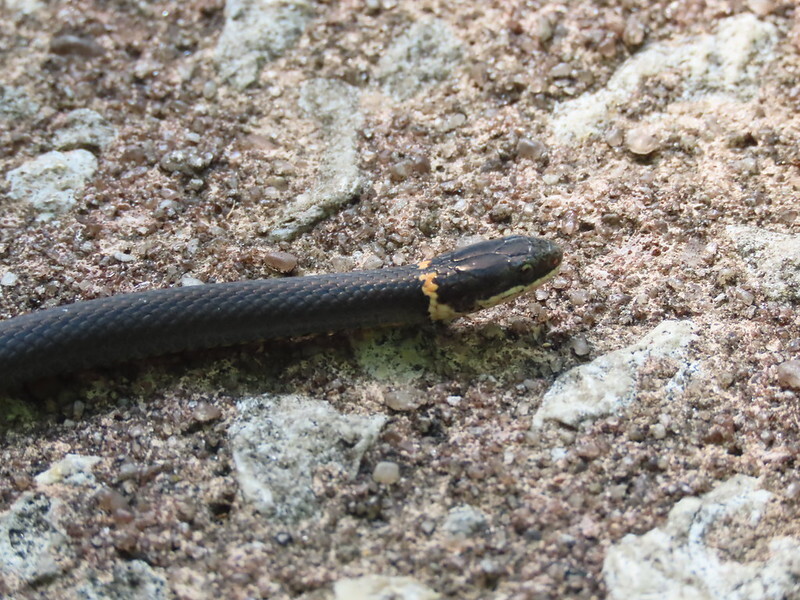
The Ring-Necked Snakes are one of the most widespread species in North America, being found in parts of Mexico and Canada and most of the United States. There are around 14 subspecies (depending on whether you are a lumper or a splitter), all of them being part of the single wide-ranging species Diadophus punctatus (the Latin name means “dotted snake with a diadem”). Florida’s most common version is the Southern Ring-Necked Snake, D. p. punctatus, which ranges across the southeastern US from Alabama up to Virginia. It is distinguished by the row of black half-moon spots along its belly and the incomplete ring around its neck. Southern Ring-Necks are found in every county in Florida. They do show some variation in their range, with individuals from the Panhandle tending to have yellow bellies and those from peninsular Florida tending to have red bellies.
A smaller subspecies, the Key Ring-Necked Snake (D. p. acricus), is found in hammock habitats in the Florida Keys. It can be recognized by its small size and its very faint neck ring. While the abundant Southern Ring-Neck is considered to be a conservation species of “Least Concern”, the Key subspecies is listed as “Threatened” due to its very restricted range and habitat.
All of the various subspecies are similar in appearance. They are small snakes, reaching a maximum of eighteen inches in length (though most individuals typically don’t exceed seven or eight inches), with a color ranging from slate blue to blueish black and a bright red, orange or yellow belly which may or may not be lined with dark spots or half-moons. The bright belly serves as a defensive display: when threatened, the snakes will roll on their backs, hide their head under their body and coil the tip of their tail to display the warning colors and to distract the predator away from the vulnerable head. They will also release a foul-smelling oil from their cloaca which makes them unappetizing to predators.
.
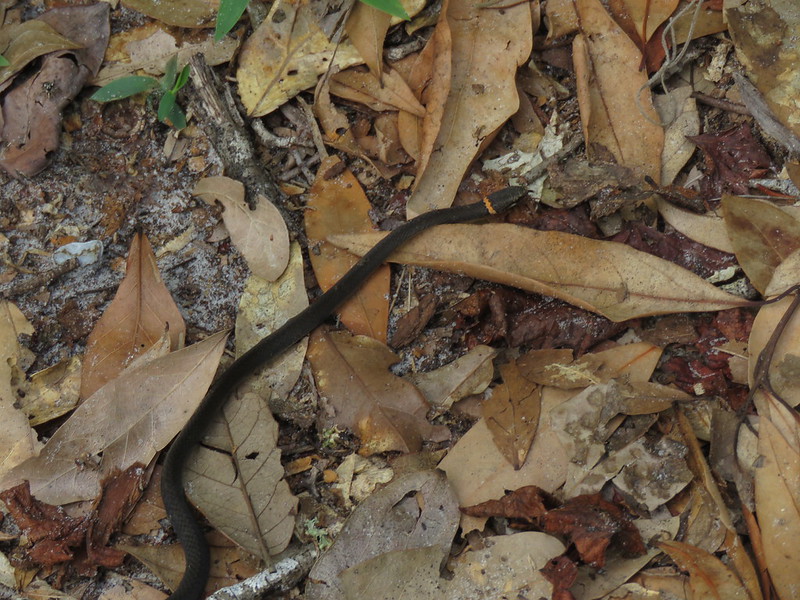
Retreating to the leaf litter. (This is a Northern Ring-Neck.)
In the technical sense, these little snakes are venomous. They are “rear-fanged”, which means they have two or three grooved enlarged teeth on each side of the back of their upper jaw, and these are connected to a Duvernoy’s gland which produces a venom that can be chewed into a victim by the rear fangs. The venom is very mild, being intended only to paralyze and numb the salamanders, worms, small lizards, and slugs that the snakes feed on. The tiny snakes are harmless to humans and seldom even try to bite, preferring to rely instead on their defensive display.
Although they are very common in most of their range, Ring-Necks are secretive snakes which are active at night and spend nearly all of their time underground or in leaf litter, where they can find their prey and avoid Florida predators like skunks, raccoons, armadillos, coral snakes, and black racer snakes. Because they are small and unobtrusive, they do well in urban areas like parks, cemeteries, or backyards, where they can reach densities of over a hundred individuals per acre. They are most often encountered by humans while digging in a garden or when they are flooded out of their burrows by heavy rains. They are also occasionally found in swimming pools, where they have fallen in and are too small to climb their way out.
In summer, females will lay half a dozen or so tiny eggs in a damp patch of soil or leaf litter or under a rotting log. There is no parental care, and the snakelings are able to fend for themselves as soon as they hatch. In Virginia where they overlap, Southern Ring-Necked Snakes will hybridize with their Northern Ring-Neck cousins.
.
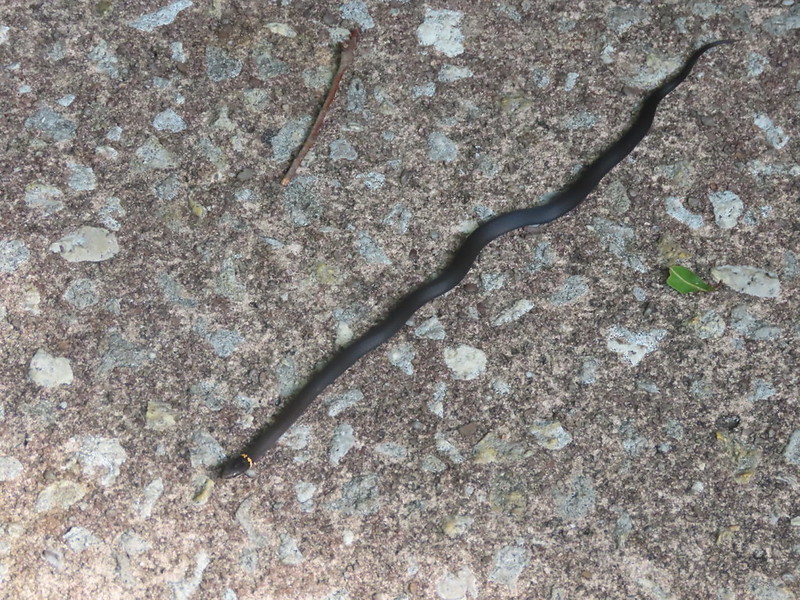
Crossing a sidewalk
I think they are adorably cute. 🙂
And now it is your turn: what is slithering around in your neck of the woods?
We are always looking for new people to produce Daily Buckets, where we practice “backyard science” by reporting and recording what we have seen in the natural world around us (and no matter where you are–even in the middle of the city–there is nature around you). You don’t need any science degrees or training or in-depth experience to be a backyard scientist, and you don’t need any expensive camera equipment or photo-editing software to do Daily Buckets. All you need is a pair of eyes and ears, a phone with a camera, and a lot of curiosity and enthusiasm.