
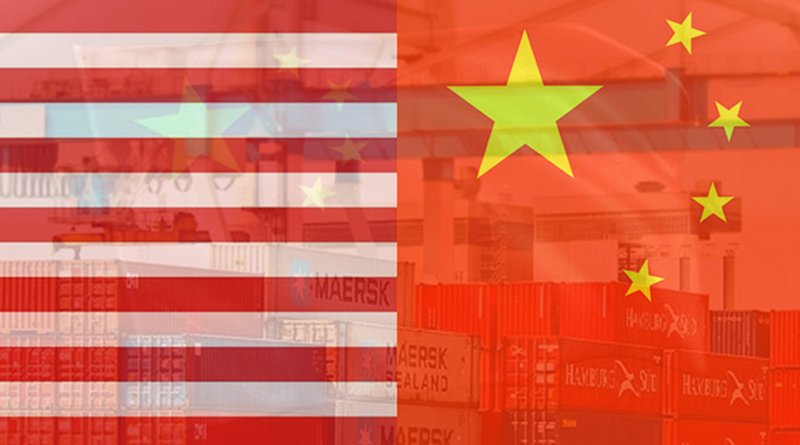
China has become the principal rival of the United States in the minds of the American foreign policy elite and the public. That assessment is fairly recent.
From the American Revolution until the end of the 1800s, Britain was America’s perceived nemesis. Afterwards, Germany replaced Britain as a major European rival before and during the Twentieth Century’s two world wars, with Britain being a U.S. ally. During World War II, the communist Soviet Union joined Britain as a U.S. ally to combat Germany and its Axis partners, Italy and Japan. However, immediately after hostilities ended, the Allies’ three former foes joined the United States and Britain in countering the USSR during the more than four-decade-long Cold War.
In the late 1950s, the two communist powers—the Soviet Union and the more radical China—began feuding, and American President Richard Nixon took advantage of the turmoil in the early 1970s to make a major diplomatic overture to Chinese Chairman Mao Zedong. Mao died in 1976; China opened its economy to private and foreign businesses beginning in 1978, thereby becoming a less thoroughgoing communist country. Yet when the Berlin Wall fell in 1989, and it was clear that the Soviet enemy had been severely weakened, the United States began to look askance at even an economically reformed China. America’s suspicions were reinforced by the Chinese government’s armed suppression of a democracy movement in Beijing’s Tiananmen Square that same year.
Even through the unipolar moment of the 1990s and the Global War on Terrorifollowing the 9/11 attacks, the United States looked with suspicion on a China purportedly experiencing rapid economic growth. The Obama administration famously tried to make a “pivot to Asia,” by strengthening formal and informal alliances in the East Asia / Pacific region and augmenting U.S. military forces there—all to counter a rising China. The view from China was that the United States was using the Chinese threat to tighten its hold over its formal and informal allies in that region.[1]
The first Trump administration declared, “The United States recognizes the long-term strategic competition between our two systems” and labeled China as a “revisionist power” seeking to upend the “liberal international order” and replace the United States at its head. Ironically, despite its earlier rhetoric, the second Trump administration has hastened Chinese success toward that goal. China seemingly has taken over the role of defending the global liberal economic order against the strident U.S. protectionist tariffs on much of the world’s exports.
China has been ruled since 2012 by authoritarian Xi Jinping (the strongest Chinese leader since Mao), who has re-entrenched Communist Party rule over Chinese society and its economy. His actions have made China an even better enemy on which the U.S. military-industrial-congressional complex (MICC) can focus, with the goal of securing ever-larger defense budgets despite the yawning $38 trillion American national debt. Yet, although bad for the Chinese people, the gross inefficiencies of a communist revival will likely drag China’s economic growth down—compounding the naturally slowing effects of a maturing economy and economic deceleration from an aging and declining population—thus probably ameliorating any Chinese threat to the United States.
Yet, for the future, U.S. anti-China hawks have produced three scenarios that will ensure China is regarded as a major threat by the U.S. foreign policy establishment and the MICC.
First, if China remains an authoritarian and increasingly communist state—even though the party’s more intrusive involvement in society and the economy might in fact make China a weaker threat—the ideological differences alone would require continuation of the current U.S. policy of far-forward containment. That view holds despite empirical evidence that authoritarian governing systems are no more aggressive than democratic ones. Eighty years of U.S. superpower interventions around the world have supplied the evidence for that conclusion, but it is not acknowledged by the foreign policy establishment, the MICC, or the American media.
Second, realist maximalists believe that even if China were to become a democracy, nationalistic forces might even make it more aggressive than it is now.
Finally, if China collapses as the Soviet Union did, the chaos might very well destabilize East Asia by setting off an internal civil war or huge refugee flows and could even lead to nuclear weapons’ proliferation or the rise of new nuclear powers if China fractured.[2]
Thus, the foreign policy establishment and MICC will have an adversarial China as a foil, whether it is strengthened, weakened, or stays largely the same in the future. However, in a recent Pew Research Center poll, the American public’s assessment was less dire when asked whether China was an enemy, competitor, or partner. Fifty-six percent said competitor, 33 percent said enemy, and 9 percent said partner.[3] Evidently, the American people, with less of a vested interest than the foreign policy establishment and MICC, have a more pragmatic view of China, despite the clear and present danger regularly and loudly expounded in the media by the “experts.”
Even if China is a threat now, has it been overly hyped? And another important question never gets asked: What does China threaten in any of these scenarios—the United States or its overextended informal global empire?
Has the Current Chinese Threat to the United States Been Overstated?
The keyword in the heading above is “United States.” Among U.S. government officials, the American foreign policy elite, the military-industrial-congressional complex, and the media, foreign “threats” are assessed through the lens of the United States as a global superpower, rather than being assessed for their threat to the territorial integrity of the United States, its republican form of government, and the American people—even though those aspects of national sovereignty are the foremost things the government is supposed to protect. As a result, any instability or conflict in any country on any continent is fair game: Any presidential administration or the foreign policy establishment can proclaim that vital U.S. interests (“national security”) are affected.
In reality, in most of the cases, the threat is to the informal, global, and now unsustainable American empire, not to the United States itself. Yet, the aforementioned huge government debt—made much worse by the long military quagmires in Afghanistan and Iraq and “defense” budgets approaching $1 trillion per year—should have long ago led to a national debate about scaling back vital U.S. security interests to a manageable few in a rising multipolar world in which the United States can no longer afford to police the world. During the Cold War and the earlier “unipolar moment” as the world’s only “beat cop,” the United States became involved in many foreign adventures, conflicts, and quagmires that proved costly in lives and money, which turned out not to be in the country’s vital interest. Vietnam, Afghanistan, Iraq, Somalia, and Libya come to mind, but many more such interventions have been carried out since World War II.
The good news is that, surprisingly, countering China’s rise and more assertive behavior toward Taiwan and in the South and East China Seas may not be as strategically necessary as is commonly believed. China is a rising regional military power, not a global martial superpower. Also, the alleged threat of “global Chinese economic penetration” turns out to be rather overblown. Let’s start with that one and then explore more plausible—but overly hyped—threats from China to the security of the United States.
The Economic Threat from China Is Almost Imaginary
Of course, Chinese private and state-owned companies do business and invest globally. The key difference between military and economic threats lies in the nature of the competition. Military competition is usually zero-sum: One country’s advantage is another’s disadvantage. The competition can be through arms races, cyberattacks, covert action, border skirmishes, proxy wars, or direct wars between nations—including between great powers, many of which have nuclear weapons. In contrast, individuals, companies, and countries trade with one another or conduct financial transactions because it is mutually beneficial.
However, instances of economic coercion do exist—for example, through trade (or financial) embargoes, raising tariffs, or imposing price floors. Yet even in those cases, one country just decides to reduce or end commercial transactions with a country that it thinks is misbehaving or has adopted “unfair trade practices.” Deciding to take such action, in a mutually beneficial relationship, means that the initiating country may suffer as much as or more than the target nation. For example, China has threatened to stop exports of rare earth minerals to the United States in response to higher U.S. tariffs on imported Chinese goods. Both countries suffer. Higher U.S. tariffs on imports raise prices to American consumers and firms, thus reducing Chinese exports. Chinese government export bans reduce China’s tariff revenues from rare earth minerals, and American civilian and defense industries would scramble to find substitutes or new sources for them. (Of course, both countries would likely, over time, find new suppliers and new markets in the global trading system, but such reordering of markets would likely result in substantial losses in economic efficiency.)
Western countries, including the United States, have expressed fears of China’s Belt and Road Initiative, which has built infrastructure in many countries around the globe. Yet many of those so-called investments are likely to be economically nonviable, raising the probability of wasteful boondoggles for both China and the receiving countries. In addition, some of the recipients have run into debt problems paying for the projects and have blamed the Chinese for their own foolish undertakings. Such debt may give the Chinese some leverage over the recipient countries but if the countries default on their debts, the Chinese will suffer financially, too. Thus, the threat to the United States of Chinese economic “penetration” in other countries is a bit fanciful.
The foregoing analysis of China’s economic behavior is not Pollyannaish. People, firms, and countries usually act on what they feel to be in their own best interests. And most of them have found that specializing in creating or making certain products and engaging in international commerce is more beneficial and efficient than aiming at autarkic self-sufficiency. Unfortunately, some countries still cling to the mercantilism of yore, shielding their home markets from imports while subsidizing industries that export internationally. China has been one of those countries, but interfering with the free market only hurts Chinese consumers to finance what are essentially welfare payments for Chinese exporters. Any nation, including the United States, that engages in such mercantilist behavior is only harming its own people. With the U.S. subsidization of certain industries and draconian trade protectionism beginning in 2021 and accelerating in 2025, the admittedly imperfect China seems a better steward of a relatively free international trading system than the United States, the traditional champion of such a system.
In addition, cheating always arises on the international scene. The autocratic Chinese government, like other governments, has engaged in economic espionage to steal U.S. technology and launched cyberattacks to threaten U.S. financial and physical infrastructure systems. It would be naive to think that the Chinese government will cease such conduct in the future. However, those threats, which will be dealt with below, are manageable.
China’s Threat to U.S. Security Has Been Hyped
The exaggeration of the Chinese threat to U.S. security is not the first instance in American history of such threat inflation. President Harry Truman and Dean Acheson, his secretary of state, helped instigate the Cold War against the Soviet Union starting as early as 1945. Republican Senator Arthur Vandenberg told Democrat Truman that he would need to “scare the hell out of the American people” to win public support for such a global crusade. Later, Acheson admitted that he and Truman had done just that by making the post–World War II Soviet threat “much more real” to the American people than the facts warranted. After the Cold War ended and the Soviet Union fell in 1991, the Soviet archives were partially opened to historians. Many of the scholars who examined the records concluded that the U.S. government’s depiction of the Soviet communist threat had been grossly exaggerated.
Even after World War II ended and the Cold War began, many national security analysts concluded that the USSR, led by Joseph Stalin, was in no shape or mood to invade Western Europe with its tank army, which remained in Eastern Europe after Germany’s surrender. The Western Soviet Union had been devastated by Adolf Hitler’s scorched-earth wartime invasion blunder and the most titanic combat in world history that ensued on the Eastern Front: as many as 30 million Soviet citizens had perished.
One of the principal reasons the Soviet threat was exaggerated was the rise of the U.S. military-industrial-congressional complex during World War II. In prior American wars, civilian factories were converted to produce weapons and then reconverted to commercial use after the combat ended. However, World War II, which was fought on several fronts simultaneously around the globe, required U.S. defense production at levels far higher than those of previous wars. The American defense industry spread from cities along the coasts and the Great Lakes to suburbs, exurbs, and even rural areas across the country. After the war ended, cities, with more diversified economies, were able to more easily transition to peacetime. Industries elsewhere would be hurt more by the drastic reduction in postwar defense spending. The affected industries lobbied their members of Congress to keep defense production higher than justifiable to shore up suburban, exurban, and rural economies.
In 1950, just five years after World War II ended, the North Korean communists’ invasion of South Korea prevented the U.S. defense industry from being fully mothballed from the earlier, much larger conflict. And after the Korean War armistice, the first large peacetime military in American history was preserved—and with it the need for a permanent, dedicated defense industry to manufacture weapons systems for a larger force.
Furthermore, an inherent conflict of interest arises within the Department of Defense (War) itself. The Defense Intelligence Agency (DIA) and the intelligence arms of the individual military services, which create threat estimates, are part of the same vast department that also contracts to build the weapons in conjunction with the permanent, dedicated defense industry. That industry now makes only a few commercial products. Thus, the defense industry is happy for the intelligence agencies to exaggerate the threat from any adversary, because the industry benefits financially when the Pentagon’s research, development, and procurement offices cite those inflated threat estimates to justify contracts for weapons that are built in excess quantities, are unneeded, or are even obsolete. Members of Congress go along with such elevated threats, defense spending, and defense contracting because the budgetary outlays create jobs and goose the economies of their states and districts, not because the spending is truly required for national security.
This military-industrial-congressional complex (or “iron triangle”) has pushed exaggerated threat assessments and elevated levels of defense spending since World War II, the Cold War, the unipolar moment, the Global War on Terror (GWOT) after 9/11, and the rise of China as a global economic juggernaut and regional military power. Those developments, however, have required the U.S. foreign policy elite to identify new enemies that then are excessively vilified as security threats: from Soviet, Chinese, and other communists during the Cold War; to Saddam Hussein and Muammar Gaddafi during the unipolar moment and the GWOT, which also targeted Osama bin Laden, al-Qaeda, and other groups–such as ISIS–having nothing to do with 9/11; to a rising China about the time the Berlin Wall fell and the Soviet threat collapsed. So, any cogent analysis of the military threat from China (which is not entirely fanciful) must be alert for threat inflation on the part of the military-industrial-congressional complex.
China Is Ruled by an Autocrat Who Engages in Nationalist Rhetoric
China is now run by Xi Jinping, the strongest autocratic leader since Mao Zedong, who ruled from 1949 to 1976. Since taking power in 2012, Xi has amassed political influence by partly nullifying the economic reforms instituted by Deng Xiaoping, Mao’s immediate successor. Deng partly freed the Chinese economy from the Communist Party’s vise grip, leading to China’s apparently rapid economic growth from 1978 onward. Xi has reversed some of those reforms. He has reemphasized inefficient state-owned industries and rickety state-owned banks; he has reinserted party commissars into the governance of privately owned businesses. This party-state meddling in the private sector is a major factor in the slowing of Chinese economic growth. In general, the resurgence of party control of the economy is bad for Chinese businesses and consumers, and the country’s general prosperity, but should lessen China’s challenge to U.S. political and military power in the longer run.
Some analysts argue that slowing economic growth will require Xi to ramp up his already nationalist rhetoric and assertive actions toward Taiwan and the South and East China Seas to hold onto the political support of the Chinese masses. However, slower growth also erodes, at the margins, his ability to build competent military forces capable of successfully carrying out his verbal threats.
Also, despite his public threats to Taiwan and expansive territorial claims, especially in the South China Sea, Xi must be worried by the performance of a fellow authoritarian’s military against a weaker country—that is, Vladimir Putin’s disastrous invasion of Ukraine. In autocratically run militaries, people avoid telling the boss about problems, lest they be jailed or executed. Putin’s military supposedly had been rebuilt after the Soviet collapse but initially performed horrendously against a much weaker foe. Although the Russian military has improved somewhat with the combat experience acquired during the war, it still has endured massive losses of men and equipment during a conflict in which the badly outnumbered and outgunned Ukraine has fought the Russians to a standstill. Thus, Xi needs to wonder whether his generals are reluctant to tell him that his military is equally hollow, despite its massive size.
For China to Absorb Taiwan Would Be Harder Than the Pentagon and Media Believe
China thinks of self-governing Taiwan as a wayward province and has stated a desire to reunite it with the mainland, by force if necessary. China has been threatening to do so for decades. In recent years, however, it has stepped up its harassment of Taiwan in the nearby airspaces and waters.
Mainland China’s claim to rule Taiwan is shaky. China has controlled Taiwan for only four of the last 130 years. Moreover, the Chinese Communist Party has never controlled Taiwan since it came to power on the mainland 76 years ago in 1949. The mainland ruled Taiwan only from 1945 to 1949—after the Japanese ended their half-century-long colonial occupation of the island from 1895 to 1945, but before the Chinese Communist Party took over mainland China in 1949. The Nationalists, who lost the long-standing civil war to the Communists, fled to what is now Taiwan that same year. Since then, Taiwan has changed from a Nationalist autocracy to a vibrant independent democracy in which ever-fewer people want to reunite with the mainland as the generations change.
Certainly, democratic Taiwan has a better moral case for self-determination than China has for forcing communist rule of the island under Beijing’s yoke. But is it really vital to American security to maintain Taiwan’s independence from China using military power? Is it even a U.S. responsibility to do so? The answer is no—unless the United States retains its financially unsustainable post–World War II role as global policeman. For decades, the United States has been overextended in that outdated role—with the accumulation of a $38 trillion national debt, projected to balloon to $55 trillion by 2030; [4] the natural rise of other power centers, such as India and China; and wealthy American allies (for example, the Europeans and Japanese) finally pledging to do more for their own defense, given that the U.S. security guarantee and nuclear umbrella protecting those countries lately seem more doubtful.
Is a Taiwan that remains independent from China really vital to U.S. security? In any U.S. war with China, Taiwan could act as a gigantic aircraft carrier from which the U.S. military could operate to attack the Chinese mainland. But one of the most likely causes of war between the United States and China would be the U.S. military coming to the aid of Taiwan in the event of a Chinese attack. The United States once had a formal alliance to defend Taiwan, as it currently does with Japan, South Korea, the Philippines, and Australia. However, after President Jimmy Carter recognized China diplomatically in the late 1970s, Congress passed the Taiwan Relations Act, which pledged the United States to help Taiwan defend itself. That commitment, to China’s anger, has taken the form of arms sales to Taiwan. The law has led to a purposefully ambiguous U.S. stance on sending U.S. forces to defend the island from any future Chinese aggression. The ambiguity is designed to deter China from attacking and Taiwan from recklessly declaring its independence, which could very well trigger open warfare. Then-President Joe Biden went beyond such ambiguity as many as six times [5] by verbally pledging to send U.S. forces to defend Taiwan if it were under Chinese attack, but the White House staff in each case walked back Biden’s comments, quickly indicating that U.S. policy had not changed, thus continuing the cloud of ambiguity.
Taiwan is also part of the “first island chain” of friendly nations—Japan, Taiwan, and the Philippines—which the United States relies on to attempt to contain the rise of China as a regional military power. The United States denies that it is pursuing such a containment policy, but informal and formal U.S. alliances with those countries are clearly designed to do so—much to China’s rage. Like all great powers throughout history, China seeks to enhance its own security by creating a sphere of influence in its near abroad, a goal the U.S. containment policy is designed to restrict.
Thus, Taiwan is strategic to U.S. security only if it is defined as requiring the American military to regularly operate thousands of miles away from the United States to police China’s natural sphere of influence. The United States would be apoplectic if another great power tried to militarily police South America, Central America, Mexico, or the Caribbean—as the Monroe Doctrine, dating from 1823, and the many past U.S. hemispheric military actions indicate. As noted earlier, anti-China hawks in the United States have been concerned about even mere “Chinese economic penetration” of Latin America—a largely empty “threat.”
Yet the militarized Hawaiian Islands, Guam, and Wake Island create sentry points far forward from the U.S. West Coast to guard that coast from any foreign attack. In contrast, pledging to defend or aid far-forward U.S. allies, formally or informally, could pull the United States into unwanted wars that would undermine, rather than enhance, the core U.S. security mandate of protecting American territory, its people, and way of life. Even an ambiguous and informal commitment to aid a Taiwan under attack could create public pressure on the U.S. government to enter a dangerous war with China—as the secret, informal Entente Cordiale with France did to most of the British government and people when they found themselves needlessly sucked into the meat grinder of World War I. And China has a credible nuclear arsenal, which Kaiser’s Germany did not.
Taiwan is the sixteenth-largest economy in the world and produces 90 percent of the world’s most advanced computer chips. However, that economic prowess does not justify the United States getting sucked into a war with China in a region remote from core U.S. vital security interests.
Besides, one of Taiwan’s means of deterring a Chinese attack might be to declare that if China begins such an attack, the Taiwanese government will destroy its chip-manufacturing facilities, thereby lessening China’s booty from the island’s conquest. Also, Taiwan does not have to win any war against the much larger China; it just has to inflict enough damage on the Chinese military to dissuade China from attacking in the first place—the so-called porcupine strategy. Much of the Taiwanese public has been blasé about the possibility of a Chinese attack on the island because it is aware of the substantial costs that Taiwan could inflict on any such attack, thus providing Taiwanese deterrence against it. According to a recent poll, 65 percent of Taiwanese believe China will not attack in the next five years.[6]
For its part, the United States needs to advise Taiwan to ensure it is buying the right weaponry to support its unilateral porcupine strategy. Conducting an amphibious assault is one of the most complex, difficult, and dangerous of military actions, especially in the age of satellite reconnaissance, precision weapons, accurate torpedoes, and the vulnerability of surface naval vessels (including large troop transports) to opposing manned and unmanned air, sea, and undersea power.[7] In an early 2025 report, even the U.S. intelligence community hedged on whether China is capable of carrying out such an assault, concluding only that China “was making steady but uneven progress on capabilities it would use in an attempt to seize Taiwan and deter—and if necessary, defeat—U.S. military intervention.”[8] Such evasiveness is the U.S. government bureaucracy’s way of saying the Chinese cannot mount a complex amphibious assault on Taiwan, at least right now.
The successful Allied invasion of Normandy during World War II, characterized by overwhelming Allied air and sea power, was launched before all the aforementioned defensive technological developments had come to full fruition. The Allies were able to feign an attack on the French port of Calais to create the element of surprise in Normandy, something that is much rarer in the age of satellite reconnaissance. Furthermore, German Western defenses in France had been weakened by the deployment of troops to the Eastern Front against the Soviet Union. Yet even with those advantages, the landings in Normandy were almost thrown back.
Starting in World War II and continuing through the Falklands War in 1982 and the ongoing Ukraine-Russia War, surface warships and maritime transport ships became vulnerable to manned aircraft, unmanned aerial vehicles (UAVs), opposing surface vessels, unmanned surface vehicles (USVs), submarines, and unmanned underwater vehicles (UUVs). In the Falklands War, the victorious British lost 6 ships and 10 were damaged. During the Ukraine-Russia War, Ukraine, a nation without a navy, deployed unmanned vehicles and land-based anti-ship missiles to sink or damage more than 20 Russian warships, including deep-sixing the flagship of the Russian fleet. Because of that success, the Russian Navy had to withdraw from the Ukrainian coast of the Black Sea, and vital Ukrainian shipping lanes were reopened there.
Opposing, and thus deterring, a Chinese amphibious assault on Taiwan, requires the Taiwanese to develop a layered defense of sea mines; precision-guided anti-ship missiles, both ashore and at sea; diesel (or even nuclear-powered) submarines; and manned and unmanned aircraft—all to attack the limited Chinese amphibious naval fleet and the supplemental, inefficient civilian fleet that would be transporting military personnel and equipment to Taiwanese shores. The Taiwanese should also buy and develop unmanned surface and underwater drones to attack Chinese ships approaching the island’s shores.
Even the ambiguous U.S. security guarantee for Taiwan (verbally made stronger several times by Joe Biden) has predictably made Taiwan rather complacent about any Chinese threat. The United States has repeatedly prodded the Taiwanese to increase defense spending by alleging that a Chinese attack was “imminent” and that Chinese leader Xi planned to have Chinese forces ready to attack Taiwan by 2027. Also, the unpredictability of President Donald Trump, especially his erratic support for NATO allies and Ukraine in its war against Russia, appears to have made Taiwan more serious about augmenting its own military and instructing its people on civil defense measures in the event of a Chinese attack. The assertive Taiwanese President William Lai has pledged to increase Taiwanese defense spending by 23 percent in 2026, with the total representing more than 3 percent of Taiwan’s gross domestic product—still low for a country alleged to be facing an alleged “imminent” threat. So, he has promised to increase defense expenditure further to 5 percent of GDP by 2030.[9] Nevertheless, as during the Cold War, the United States appears to be more concerned with regional threats around the world than even friendly countries in those regions are.
Taiwan has lengthened its mandatory military conscription period, instituted more rigorous troop training, and increased pay and benefits to address troop shortages, complaints of poor training, and low morale.[10] The Taiwanese are partnering with a U.S. company to produce loitering cruise missiles and underwater drones, with subcomponents manufactured in Taiwan.[11] The United States should even consider selling the Taiwanese one or more nuclear submarines, Tomahawk land attack cruise missiles, and offensive surface-to-surface ballistic missiles to strike back at the Chinese mainland if China attacks Taiwan—but only if it is made clear that the United States would not directly come to Taiwan’s aid in any such attack. Such weapons, with their offensive potential, would dramatically increase the pain to the Chinese of any attack and thus contribute significantly to Taiwan’s deterrent capabilities. Ending the ambiguity of U.S. policy—by selling Taiwan both defensive and offensive weapons while making clear that the United States would not directly defend Taiwan against a Chinese attack—would likely jolt the Taiwanese government and populace into increasing their security spending and preparations further.
A big problem that the Chinese would encounter in any amphibious assault on Taiwan is that the island features only a few beaches and ports. Even if Chinese forces made it ashore, they would face a tough slog on unfriendly terrain—a mountainous island with flooded rice paddies. On its inhospitable terrain, the Taiwanese could fight a guerrilla campaign that quickly could become a quagmire for the Chinese. Finally, to conquer Taiwan, the Chinese would need to take the nation’s capital, Taipei. Only a few major arteries enter the city, which Taiwanese forces could blockade.[12] The Taiwanese citizenry is also being prepared for the possibility of urban warfare.
More generally, it is uncertain how a Chinese military that hasn’t fought a major war in more than 75 years[13] in an autocratic society of “yes men” will perform in such a complex amphibious environment, given the major technological developments since World War II. Even the vaunted U.S. Marine Corps—which conducted a successful, if bloody, island-hopping campaign in World War II that involved seven amphibious landings and a daring amphibious assault in the Korean War in 1950—no longer prioritizes amphibious assault missions. It should be remembered that, in 1944, during its famous island-hopping campaign, the U.S. military avoided an amphibious assault on Taiwan, believing it too difficult; technological advancements since then likely have made such an assault even harder. Perhaps the Chinese military should be wary of trying it, too.
Some analysts say that because of the difficulties with an amphibious assault, the Chinese instead might deploy their naval and coast guard forces to blockade Taiwan. However, because any naval blockade is considered internationally to be an act of war, Taiwan could then begin attacking the same vulnerable Chinese surface ships with submarine-, surface-, air-, and shore-based anti-ship missiles; submarines; manned aircraft; and aerial, surface, and underwater unmanned vehicles. If China cut undersea communication cables to Taiwan, they would need to be repaired, so Taiwan must ensure that it has the capabilities to carry out those operations.
Another way of enhancing Taiwanese deterrence is for other smaller but wealthy countries in East Asia that also worry about a rising China—such as Japan, South Korea, Australia, Vietnam, and the Philippines, which have a greater strategic interest in an independent Taiwan than the United States does—to negotiate public agreements with Taiwan to send forces to help the island defend itself if it is under threat of blockade or attack from the Chinese. Analyst Michael E. O’Hanlon has dubbed cooperation of that kind “integrated deterrence.”[14] Such commitments by other friendly nations and American advice to Taiwan on the right weapons to purchase to run a potent porcupine defense could allow the United States to fully disengage from any implied Taiwanese security guarantee.
Finally, some commentators see China’s official policy of encouraging economic and cultural ties with Taiwan as an insidious attempt by the Chinese to prepare for reunification. That intent may be real, and the effects should not be understated, but such ties tend to at least create a peace lobby in each country, even if they hardly guarantee that war can be avoided.
In short, the Chinese could face substantial costs if Chairman Xi chooses to launch an amphibious assault or blockade of the island. Any invasion would face daunting terrain and a possible guerrilla war ending in a quagmire (which could be premeditated, as Saddam Hussein planned for guerrilla war prior to the U.S. invasion of Iraq). Any blockade would also face the long-standing vulnerability of surface naval vessels to attack from the air, on the ocean surface, and from under the sea.
Are the East and South China Seas That Important to U.S. Security?
The East and South China Seas are said by China to be its “near seas.” However, China really regards both areas as one body of water, with its claim on Taiwan in the middle of its long-standing territorial claims in both waters.[15] In recent decades, China has increased its military, paramilitary, and civilian ability to patrol the seas, but so have other countries involved in the regional maritime territorial disputes. Recently, all nations have taken more aggressive offshore actions over seemingly petty disputes about islands and even rocks. Michael D. Swaine, in testimony before the U.S.-China Economic and Security Review Committee, cogently suggested that nationalistic actions by several East Asian countries, contesting China’s territorial claims in those seas, are currently most likely to drag the United States into conflict with China. In fact, he noted that China carefully deploys white civilian government vessels, rather than gray Chinese Navy vessels, to joust with other countries over small islands in both seas. He usefully suggested ways for the United States to reduce the risk of conflict in those locations, including conducting more low-profile diplomacy, encouraging countries to agree on a binding code of conduct, and promoting joint resource development through a multinational joint venture that would adjudicate exploration rights.[16]
Disputes in the East China Sea
Although South Korea borders the East China Sea and Taiwan is also nearby, the main dispute is bilateral between Japan and China over the Senkaku Islands, which Japan controls. China calls them the Diaoyu Islands, but Japan insists that China has no valid claims on them. Although the islands are uninhabited, the waters of the East China Sea contain valuable fishing grounds and underwater oil and natural gas deposits. As in the South China Sea, the United States has no claims but insists on the right of navigation through sea lanes in international waters.[17] (The same claim has been used as an excuse by the U.S. superpower to intervene militarily in maritime disputes all over the world.) Of course, Japan is one of the closest U.S. allies, with the United States obligated by treaty to defend it. Japanese disputes with China over assertive Chinese claims over the entire sea thus become possibly unwanted indirect U.S. entanglements.
Other than the U.S.-Japan defense treaty commitment possibly dragging the United States into a conflict with China, which could escalate into a nuclear exchange, U.S. security would not be much affected if even China’s maximum claims in the East China Sea were recognized. China would have no incentive to interfere with trade going into and out of its ports; Japan and South Korea have ports that don’t face the East China Sea, so U.S. trade with those developed countries would be less affected by any Chinese restrictions there.
Thus, control of the East China Sea is not strategic for the United States. Therefore, U.S. naval patrols just to “help out” Japan (and South Korea) are unneeded, unnecessarily provocative to Beijing, and susceptible to escalation in the event of a mishap or miscalculation by Chinese or American naval forces. In short, the United States could help mediate between Japan and China if needed but should not get involved in jousting with Chinese vessels sailing there.
Disputes in the South China Sea
Unlike China’s bilateral dispute with Japan over ambitious Chinese territorial claims in the East China Sea, its disputes in the South China Sea tend to be multilateral. Multilateralism arises because of the number of nations opposed to China’s even more assertive “cow’s tongue” claim over the entire South China Sea and because many of those countries are part of ASEAN (the Association of Southeast Asian Nations). China has a dispute with the Philippines over the Spratly Island chain; a dispute with Vietnam over the Paracel Island chain; and quieter disputes with Malaysia and Brunei over the expansiveness of China’s territorial claims in the sea. Also, the sea itself contains more fishing grounds and potential oil and gas fields than the East China Sea. As in the case of the East China Sea, the United States has a formal ally—the Philippines—bordering on the South China Sea. As noted, the United States also has an informal ally, Taiwan, nearby.[18]
Yet again, the only direct claim the United States has to the sea is freedom of navigation in international waters. However, in the worst case, if China were successful in controlling and restricting trade across the entire sea, the United States would still be able to trade with the Philippines, Malaysia, and Vietnam through ports not facing it. And once again, sending U.S. naval forces far forward to patrol the sea just to try to enforce freedom of navigation is unneeded, needlessly provocative, and susceptible to escalation. As with the East China Sea, the United States could help mediate between China and other claimants but should not get involved in jousting with Chinese vessels.
The Larger Issue for the United States
Although the Chinese military is developing and fielding hypersonic missiles, more advanced nuclear submarines, anti-satellite weapons to challenge U.S. dominance in space, and other advanced weaponry, China still spends only a quarter of what the United States does on defense annually. China spends about $250 billion, while the United States spends about $1 trillion.[19] Because defense know-how is cumulative, the yearly funding gap over the decades has likely compounded the difference in effectiveness between the two militaries. For example, it takes militaries decades to perfect the operations required to safely launch and retrieve supersonic aircraft from an aircraft carrier, essentially a rolling postage stamp in the ocean; the United States is one of the few nations in the world that has perfected this operation to a high art. Thus, the U.S. military is much stronger and has considerably more recent combat experience than the Chinese armed forces.
If the United States did lose a war to China, it would only be because U.S. forces would be operating far forward in or near Chinese waters with extended supply lines or because the U.S. military-industrial-congressional complex wasted taxpayer dollars by buying the wrong weapons to serve parochial economic interests rather than effective military ones. In fact, all those long-term efforts and money spent to develop U.S. carrier air power could prove vulnerable to submarines with torpedoes and anti-ship missiles, land-based manned aircraft and ballistic missiles, and even unmanned aerial, surface, and underwater drones.
Michael D. Swaine correctly concluded that the larger issue for the U.S. role in both the East China and the South China Seas is the U.S. desire to continue to dominate the Western Pacific region, as it has since World War II. Reacting to a “Century of Humiliation” by foreign powers (including the United States), from the mid-19th to mid-20th century, a rising China is especially conscious of its sovereignty and demands to be taken seriously as a great power. China is now pushing back more on U.S. domination of the region and is installing anti-intervention (anti-access/area denial—A2/AD) weapons on its shores to counter U.S. naval patrols.[20]
Graham Allison studied 16 cases since 1500 of a rising power challenging a status quo power, finding that in 12 cases war ensued.[21] One case that did not result in war was Britain’s peaceful acceptance of the U.S. rise to great-power status in the Western Hemisphere in the late 19th century. Perhaps the United States should think about doing the same regarding China’s near-abroad instead of attempting to maintain needless U.S. supremacy in the Far East and Western Pacific.
One cannot call China a rogue expansionist state, such as Napoleonic France or Adolf Hitler’s Germany. After all, China has now joined the world’s club of great powers and wants a sphere of influence as a security buffer, as most great powers have demanded throughout history. It has joined the world economic system—maybe currently being a better steward of it than is the United States—and has a capable nuclear arsenal. All those factors should make the United States consider giving China some space to rise naturally.
The unstated U.S. containment policy, one of the few things China’s government propaganda initiatives is right about, will probably not be successful unless Xi destroys the powerful Chinese economy by completely reviving communism in the country. China is no longer like the Soviet Union, with a totalitarian economy that is likely to implode anytime soon. Thus, the tired and likely ineffective U.S. policy is unnecessary, costly, and dangerous. Finally, enhancing formal and informal bilateral alliances in East Asia gives allies the protection they need to potentially take aggressive actions that could drag the United States into disputes with their big Chinese neighbor.
Real Threats to U.S. Security from China Are Manageable; Tariffs Are Not the Answer
The real threat to U.S. security from China is illegal espionage, especially to gain U.S. weapons and dual-use technologies (civilian knowhow that can be used for military purposes). To steal weapons and dual-use technology, China can either hack the computers of the U.S. government, government defense contractors, commercial high-tech firms, or academic research institutions, or use spies to infiltrate those organizations.[22] However, to maintain its global leadership in offensive cyber capabilities, the U.S. government probably conducts as much, or more, hacking into foreign nations’ computer systems, especially those in China.[23]
Private defense contractors and civilian technology firms have commercial incentives to safeguard their valuable technologies from computer hackers or spies. Also, the U.S. government can help companies by giving them a heads-up about possible cyber or espionage threats and by arresting and prosecuting illegal hackers and spies. If companies are working on classified weapons or other technological contracts, their personnel undergo government background checks at the appropriate classification level.
The sale of weapons technology to China, whether direct or indirect through the reexport of U.S. technology from recipient countries, is strictly controlled by the U.S. government. However, the Chinese can obtain U.S. dual-use technology legally: by forming joint ventures between U.S. and Chinese companies, or by allowing U.S. companies to sell their products in China only if they license the technology to Chinese companies for manufacturing. The U.S. government can crack down on such commercial interactions with Chinese firms, but there are significant drawbacks to doing so, including hurting U.S. companies. The United States became the world’s technology leader by creating an open system of scientific and technological exchange. Clamping down on transfers of dual-use technology can hurt U.S. technology development as much as it impedes Chinese weapons improvement.
A better solution in the dual-use area is for the U.S. government to allow most such technology transfers while reforming the captive, insular, slothful, and inefficient U.S. defense industry by allowing more competition, especially among subcontractors to major defense prime contractors. Unique military specifications should be reviewed and relaxed where possible, so that more commercial technology can be incorporated faster into U.S. weapons systems by firms that don’t usually compete for defense contracts because of over-specification of product features or overregulation of contract terms. Such reform, by increasing competition in a relatively closed defense market, would improve weapons performance, speed up the deathly slow fielding of new weapons technology, and reduce defense costs to the American taxpayer. At present, the military-industrial-commercial complex slowly spins out small numbers of costly over-specified legacy weapons—for example, potentially vulnerable aircraft carriers or F-35 fighter aircraft—at the expense of large numbers of advanced hypersonic missiles and capable air, surface, and underwater drones, which would seem to be the future of warfare.[24]
In other words, the U.S. government should not shoot the goose that lays the golden egg—by restricting open exchanges of ideas, science, and technology to try to combat an exaggerated Chinese threat. Instead, it should let the goose have more freedom to field new U.S. technology in weapons faster to simply outrun Chinese weapons technology, whether developed or stolen. Reform of the uncompetitive, slow, and wasteful Pentagon weapons research, development, and procurement process will be challenging, however. In 2001, then–Secretary of Defense Donald Rumsfeld compared the entire Department of Defense system to the efficiency of Soviet five-year plans, and little has changed in the quarter century since.
The effect of any U.S. reform of the Pentagon’s weapons acquisition process on the race to deploy new technology into the field should be magnified by Chinese leader Xi Jinping’s reescalation of the Communist Party’s role in China’s economy and society. Given that he is emphasizing state-owned industries and is appointing political commissars to private firms, Chinese introduction of technology into weapons systems may very well be slowed in the future.
Yet, the federal Department of Homeland Security’s Cyber and Infrastructure Security Agency (CISA) accuses China of exploiting cyber tactics beyond espionage and the theft of U.S. technology. Hackers such as Volt Typhoon and Salt Typhoon, believed to be associated with the Chinese government, are allegedly planting cyber “time bombs” into critical U.S. infrastructure,[25] such as computers that control utilities (for example, water, wastewater, and electrical grids); are at the core of key financial, telecommunications, transportation, aviation, and pipeline systems; and run other critical American infrastructure systems.[26] Those Trojan horses would then activate in times of severe tension or war with China over Taiwan or the East or South China Seas. The U.S. intelligence community and Homeland Security can play a useful role in alerting private businesses to such threats and, if requested, help to find specific infiltrations and assist businesses in cleaning their systems and bolstering them against future threats. Better yet, instead of just relying on such cyber defenses, why not reduce the likelihood that they will be needed by reassessing the neo-imperial need for the U.S. to dominate the East Asia / Western Pacific region?
Finally, it is alleged that the Chinese run disinformation campaigns in the United States (and Taiwan), much as the Russians did during the 2016 U.S. election. The real crime the Russians committed—in bald coordination with Donald Trump, as he publicly encouraged the illegal Russian hacking of Democratic emails—was that they hacked the emails that same night. As noted earlier, American businesses and organizations are responsible for securing their own data systems from illegal hacking, foreign or domestic (the Democratic Party did a lousy job of securing its data); but U.S. intelligence or law enforcement can provide warnings to such organizations if they discover that such illegal activities either are occurring or are imminent.
The Russians also disseminated disinformation (untrue information) on the Internet and social media during the 2016 election. The U.S. national security establishment is worried that the Chinese might do something similar, endangering American society. The absurd fear that Chinese disinformation would corrupt American youth is the reason Congress banned Chinese-owned TikTok (famous for dance videos) unless the Chinese owner could find an American buyer. Yet was the information distortion from a private Chinese company any worse than it will be from Trump’s intervention in the marketplace to sell the company to his cronies?
Thomas Jefferson once said that the best response to lies and propaganda in the media is to counter them with the truth. Instead of threatening to ban foreign-owned platforms or actually doing so—likely in violation of the First Amendment speech rights of millions of users—the U.S. government should simply use Thomas Jefferson’s remedy of truth-telling to counter foreign disinformation. Yet, sometimes, the U.S. government itself has a hard time following Jefferson’s advice.
Conclusion
Both the president and members of Congress from both sides of the aisle seem to be tripping over themselves to make Xi Jinping and China the new bogeyman, to justify punitive measures, such as tariffs or increases in U.S. defense spending. Yet the Pentagon is now circulating a National Defense Strategy that upends its first Trump administration (2018), which cited China as the primary threat to the United States. The draft of the new strategy prioritizes internal and Western Hemisphere military actions over countering China.[27] That strategy is half an improvement, emphasizing hemispheric security, which is closer to core U.S. security interests than worrying about China in the distant East Asia / Pacific region. Yet U.S. actions in the hemisphere so far in the second Trump administration have smacked of the heavy-handed neo-imperialism of yore, and the use of the U.S. military for internal security is downright dangerous to the continuance of the American republic.
This paper has tried to dispel the exaggeration of the Chinese threat. True, China is a rising global economic and regional military power. China’s foreign trade and investment policies do confer some “influence” around the world, but at a cost. Investing in and lending money to countries to build white-elephant infrastructure projects under the Belt and Road Initiative depletes or diverts Chinese resources from more efficient economic activities or investing in military technology and has generated much ill will from the recipient developing countries’ ballooning debt burdens.
As for military threats from China, one must ask how a Chinese attack on Taiwan or increased naval assertiveness in the East and South China Seas directly affects U.S. security. This question is only rarely asked. Those threats affect U.S. security directly only if the United States insists on maintaining a neo-imperial, far-forward military posture in East Asia. Taiwan’s value in any wider war with China—as a U.S. base for warships or ground forces or by acting as the equivalent of a giant aircraft carrier by hosting (in a still vulnerable way) land-based aircraft for an air war—is diminished if defending Taiwan in the first place is the most likely action to provoke that wider war. Similarly, getting involved in petty territorial disputes among East Asian countries in the East and South China Seas is unnecessary because U.S. commerce can take advantage of alternative ports for trade with Japan, South Korea, Taiwan, the Philippines, Indonesia, Malaysia, Singapore, New Zealand, and Australia that don’t depend on transiting those seas. Finally, in past wars—for example, in the Civil War—belligerents have been overly optimistic that the combat would be decided quickly and decisively in their favor. Any wider war between the United States and China could end in a similar bloody, drawn-out conventional conflict (like that of the current Ukraine-Russia War) or escalate to a nuclear exchange between the two battling countries.[28]
Thus, the United States must allow Taiwan to buy all the weapons it needs to run a “porcupine” defense—even offensive weapons to deter a Chinese attack—but must make clear that the island will not receive direct U.S. help in defending itself. Instead, Taiwan should enlist the help of potential regional allies, which have less ambiguous incentives to form an integrated deterrence against China—for example, Japan, South Korea, Australia, the Philippines, Vietnam, Indonesia, Malaysia, and so on. Regular U.S. naval patrols in the East and South China Seas make little sense if their mission is to ensure “freedom of navigation” in those waters, when any Chinese restrictions in those waters would not significantly impair U.S. trade.
If the Chinese economic or military threat to the United States has been exaggerated, as it has, why do we need to resort to punitive measures, such as tariffs, to punish China? International trade between people, companies, and countries occurs because it is mutually beneficial. Cutting off trade by imposing economic embargoes or making it more costly with higher tariffs or price floors hurts the United States as much as or more so than China. The use of such economic weapons can lead to slower economic growth and greater inflation in the United States and China. The U.S. government can assist private businesses by providing warnings of Chinese hacking and espionage and apprehending economic or military spies. The only other policy action needed is not even punitive toward China: introducing more competition into Pentagon acquisition programs to get new technology into American weapons faster and at lower cost to taxpayers.
As for tariffs to punish China for not shutting down fentanyl production as much as the United States would like, punitive military actions or aggressive law enforcement tactics have clearly failed in the half-century drug war and will continue to fail as long as demand remains high in the United States and other consuming countries. Legalization of such drugs would cut their price, vastly reducing the huge profits and associated violence of illegal drug trafficking, and allowing the prioritization of education and treatment programs.
In conclusion, any threats from China are manageable without economic actions, including tariffs, or military containment. For that reason, the United States can have a better relationship with China with less unneeded economic and military intervention by the U.S. government.
Notes
[1] Jia Qingguo, “Is the ‘China Threat’ Real or Trumped Up?,” East Asia Forum, August 3, 2025.
[2] Ming Xia, “‘China Threat’ or a ‘Peaceful Rise of China’?,” New York Times.
[3] “Views of China as a Competitor and Threat to the U.S.,” Pew Research Center, April 17, 2025.
[4] Tom Hoenig, “Much More Inflation Coming?” (video), Committee for the Republic, September 23, 2025.
[5] Michael E. O’Hanlon, “Could the United States and China Really Go to War? Who Would Win?,” Brookings Institution, August 15, 2024.
[6] Tessa Wong, “Taiwan Is Preparing for a Chinese Attack but Its People Don’t Think War Is Coming Soon,” BBC, August 25, 2025.
[7] David Sacks, “Why China Would Struggle to Invade Taiwan,” Council on Foreign Relations, June 12, 2024.
[8] Quoted in Michael Martina, Patricia Zengerle, and Erin Banco, “China Poses Biggest Military, Cyber Threat to US, Intel Chiefs Say,” Reuters, March 26, 2025.
[9] Wong, “Taiwan Is Preparing for a Chinese Attack.”
[10] Wong, “Taiwan Is Preparing for a Chinese Attack.”
[11] Mirror Now, “Taiwan-US Team Up as China Threat Looms; Taipei to Manufacture Missiles, Drones with US” (video), September 18, 2025.
[12] Sacks, “Why China Would Struggle to Invade Taiwan.”
[13] O’Hanlon, “Could the United States and China Really Go to War?”
[14] O’Hanlon, “Could the United States and China Really Go to War?”
[15] April A. Herlevi and Brian Waidelich, “The East and South China Seas: One Sea, Near Seas, Whose Seas?,” War on the Rocks, May 9, 2024.
[16] Michael D. Swaine, “China’s Maritime Disputes in the East and South China Seas,” testimony before the U.S.-China Economic and Security Review Commission, April 4, 2013.
[17] Herlevi and Waidelich, “The East and South China Seas.”
[18] Herlevi and Waidelich, “The East and South China Seas.”
[19] Pallavi Rao, “Ranked: Top 15 Countries by Military Budgets in 2025,” Visual Capitalist, June 27, 2025.
[20] Swaine, “China’s Maritime Disputes.”
[21] Graham Allison, Destined for War: Can America and China Escape the Thucydides Trap?(Houghton Mifflin Harcourt, 2014).
[22] Federal Bureau of Investigation, “The China Threat,” accessed October 16, 2025.
[23] “China Remains Top Military and Cyber Threat to U.S., Intelligence Report Says,” The Guardian, March 25, 2025.
[24] Cyrus Janssen, “Why the U.S. Can’t Win a War with China” (video), September 13, 2025.
[25] Cyber and Infrastructure Security Agency, Department of Homeland Security, “People’s Republic of China Threat Overview and Advisories,” accessed October 16, 2025.
[26] Jon Harper, “Air Force Cyber Leader Warns Threats Like Volt Typhoon Could Enable China to Wage ‘Total War’ Against US,” DefenseScoop, September 23, 2025.
[27] The White House, National Security Strategy of the United States of America, November 2025; Paul McLeary and Daniel Lippman, “Pentagon Plan Prioritizes the Homeland Over the Chinese Threat,” Politico, September 5, 2025.
[28] Tyler Hacker, “What If Our Assumptions About a War with China Are Wrong?,” Modern War Institute, May 20, 2025.