
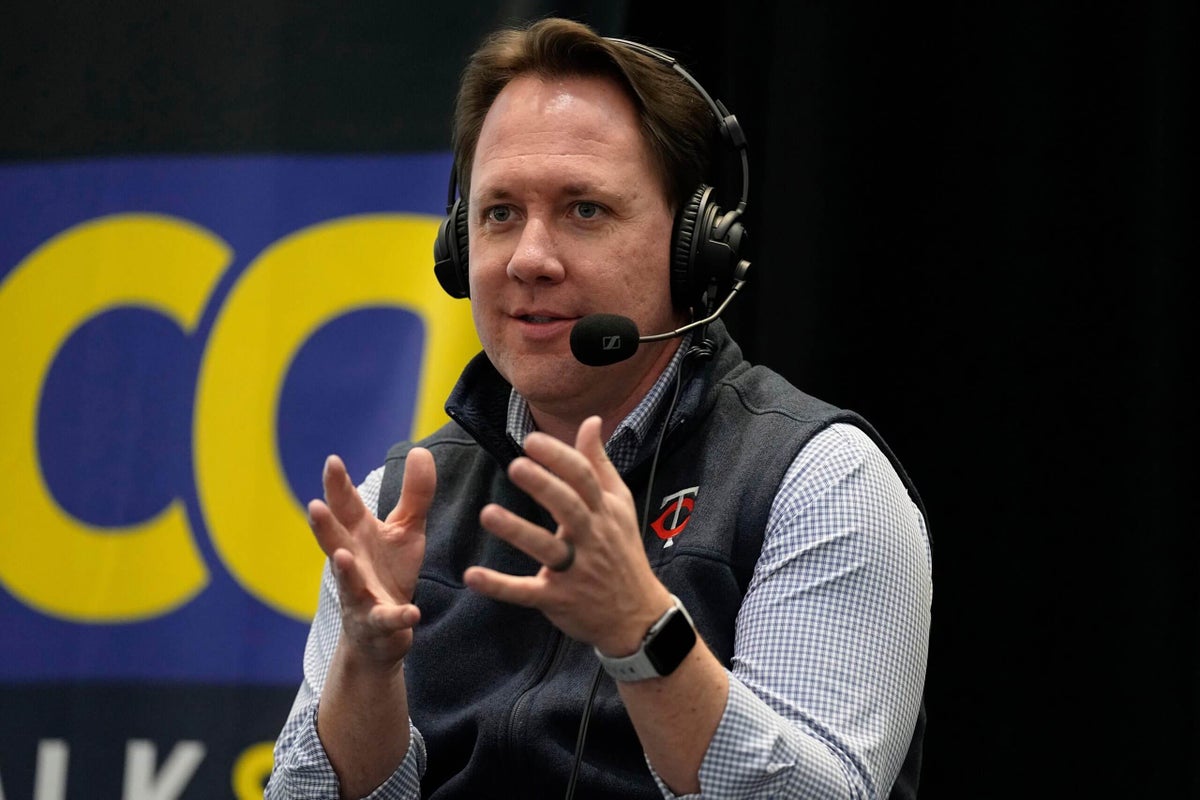
Two hours after the Minnesota Twins announced they “mutually agreed to part ways” with Derek Falvey, the team’s longtime front-office boss joined a video call for an exit interview with shocked media members. Falvey was in remarkably good spirits given the circumstances of his abrupt departure.
Falvey behaved as if a weight had been lifted off his shoulders, smiling and reminiscing and even telling the story of his awkward first interaction with the late Sid Hartman. He seemed at peace with the decision to leave the job he’s held since October 2016, and do so two weeks before spring training.
My sense is it’s not necessarily that Falvey wanted to leave the job, which expanded last year to a dual team presidency covering both baseball and business operations, but rather that he’d been pushed to a breaking point trying to do it well with shrinking resources and a new Pohlad at the helm.
Falvey used a $165 million payroll in 2023 to build a division-winning team that snapped a two-decade playoff losing streak, the reward for which was ownership infuriatingly dropping payroll by $30 million the next year, and then cutting it by another $30 million this offseason.
“It’s been a challenge at times,” Falvey said. “I’d be lying to say anything else. Everyone is going to have different limitations or challenges they have to navigate through. I do think for us over the course of certainly the last 16 or 18 months, those were ratcheted up.”
Now the Twins’ payroll is hovering around $100 million, below Metrodome-era spending levels relative to the league as a whole. That left Falvey with few appealing options to improve a 92-loss team that needs all kinds of help following last year’s trade-deadline fire sale and second-half ineptitude.
Meanwhile, the Pohlad family pushed out Joe Pohlad as the executive chair in December, replacing him with older brother Tom Pohlad, who has since repeatedly made it clear he expects the Twins to be competitive this season without actually giving the front office the resources to add impact talent.
Six months ago, Joe Pohlad approved and perhaps even encouraged a fire sale that stripped the roster of Carlos Correa and nearly the entire bullpen. And now Tom Pohlad is expecting a competitive team to be built from that rubble while simultaneously slashing payroll by another $30 million.
“Yes, our payroll is down from last year,” Tom Pohlad said. “I think there are still some investments to be made between now and Opening Day. I’d also say, at some point, I’d love to get off this payroll thing for a second. Let’s judge the success of this year on wins and losses, and on whether we’re playing meaningful baseball in September.”
There’s a big disconnect there that no doubt has been weighing on Falvey, whose strong reputation across the league suggests he’ll have no trouble landing a similarly prominent front-office role once he’s ready to take on another challenge, where the deck isn’t quite so stacked against him.
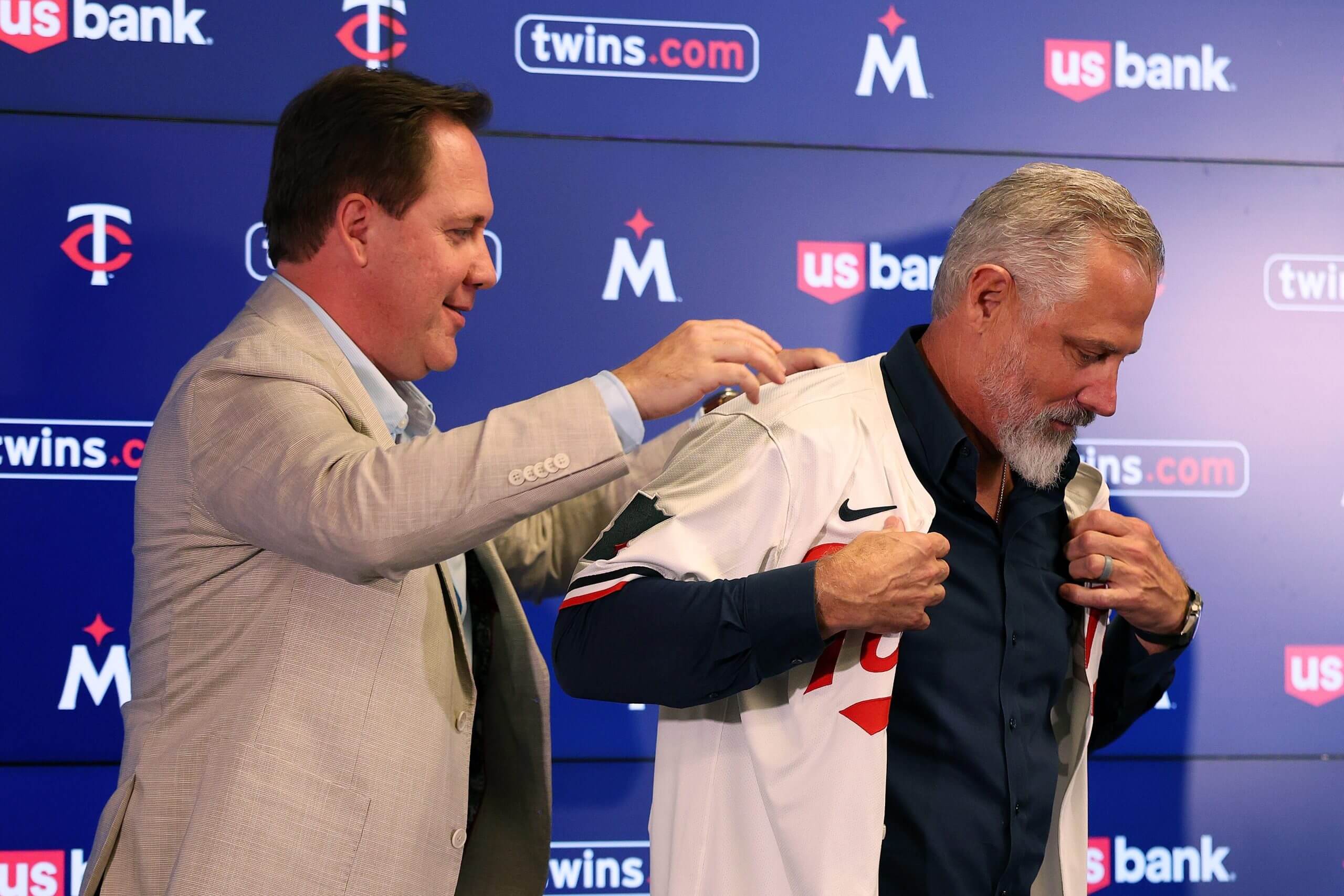
Derek Falvey introduced Derek Shelton as the Twins’ new manager less than three months ago. (David Berding / Getty Images)
“I don’t think my baseball chapters are over,” Falvey said. “Exactly what comes next, I want to actually give myself some time to think about what exists right now today. But I love this game of baseball, and I love building teams, and I love being part of a team.”
One high-ranking team official in a different MLB front office suggested to The Athletic that Falvey would be “back in the big seat somewhere” as soon as next season, a sentiment multiple Twins staffers also echoed in the wake of being blindsided by the news.
“We have to have a good season in 2026,” Pohlad said last week. “Just because I say we’re trying to build a team that can play a string of October seasons, that doesn’t mean we’re not all in on 2026. Frankly, for us to be able to build a team and build a business that can invest in a team, we have to have a strong 2026.”
If the Pohlads were serious about putting a winning team on the field this season, they would have given the front office the means to add meaningful talent that can’t be found shopping in the clearance aisle. To talk a big game about expectations and cut payroll by $30 million is detached from reality.
FanGraphs’ latest projections have the Twins at 77-85, fourth place in the American League Central. BetMGM’s over/under total for the Twins is 72 1/2 wins, third-lowest in the American League.
Falvey was far from a perfect front-office lead, whiffing on plenty of trades and signings. But no one will ever know what could have been possible had the 2023 success been followed by payroll stability, let alone by increased spending, because the Pohlads brought all momentum to a screeching halt.
“We had that series against Toronto and I’ll never forget the way the fans made me feel,” Falvey said. “Just the fact everyone could experience that in this ballpark. It was absolutely on fire. I’ll never forget that. I wish we were able to carry that forward. I wish that momentum had continued.”
Falvey was a good soldier, which is why “mutually parted ways” is officially how the nine-year relationship ended. But if the breakup happened because Falvey was simply tired of fighting this increasingly unwinnable battle, it’s yet another Pohlad-created mess in search of a new scapegoat to clean up.