
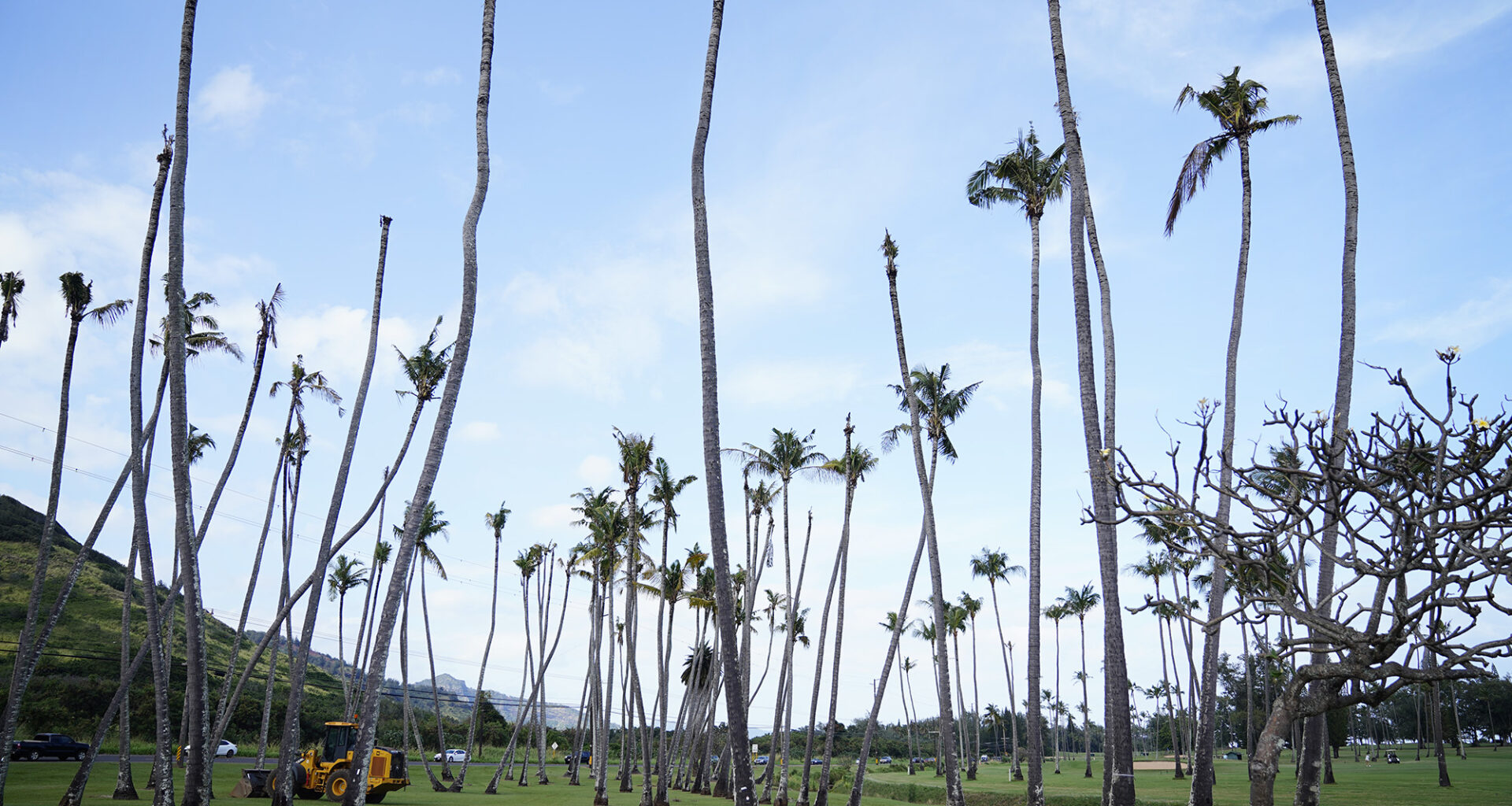
The nearly 100-year-old Wailua Municipal Golf Course is home to more than 580 coconut trees. It’s also one of Kaua‘i’s most visible sites for coconut rhinoceros beetle damage.
Located makai of Kūhiō Highway, trees that would normally have full, verdant leaves are dull and have V-shaped cuts in their fronds. Some are bare and look more like matchsticks.
It’s not for lack of trying to mitigate the invasive pest. The trees’ crowns have been sprayed with a pesticide twice, and the trunks were injected twice with a systemic pesticide for longer term protection.
The Kaua‘i Department of Parks & Recreation maintains that even though the trees still look damaged, the treatments are working. Staff have collected 1,679 fallen, dead adult beetles over the last three years.
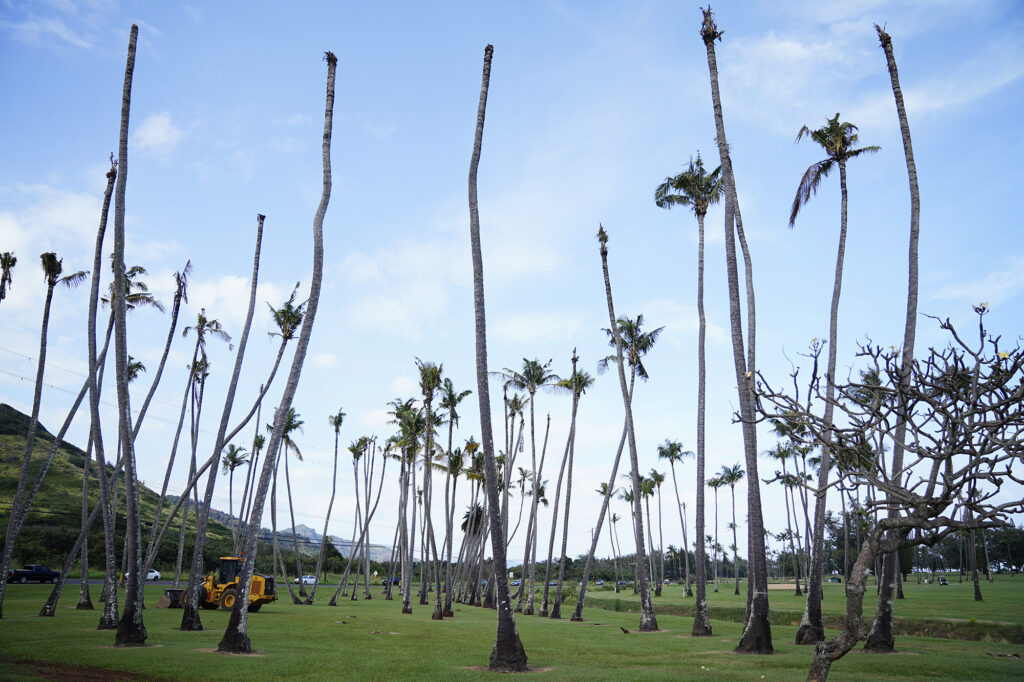 The Kaua‘i Department of Parks & Recreation injected roughly 580 coconut trees at Wailua Municipal Golf Course with a systemic pesticide in June 2024 and January 2025. Earlier treatments were applied in 2023 with drones and in partnership with the state Department of Agriculture and Biosecurity. (Kevin Fujii/Civil Beat/2026)
The most recent treatment, a systemic pesticide that travels through the trees’ vascular systems, was done in January 2025. While crown sprays kill the beetle on contact, systemic pesticides require the beetles to feed from the trees to die. The bugs eat the trees’ hearts — where new fronds develop — so it can take months for foliage damage to appear.
“The general public sees these trees that are damaged and thinks, ‘Oh my goodness they’re getting whacked,’ but in actuality, we need them to get whacked to kill (the beetles),” said Patrick Porter, county parks director.
But with the beetles continuing to spread around the island, the county is increasingly turning its attention to green waste, mulch piles and other breeding sites, where beetles spend four to six months growing from eggs to adults. A single adult female beetle can lay up to 140 eggs in her lifetime.
“The reality is if you don’t go after the larvae and you don’t go after your mulch cycle, you’re just pissing in the wind,” said Kaua‘i County Council member Fern Holland. “Because there are just going to be hundreds and hundreds of them hatching all the time, and you can’t go after all of them.”
Squirt Guns, Bait Traps And Steam
Once a week, Holland can be seen outside her Kapahi home using a water gun to spray her palm trees’ crowns with basil oil and soap. Occasionally, a friend will climb her trees to apply sand and salt.
While she knows her methods won’t actually kill the beetle, they might still prevent it from damaging her beloved trees, several of which were planted by her late boyfriend.
But she’s starting to lose that fight. She first noticed CRB-damaged palms in her neighborhood over the summer.
“In biosecurity crises such as this where there’s, like, not a lot of ways to kill them, I’m like, ‘Am I just scaring them into my neighbor’s yard?’” she said.
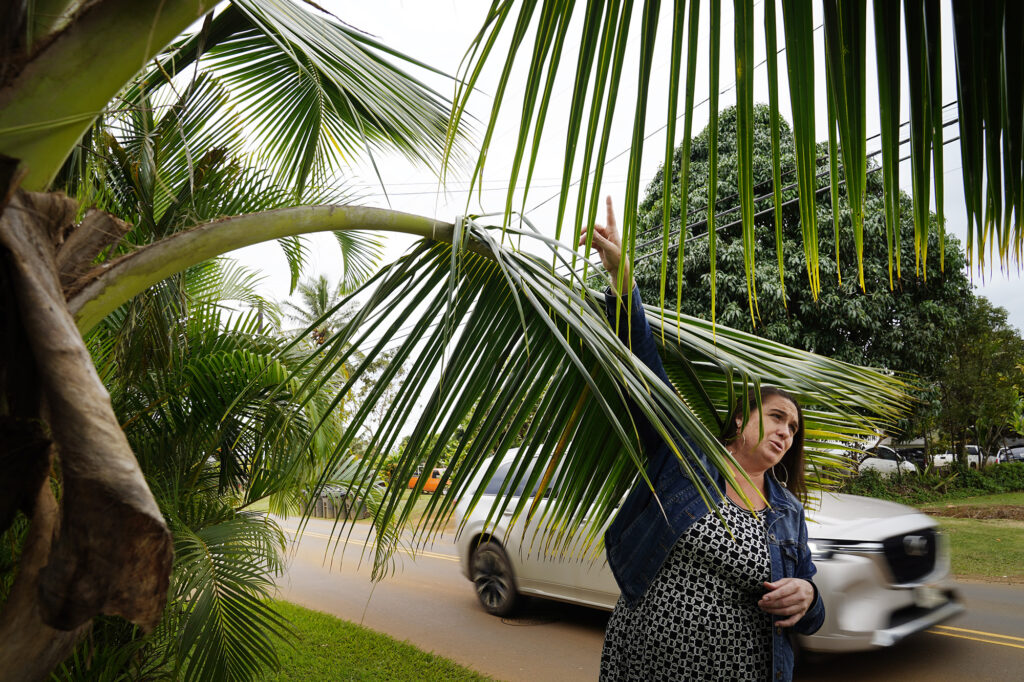 Kauaʻi County Council member Fern Holland shows the damage coconut rhinoceros beetles have done to her Samoan coconut tree. (Kevin Fujii/Civil Beat/2026)
Holland, chair of the council’s Parks & Recreation/Transportation Committee, has been working with the county and others to address CRB. Currently, their efforts focus on bait traps at the Wailua Municipal Golf Course, a popular course supported by taxpayer dollars, and at some of the county’s refuse transfer stations to attract the beetles to designated green waste piles that will then be regularly steamed.
The County Council recently accepted on behalf of the parks department a donation of in-kind services from Mr. Lance’s Steam — worth $11,790 — to steam treat eight green waste piles totaling 262 cubic yards at the Wailua course.
Porter anticipates that the parks department will later pursue a long-term contract for regular steaming of its green waste piles.
Static, coned-off green waste piles will be set up at the Līhu‘e and Hanapēpē transfer stations. Keola Aki, solid waste manager, said the Solid Waste Division will need to first get a permit from the state to do this since the designated piles will sit at the facilities. Currently, material is hauled out of those facilities every month.
Kauaʻi Reader Survey
Have you experienced trash pickup delays?
Delays have recently become more common. We want to hear how this has affected your household.
(We won’t share your name without getting your permission first).
Last May, the County Council allocated $100,000 for invasive species and another $100,000 for CRB. It was the first time the county designated funds specifically to address the beetle.
Niki Kunioka-Volz, economic development specialist with the Kaua‘i Office of Economic Development, said none of that funding has been spent yet. They’re considering using it to help get the breeding site at the Wailua golf course under control, such as by purchasing an air curtain burner, a fan-powered incinerator of sorts to dispose of green waste. The burner could also be a tool for the broader community.
The county, she said, needs to get a handle on the golf course to help slow the beetles’ spread on the Eastside.
Holland said she plans to pursue more county funding for CRB this year. She said the county’s ability to respond to CRB is limited because biosecurity is a state-level responsibility, adding that it also needs more support than it’s been getting.
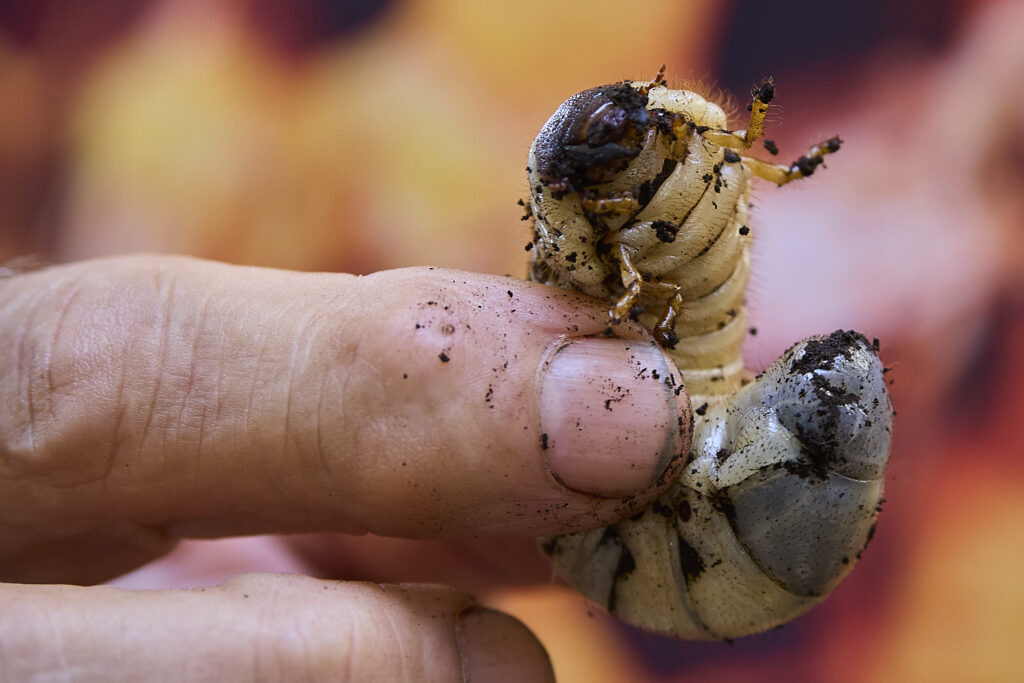 Coconut Rhinoceros Beetle was first detected on Kaua‘I in May 2023. Larvae can grow up to 3” and crawl on their side. (David Croxford/Civil Beat/2025)
In 2024, the county received $200,000 from the state Department of Agriculture. That money was used for a CRB outreach campaign, training CRB detection dogs and distributing deterrent materials. State funding was also expected to help the county purchase a curtain burner, but that plan fell through.
Earlier this month, state legislators threatened to cut invasive species funding from the newly expanded Hawai‘i Department of Agriculture and Biosecurity over its slow progress in curbing threats such as coconut rhinoceros beetles.
“I’d like to see the pressure put on them to release the funds to the counties,” Holland said.
‘They’re Essentially Everywhere Now’
Some of the Wailua golf course’s trees have died, though Porter didn’t know how many. Some may have just been too damaged by the time they were treated; others may have already been in declining health.
Porter said he doesn’t think systemic injections are a long-term solution because each shot creates a wound in the trunk.
Additionally, while the department was able to use its in-house chemical operator, he said each round of injections for the 582 trees costs about $30,000 for equipment and chemicals.
Some community members oppose the use of chemical pesticides because they can harm pollinators and the surrounding environment. Coconut trees, or niu, are also a culturally significant tree.
Indrajit Gunasekara, co-founder of Niu Now, a community group focused on saving old Hawaiian coconut genetic diversity, questioned whether the Wailua golf course treatments were working. In November, he saw emerging fronds with signs of new CRB attacks. He also saw over 400 trees with their flowers still attached. Flowers are supposed to be removed from injected trees.
Gunasekara had conducted a field survey of 1,200 coconut trees across 40 randomly assigned blocks of 30 trees between Kekaha to Hā‘ena on Nov. 13 and 14. His goal was to identify how far CRB had spread and the damage it was causing.
Heavy CRB damage was observed in Līhu‘e-Wailua, Wailua Homesteads and Kalāheo, and it appeared the beetle had been in those areas for longer than a year, based on the age of damaged fronds. Hanapēpē and Anahola had more minor damage, and beetles appeared to have been present in those areas for three months.
Gunasekara said one of the main findings was that there’s still hope, and coordinated community efforts can slow or reverse the beetles’ spread. He emphasized that his survey was very limited and meant to spark discussions.
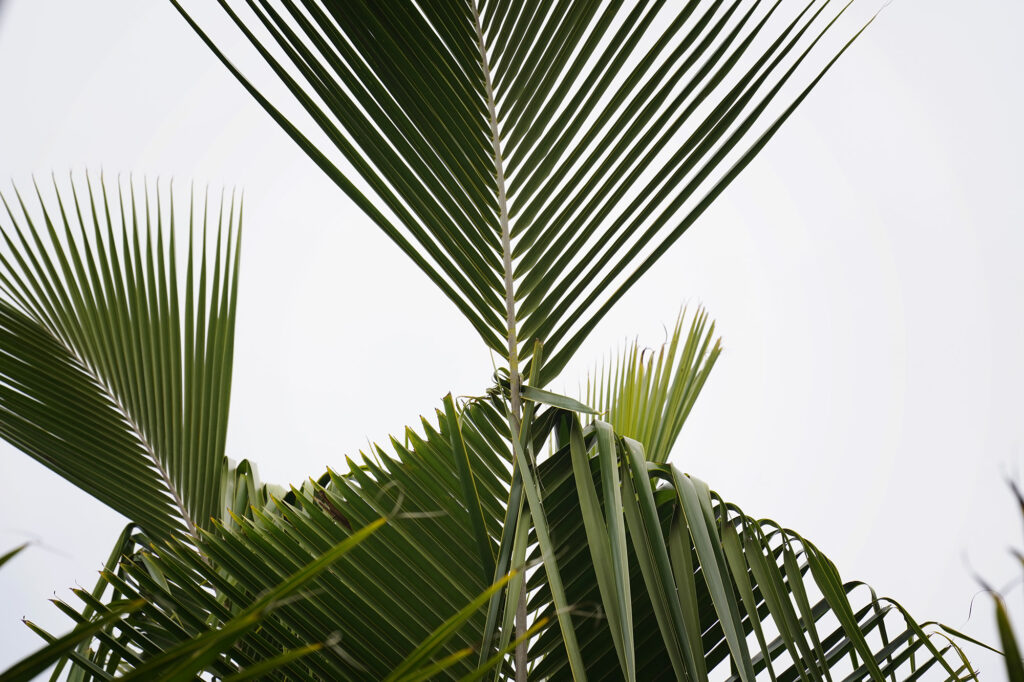 A sign of coconut rhinoceros beetle damage is evident in Kauaʻi County Council member Fern Holland’s tree. (Kevin Fujii/Civil Beat/2026)
Hanapēpē resident Chris Ka‘iakapu said he hopes the findings encourage the broader community to get involved in eliminating CRB and plant more coconut groves.
He’d also like to see more regulations around stockpiling green waste and more agricultural burning of green waste. According to the state Department of Health, there are two current Kaua‘i applications for agricultural burning specifically related to CRB. Approvals are pending site visits.
Ka‘iakapu has been using salt and sand to deter CRB from his own coconut trees, as well as those of others in the community.
“We know they’re essentially everywhere now,” he said. “I just had a detection in Kekaha, in Pakalā, and people aren’t really aware.”
He’s part of a community effort led by a group called E Ola Kākou Hawai‘i to map CRB feeding and breeding sites, damage, and entrapment and treatment measures. The project is funded by a county innovation grant. He said the efforts will build on Gunasekara’s survey findings.
“It’s going to take the community,” he said. “We need as much help as we can get to fight this pest.”
A Longer Battle
The National Tropical Botanical Garden’s south shore gardens are waging their own fight against the beetle.
Tobias Koehler, director of the McBryde and Allerton gardens, said their priority is protecting loulu palm. The roughly 700-tree collection comprises all but one of the 27 loulu species found on Earth, including 22 endemic to Hawai‘i. For some species, the garden has more trees than exist in the wild.
“Every single one of these loulu palms, basically, is priceless, and we can’t afford to lose any of them at all,” he said.
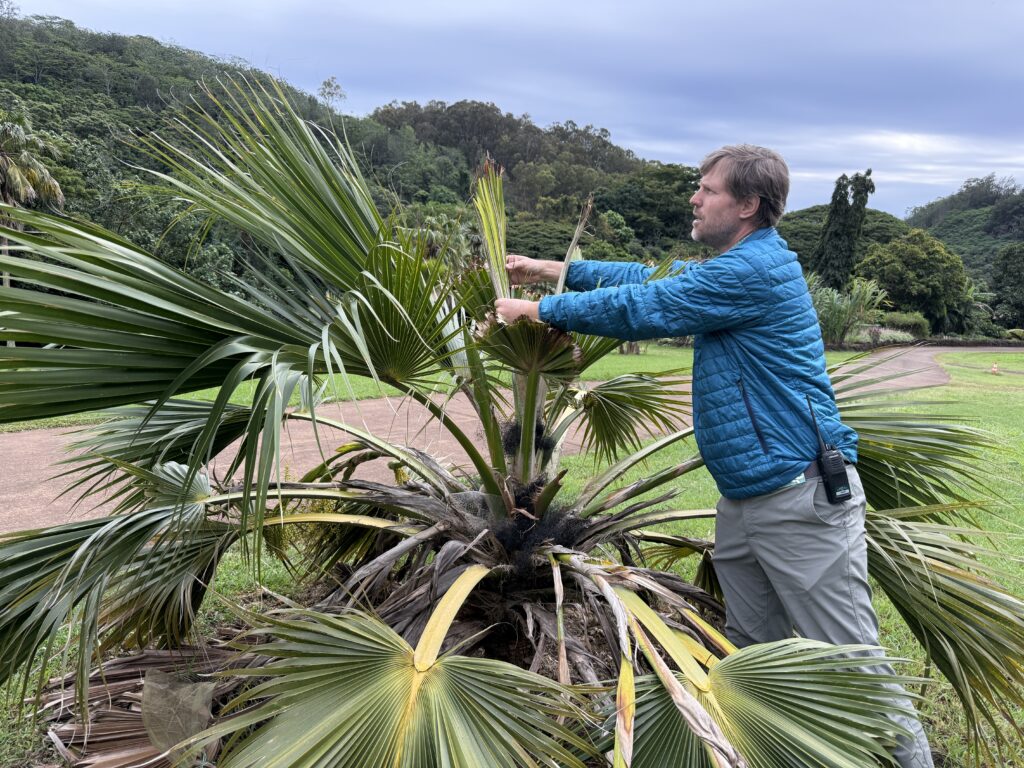 Tobias Koehler, director of National Tropical Botanical Garden’s McBryde and Allerton gardens, points to a loulu palm collected from Moloka‘i that is recovering from coconut rhinoceros beetle damage. (Noelle Fujii-Oride/Civil Beat/2026)
About 5% of the garden’s loulu have shown signs of CRB damage, for which staff is constantly on the lookout. One of the challenges is that loulu are more vulnerable than coconut trees to beetle attacks due to their smaller crown sizes, which range from 4 to 10 inches in diameter, making it easier for beetles to reach the growing tip. Loulu are also more susceptible to secondary fungal infections.
The garden uses a four-pronged approach to protect its loulu. Staff apply systemic pesticides, crown treatments and fungicides, and net the crowns. That effort costs about $350,000 to $400,000, including labor — that’s over $500 per tree.
CRB Resources for Kaua‘i
“That is an insane level of effort going into 700 plus palms,” Koehler said.
The NTBG, because of its conservation focus, is exempt from having to remove flowers from treated trees. That’s so the garden can collect the fruit to share with other conservation partners and ensure that the species continue.
“We’re pacing ourselves for a five- to 10-year battle before something like a biocontrol becomes available and is effective,” he said.
The Kaua‘i Invasive Species Committee also is preparing to step up its CRB efforts. It’s hiring a full-time CRB technician who will help the public identify the beetles and larvae, conduct field surveys, and provide CRB management training and technical assistance.
Related: If your trash pickup on Kauaʻi has been delayed, take our two-minute survey below. (Can’t see the form? Try here.)
Loading…
Civil Beat’s reporting on Kauaʻi is supported in part by a grant from the G. N. Wilcox Trust; coverage of climate change and the environment is supported by The Healy Foundation, the Marisla Fund of the Hawai‘i Community Foundation and the Frost Family Foundation.

Sign up for our FREE morning newsletter and face each day more informed.
Sign Up
Sorry. That’s an invalid e-mail.
Thanks! We’ll send you a confirmation e-mail shortly.