
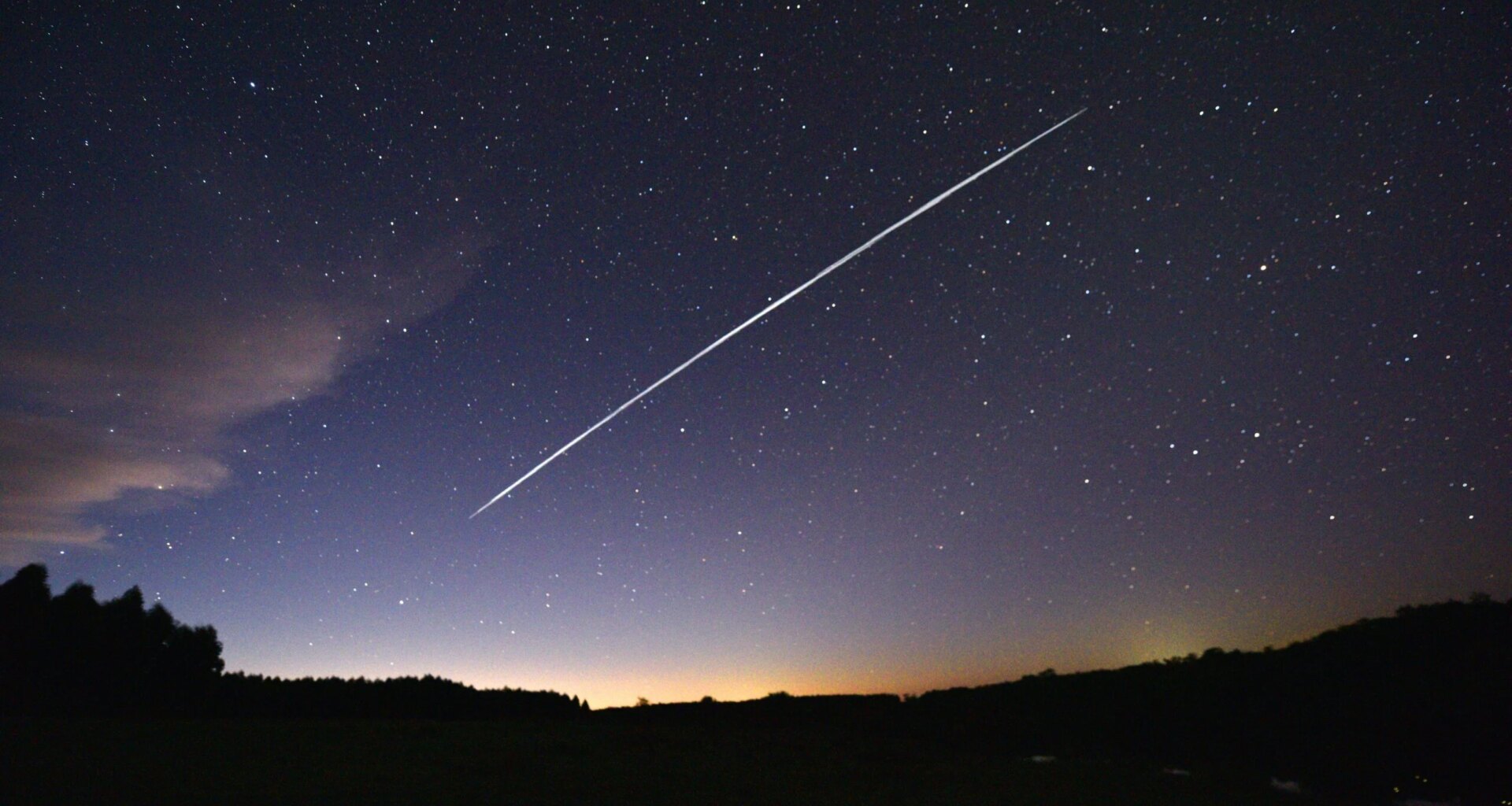
WASHINGTON — SpaceX today unveiled an online tool, called Stargaze, for tracking space objects and warning of potential on-orbit collisions — with a promise to provide the system’s space situational awareness (SSA) data free of charge to other satellite operators.
SpaceX recently faced a collision scare in December when a Chinese satellite nearby one of its Starlink communication birds made an unannounced maneuver. That and other near misses over the past year has prompted the company to lower some 4,400 Starlinks to about 480 kilometers where there is less congestion, in part because dead satellites and other debris falls out of orbit faster due to the stronger gravitational pull of the Earth.
Stargaze is generating SSA data based on the use by the company’s nearly 9,600 Starlink satellites to orient themselves, and “significantly enhances the safety and sustainability of satellite operations in low Earth orbit (LEO),” according to SpaceX’s website.
“The system autonomously detects observations of orbiting objects [which] are then aggregated to generate accurate orbit estimates and predictions of position and velocity for all detected objects in near real-time,” the company explains.
“These predictions integrate into a space-traffic management platform that identifies potential close approaches between objects in space and generates Conjunction Data Messages (CDMs). To fully realize the utility of such frequent observations, SpaceX developed this system to provide conjunction screening results within minutes, compared to the current industry standard of several hours.”
SpaceX will provide those CDMs to those other operators who share data about the whereabouts and movements of their own satellites, according to the company announcement.
“By providing this ephemeris sharing and conjunction screening service free of charge, we hope to motivate operators to take similar steps towards ephemeris sharing and safe flight,” the company said.
Given Elon Musk’s deep pockets, and the fact that SpaceX is one of, if not the most dominant player in the US space market, the company’s move to into the commercial SSA arena may make some strong waves — both for other space tracking firms, and the years-long effort by the Department of Commerce to develop a civil space tracking service designed to free the Defense Department to focus its space monitoring capabilities on potential on-orbit threats from adversaries.
The Trump administration in its fiscal 2026 budget request sought to kill DoC’s Traffic Coordination System for Space (TraCSS) program, arguing that private, for-profit companies were more than ready to take on the job of tracking space objects and providing warnings of potential collisions to operators using the Space-Track.org database provided for free by DoD.
“This has potential consequences to the nascent commercial SSA community and TraCCS,” one former government expert said.
On the other hand, several experts said that Stargaze as currently configured isn’t technically capable of providing a one-stop SSA shop for space operators.
For instance, Stargaze will provide SSA data only relevant to operators with satellites in “low LEO,” because it cannot monitor other orbital regimes, one current government expert told Breaking Defense today. “Their star trackers aren’t telescopes.”
Richard DalBello, former head of the Office of Space Commerce responsible for TraCCS, welcomed SpaceX’s move as a contribution to space safety and security, but cautioned that a civil SSA system is still needed.
“TraCSS still matters. Civil space traffic coordination needs a neutral, standards-based backbone that isn’t tied to any single operator’s platform, incentives, or service terms. A publicly stewarded, open-architecture layer is what builds interoperability, trust, and durability across the whole ecosystem — and what the U.S. government can stand behind with allies and partners,” he wrote in a post on LinkedIn.
SpaceX did not respond to a request for comment.