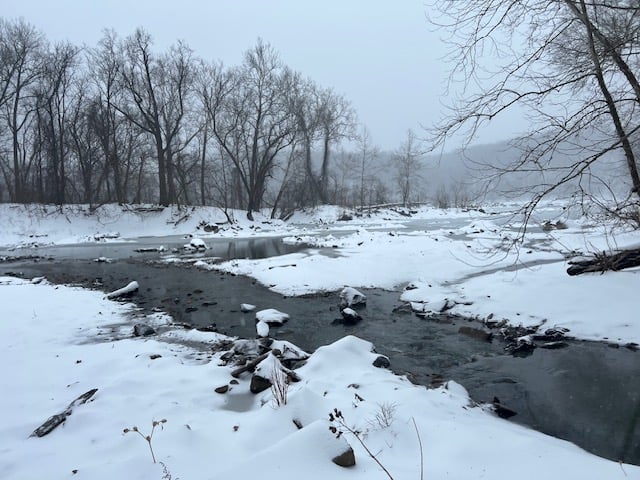
Photograph by Burton Gray.
Unless you’ve been living under a rock (or a cascade of “snowcrete,” which might actually be plausible) for the past two weeks, you have probably heard that a deluge of poop water has been wending its way through the Potomac River since January 19. That’s when a 72-inch section of the Potomac Interceptor pipe, which carries wastewater from Fairfax and Loudoun counties to the Blue Plains Advanced Water Treatment Plant in Southwest DC, collapsed and began spewing raw sewage into the river—as much as 40 million gallons a day. Fortunately, Thursday marked the first day that no sewer overflow journeyed out of the broken pipe segment and into the waterways, which overseeing agency DC Water says was a major step in the containment process.
Still, an estimated 300 million gallons of feces-infested water had already entered the Potomac as of Tuesday, according to a report by the nonprofit Potomac Riverkeeper Network. The group has also been performing independent testing of river water, which so far has revealed dangerously high E. coli levels at sites throughout the region—including contamination roughly 12,000 times the safe limit for human contact just downstream of the break near Cabin John. Four miles downstream of the leak, at Fletchers Cove in DC, riverkeepers measured E.coli levels that were still 60 times higher than what’s considered safe.
“We are aware of testing done by the Potomac Riverkeeper that found high levels of bacteria in the waterway near the spill, as would be expected,” the Maryland Department of the Environment told Washingtonian in a statement Friday. “DC Water has indicated that it will do water testing in connection with its cleanup of the spill. We also plan to do water monitoring and will stay engaged in the long term to ensure that the spill and its environmental impacts are remediated.”
One major silver lining of this literal shitshow: Our local drinking water supply should not be affected. “The overflow is downstream of the Washington Aqueduct’s intakes for drinking water at Great Falls,” DC Water spokesperson Sherri Lewis told Washingtonian in a statement Tuesday. “Additionally, the Potomac Interceptor is a sanitary sewer line; and the wastewater system and the drinking water system are completely separate.” But a raw sewage spill of this magnitude still presents risks to public health and wildlife. Here’s what to keep in mind, even now that the leak is largely contained.
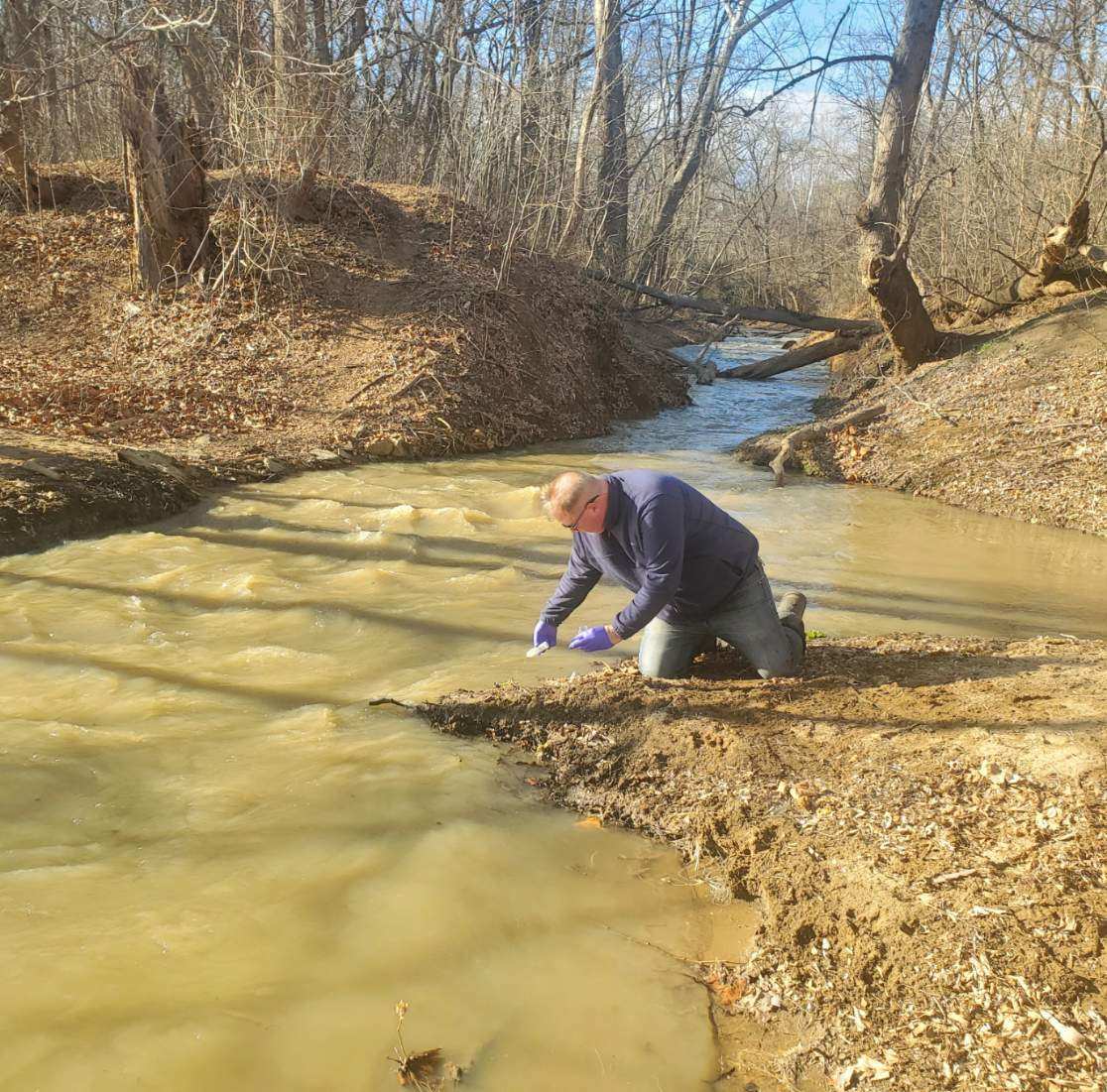 Dean Naujoks of the Potomac Riverkeeper Network tests contaminated water for pathogens. Photograph courtesy of the Potomac Riverkeeper Network.
What precautions should you take around the river?
Though gratitude is hard to source from such muddied waters, experts are thankful that this ordeal is happening now and not during the spring or summer. “We’re lucky the sewage spill happened when both the recreational activities are low, as well as the biological and animal activities,” says Hedrick Belin, president of the Potomac Conservancy. “It’d be a different conversation, I think, if this were heading into July 4 weekend.” But even if you’re not planning to take your canoe for a spin in the city’s Arctic temperatures any time soon, there are a few public health concerns to keep in mind. Lest we forget: “Everything that you find in raw sewage—bacteria, but also pathogens, parasites—are in the Potomac River now,” says Dean Naujoks of the Potomac Riverkeeper Network.
Maryland’s Department of the Environment has closed an upper segment of the river in Charles County due to concerns about shellfish harvesting. “We used computer simulations to figure out a ‘worst-case’ scenario on how the pollution could travel and be diluted to determine the closure area,” which “includes the Potomac River from Charles County and bordering Virginia areas, extending from the Port Tobacco River region down to the U.S. Route 301 bridge,” the department told Washingtonian in its statement. The agency says it has “no evidence shellfish outside of the defined emergency closure area have been affected” at this time, but they plan to collect water samples in shellfish harvesting areas next week.
“The actual worst exposure scenario down the river and toward the bay is shellfish,” says Lynn Goldman, a professor of environmental and occupational health at George Washington University’s Milken Institute School of Public Health. Because shellfish are filter-feeders, they take in a lot of water. “Those advisories, typically after a sewage spill like this, have to go on for three weeks, because that’s how long it takes to clear these viruses—mostly—out of the shellfish.” The Potomac Riverkeeper Network would like to see the DC government issue a similar shellfish advisory. “We have not made any plans as yet for that, but we do support our regional partners in their messaging, so it is possible we will do so,” the DC Department of Environment and Environment told Washingtonian in a statement Friday. (Shellfish growing areas on the Virginia side of the Potomac, riverkeepers say, are not currently affected by the spill.)
“The great thing, in terms of most ways you can be exposed to the the waste that was emitted, is that there is dilution—and that is really helpful when it comes to people who just have contact with the water, are floating on the water, swimming in the water, their dogs are in the water,” Goldman says. “If you’re not super close to a spill, there’s not a very high concentration of the pathogens that certainly are in the fecal waste.”
And surely nobody is planning to go swimming in the river anytime soon, which you can’t really do anyway. Actually, wait: In a nearly poetic display of irony, the Chesapeake Climate Action Network’s annual Polar Bear Plunge at National Harbor is scheduled for February 21. It was originally booked for February 7; organizers decided to delay it “out of an abundance of caution,” a CCAN spokesperson tells Washingtonian. Should you partake? Stay abreast of local testing developments. “If I were thinking about an event where a lot of people are in the water, I’d be testing the water on any day, much less after a spill like this,” Goldman says. “Because any day there can be overflows—even if they’re not big ones, there could be smaller ones that are even closer to that location and that could have more risk to the people in that stretch of the river because they’re closer to it.”
As of now, it should be safe to stand on land within the vicinity of most of the Potomac. “If I were walking my dog by the river right now, unless I were right there by where the break occurred, where there might still be leakage, I would not be so concerned,” Goldman says. “And I’d be quick to say that any day when we have a heavy rain, there are areas that have overflows around not only the Potomac, but also Rock Creek and other other waterways.”
What’s the risk to local wildlife?
Most of the fish swimming in the most contaminated waters have probably died, Belin says. “But as the sewage plume moves downstream and gets more diluted—it’s not covering the whole width of the river in some places yet—it’s certainly unclear what this might mean.” The Potomac Conservancy releases a report card every couple of years evaluating the environmental health of the river; since 2020, the river’s shad population has maintained an “A” grade. That’s a big deal, since the migratory fish have been steadily making a comeback since the Interstate Commission on the Potomac River Basin made moves in the 1990s to refresh a dwindling population caused by water pollution and dam-building in the 1970s. “There’s been a lot of hard work to get it to that point,” Belin says. “Hopefully, this sewage spill clears up and is gone by the time they start running in the spring, because otherwise that’ll have both recreational and economic impacts.”
At the end of the day, “it’s pretty unprecedented, where there’s been a massive spill of this size and then [part of it] gets kind of trapped and locked in ice,” Naujoks says. Experts are not sure exactly what will happen when that ice melts.
When will the water stop being poopy?
The natural flow of the river will eventually carry the sewage out of the waterway itself, according to Belin. “If you think about shutting off the faucet, if you will, of sewage into the river—at that point, it becomes, ‘Well, how long is it going to take for it to move down the river, and how is it going to mix?’ ” He estimates that approximately two months from now, in March or April, “hopefully this sewage plume [will have] completely dispersed.”
Unfortunately, and I hate to report this, there have been some spots along the C&O Canal where sewage has overflowed onto the land. “When [the water] sort of settles, there’s a good chance—on the shorelines downstream and then in the basin of the canal—there could be manure,” he adds. “Keep in mind, that definitely has to be cleaned up, but it’s really cold out.” That means the bacteria living in this shipwrecked poop will likely die much more quickly than it would have during warmer weather, since it thrives in human and animal body-adjacent temperatures.
According to Belin, this spill “should be seen as a wake-up call about what it’s going to take to keep this river clean.” The Potomac Interceptor was built back in the 1960s, and experts think it might be time to give it a makeover. “All infrastructure has a lifespan,” Belin adds. “So we certainly want to do everything we can to make sure there are no other ruptures like this somewhere else on the Potomac Interceptor going forward.”