
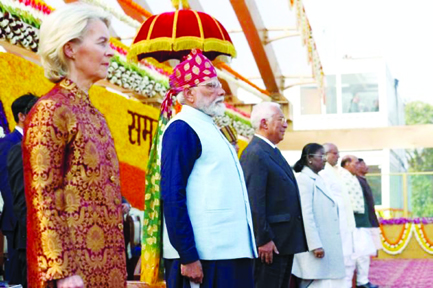
NEW DELHI (TIP): India marked its 77th Republic Day on January 26 with a spectacular parade along Kartavya Path, blending military strength, rich cultural heritage and diplomatic symbolism. The ceremonial event unfolded before an audience of nearly 77,000 people, including the chief guests—European Commission President Ursula von der Leyen and European Council President Antonio Costa—underscoring India’s expanding global partnerships.
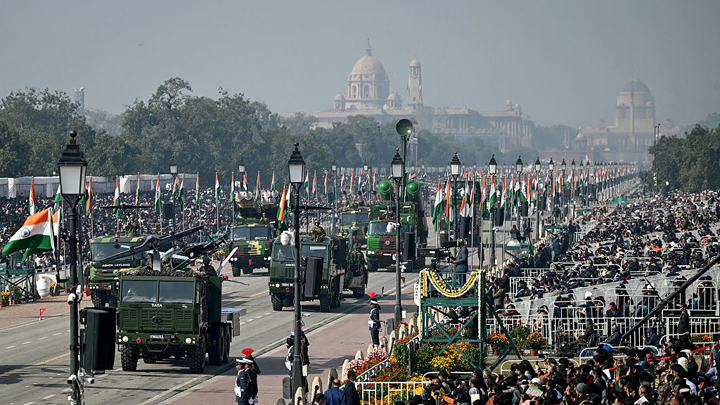 Display of military power
As in previous years, the parade was a powerful expression of national pride, with special emphasis this time on Operation Sindoor, India’s targeted military action against terror infrastructure in Pakistan following last year’s deadly attack in Pahalgam. The operation featured prominently through a tri-services tableau and a distinctive arrowhead formation during the flypast, highlighting jointness among the armed forces.
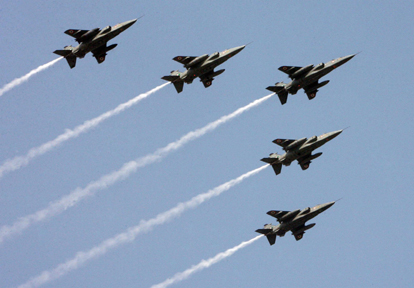 A Fly past by Indian Air Force aircraft.
The theme of the cultural segment revolved around the 150th anniversary of “Vande Mataram,” India’s national song. About 2,500 artists from across the country performed a meticulously choreographed dance presentation, fusing folk and classical traditions to celebrate the enduring legacy of the song penned by Bankim Chandra Chattopadhyay in 1875. The musical composition for the performance was created by Oscar-winning composer M.M. Keeravani and extended beyond the customary two stanzas.
Prime Minister Narendra Modi, in a message on social media platform X, said the Republic Day parade showcased India’s robust security apparatus, technological capabilities and commitment to national defense, while also celebrating the country’s cultural diversity and unity.
The celebrations began with Prime Minister Modi paying homage to the fallen soldiers at the National War Memorial. Soon after, President Droupadi Murmu arrived at Kartavya Path with the chief guests in a ceremonial carriage drawn by six horses. The national flag was unfurled, followed by a 21-gun salute fired by the Army’s 172 Field Regiment using 105 mm light field guns.
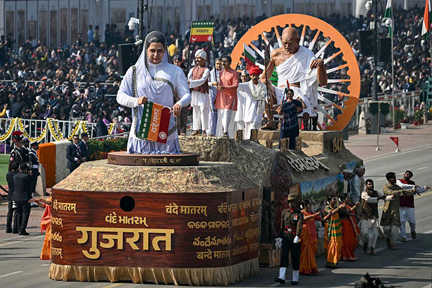 The Vande Mataram tableau featured the Father of the Indian Nation, Mahatma Gandhi.
Before the parade commenced, President Murmu conferred the Ashoka Chakra, India’s highest peacetime gallantry award, on astronaut and Indian Air Force officer Group Captain Shubhanshu Shukla for his role as pilot in last year’s historic Axiom Mission to the International Space Station.
The military segment of the parade highlighted India’s growing emphasis on modern warfare and indigenous capabilities. Unmanned systems took Centre stage for the first time, reflecting their increasing role in surveillance, reconnaissance and precision strikes, particularly in the backdrop of Operation Sindoor. The parade adopted a phased battle array format, demonstrating how various platforms are deployed in real combat scenarios.
Among the systems on display were new additions such as the Suryastra universal rocket launcher and a long-range anti-ship hypersonic missile capable of travelling at speeds exceeding Mach 5. Other showcased equipment included BrahMos and Akash missile systems, T-90 and Arjun tanks, Dhanush and ATAGS artillery guns, BMP-II infantry combat vehicles, and a range of all-terrain and light strike vehicles.
In a first, the ceremonial procession also included double-humped Bactrian camels, Zanskar ponies, black kites used for surveillance and anti-drone roles, and five indigenous dog breeds—symbolizing both tradition and innovation within the armed forces.
The flypast featured 29 aircraft and was conducted in two phases—during the parade and at its conclusion—aligning with the Indian Air Force’s role in the battle order. A special formation named “Sindoor”, comprising Rafale, MiG-29, Sukhoi-30 and Jaguar fighter jets, paid tribute to the Air Force’s contribution during Operation Sindoor.
The tri-services tableau titled “Operation Sindoor: Victory Through Jointness” depicted coordinated air strikes, naval maneuvers, and ground offensives, reflecting India’s evolving doctrine of integrated military command.
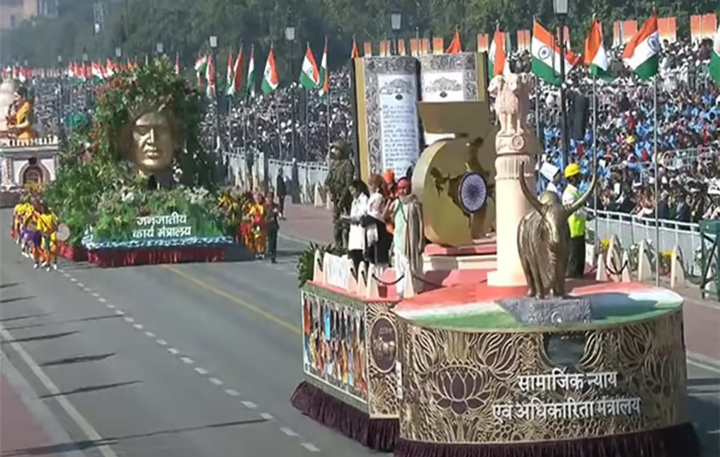 The tableaus displayed India’s culture.
Adding a strong diplomatic dimension to the celebrations was the presence of a large delegation from the European Union. A small EU military contingent also participated in the parade, carrying flags associated with the bloc’s naval missions. Prime Minister Modi described the visit as a reflection of the growing India–EU partnership and shared democratic values, with the engagement expected to give momentum to cooperation across multiple sectors, including trade.
Visually enriching Kartavya Path were reproductions of rare paintings created in 1923 by artist Tejendra Kumar Mitra, illustrating verses of Vande Mataram. Several state and ministry tableaux also echoed the national song, aligning with the parade’s overarching theme, “Swatantrata Ka Mantra – Vande Mataram.”
The celebrations came amid renewed public discourse on the historical and political significance of Vande Mataram, a debate that had resonated in Parliament in the past year. Against that backdrop, the Republic Day parade stood as a reaffirmation of India’s democratic ideals, cultural continuity, and strategic resolve on the world stage.