
The Athletic has live coverage of the 2026 Australian Open women’s singles final between Aryna Sabalenka and Elena Rybakina.
Carlos Alcaraz continued his quest to complete the career Grand Slam by beating Alexander Zverev in the longest Australian Open semifinal in history Friday, but not without suffering along the way.
After going two sets up, Alcaraz was closing in on the final before pulling up midway through the third set with what looked like muscle cramps. Alcaraz’s movement was limited thereafter, handing Zverev a route back into the match and prompting a five-set thriller with three tiebreaks.
But why was Alcaraz receiving treatment for cramps possibly controversial? And why did that treatment — at least initially — leave Zverev so enraged?
What happened in Melbourne?
Alcaraz was two sets up and, despite twice vomiting into a towel at the change of ends in the third set, apparently in control. But at 4-4 in that set, the 22-year-old Spaniard winced after stretching for a volley.
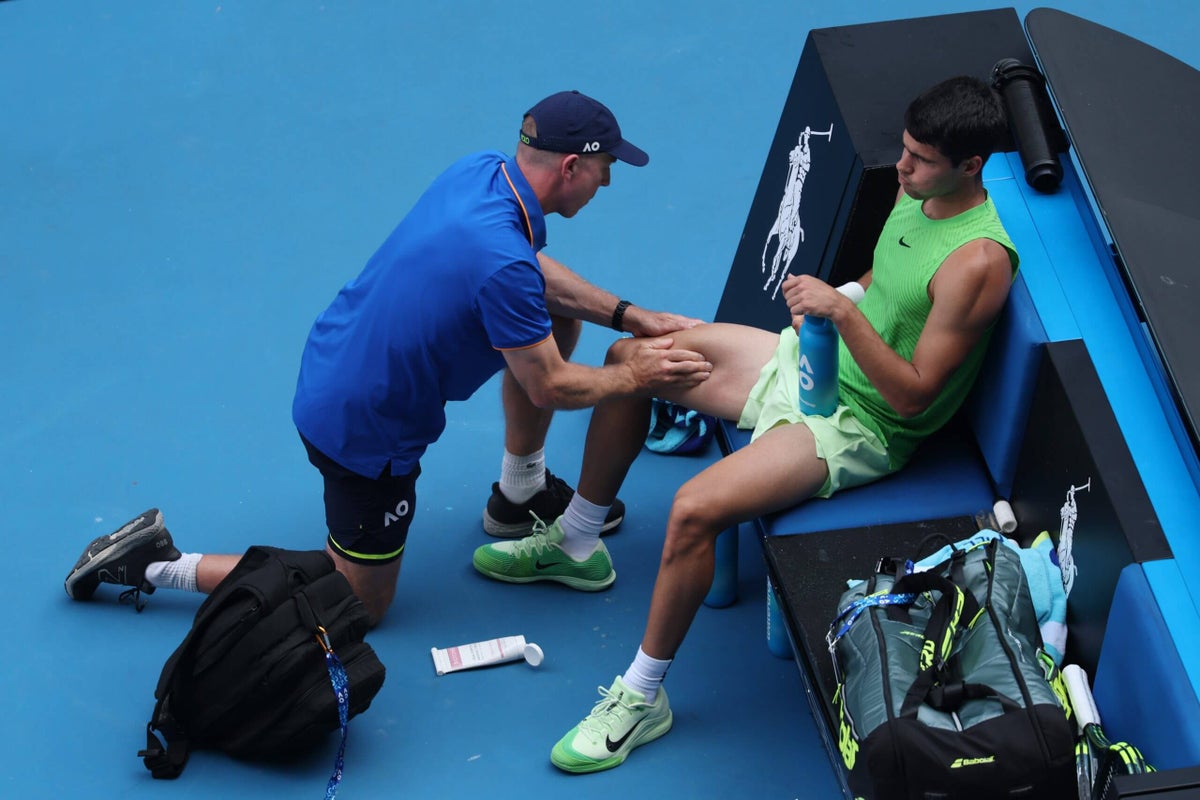
He saw the game out, holding for a 5-4 lead despite not being able to move properly, then sat down for the changeover. He then started to receive medical attention for what looked like a combination of an upper-leg injury and cramp, before the chair umpire formally called a medical timeout.
Zverev exploded in anger believing that Alcaraz was suffering only from cramp, and so should not have received a full timeout.
“He has cramps. What else should it be? This is absolute b——. That is unbelievable. That can not be. You can not be serious. You protect the both of them. It’s unbelievable,” Zverev said in German to the supervisor.
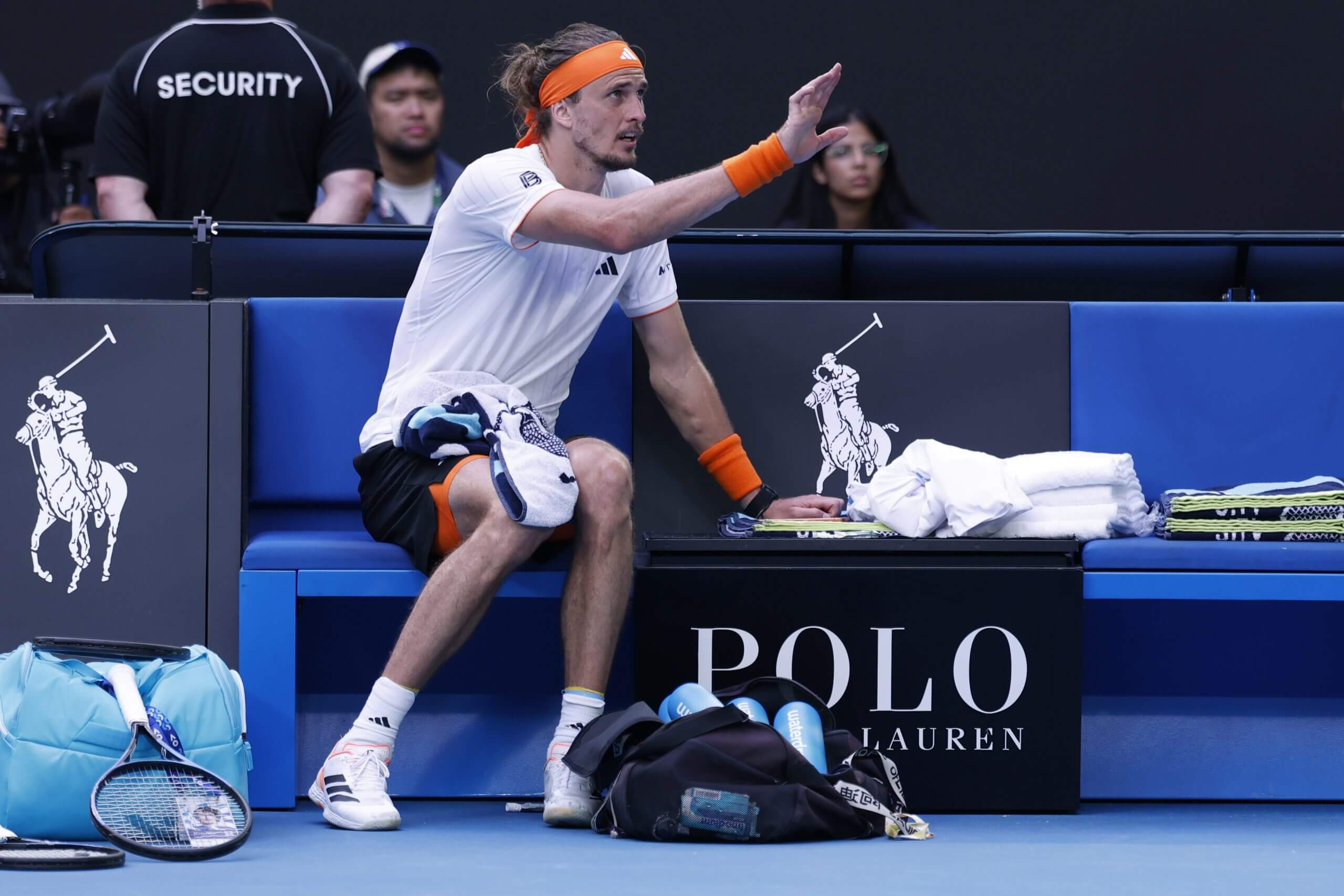
Alexander Zverev expresses his frustration to the umpire (Darrian Traynor/Getty Images)
What does the Grand Slam Rulebook say about treatment for cramps?
Suffering from cramp is not grounds for a medical timeout. Players are instead allowed to treat cramps at three changeovers maximum, each of which last for a 60-second sitdown.
The rulebook states: “A player may receive treatment for muscle cramping only during the time allotted for change of ends and/or set breaks. Players may not receive a medical timeout for muscle cramping. In cases where there is doubt about whether the player suffers from an acute medical condition, non-acute medical condition inclusive of muscle cramping, or non-treatable medical condition, the decision of the sports physiotherapist, in conjunction with the Tournament Doctor, if appropriate, is final.
“If the sports physiotherapist believes that the player has heat illness, and if muscle cramping is one of the manifestations of heat illness, then the muscle cramping may only be treated as part of the recommended treatment by the Sports Physiotherapist for the heat illness condition.”
However, even if a player appears to be suffering from cramps, they might have suffered a muscular injury — as Alcaraz feared after pulling up.
The handbook goes on to add: “A player who has stopped play by claiming an acute medical condition but is determined by the sports physiotherapist and/or tournament doctor to have muscle cramping, shall be ordered by the Chair Umpire to resume play immediately.”
In his news conference, Alcaraz said that the pain he was experiencing led him to believe that he had a muscle injury. He told the trainer this, who deemed that he could receive a medical timeout as a result. It appears that Alcaraz was wrong, as he said in the same news conference that he had not suffered an injury.
But the sensations at the time were not false. Indeed, the physio who treated Alcaraz did not determine him to only have been cramping.
“In the beginning it was on a specific muscle, so I didn’t think was cramp at all at the beginning,” he said. “So I didn’t know exactly what it was because I just go around to a forehand and then I started to feel it just in the right adductor. So that’s why I just called the physio. The left leg was good. I mean, not good, but decent.”
What happened next?
Alcaraz’s choice of drink at the next break, as well as further treatment in which he had his other leg massaged, appear to support the argument that he had cramps. The six-time Grand Slam champion swigged pickle juice (more on this later).
Zverev went on to win the third set in a tiebreak, and Alcaraz continued to wince and limp going into the fourth. But it still went the same way, with Zverev triumphing in a tiebreak. He said that inability to see off Alcaraz quicker actually cost him later in the match.
Even after Zverev served for the match at 5-4 in the deciding set, Alcaraz remarkably won 7-5 to reach the final. Zverev said that by that game, and his following service game, in which Alcaraz won the match, he was physically spent. Alcaraz felt similarly cleaned out, even as he extended his absurd record in five-set matches to 15-1.
“I was struggling in the middle of the third set. Physically, it’s one of the most demanding matches I’ve ever played in my short career. I have been in these kind of situations before, I knew what I had to do.” Alcaraz said on court.
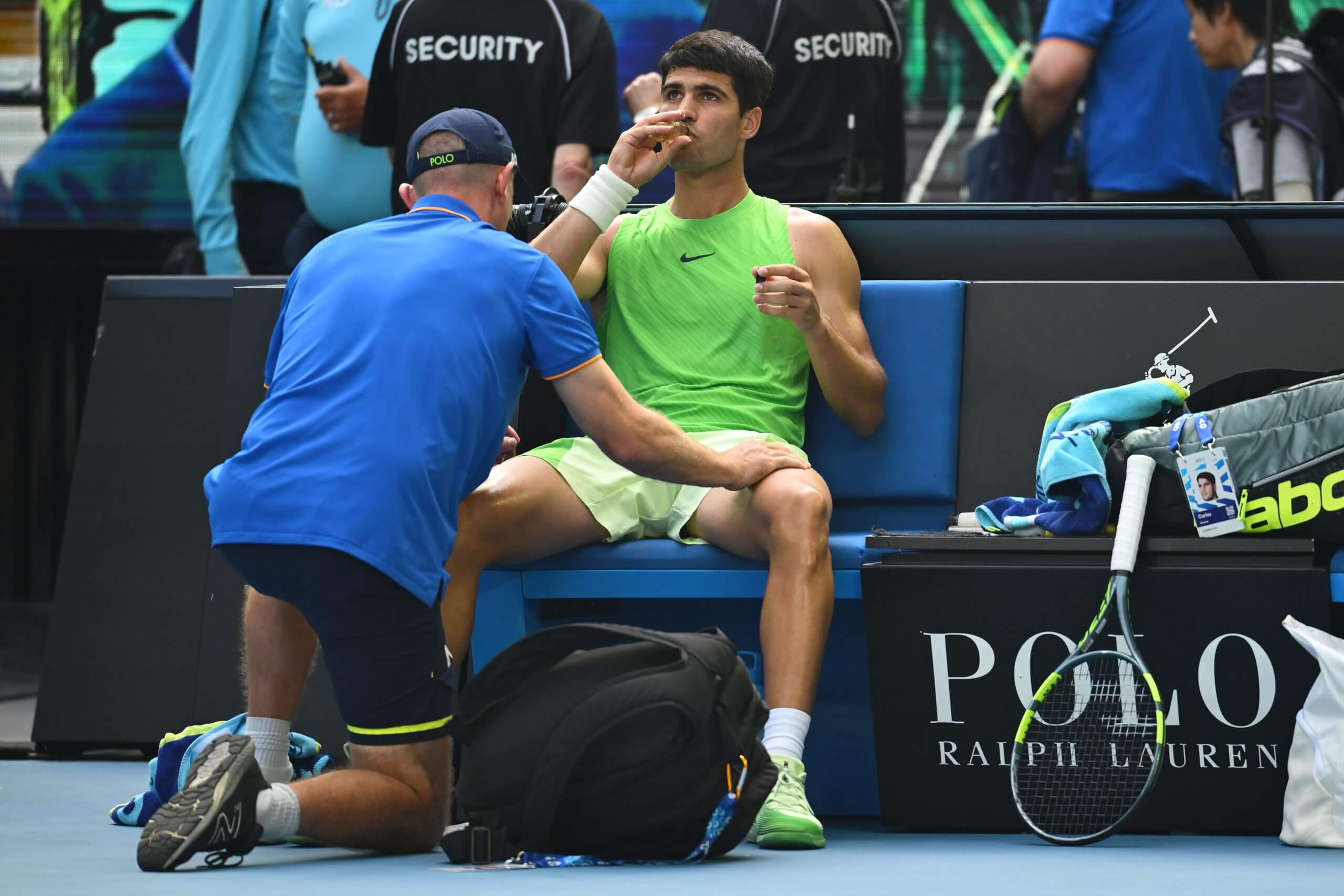
Carlos Alcaraz drinks pickle juice while receiving treatment (Quinn Rooney/Getty Images)
What did Alcaraz and Zverev say post-match?
Alcaraz was asked after the game about Zverev’s frustration, and to explain whether he thought the medical timeout was within the rules.
“In the beginning it was on a specific muscle, so I didn’t think was cramp at all at the beginning,” said Alcaraz. “So I didn’t know exactly what it was because I just go around to a forehand and then I started to feel it just in the right adductor. So that’s why I just called the physio. The left leg was good. I mean, not good, but decent.
“And after that with all the stress, I didn’t know what’s going on. I didn’t know if it’s going to be worse or not. But, you know, in that moment I just talk to the physio. I said: ‘Okay, I just went to run to the forehand side, and I started to feel like the right adductor.’ He decided to take
the medical timeout, and he did it.
“You know, once again, I just told what happens to the physio, and he decides to take medical (timeout).”
In his news conference, Zverev refused to be drawn on his on-court outburst. He said he preferred to focus on the match, and while he acknowledged that he “didn’t like” the fact that Alcaraz received a medical timeout, he said it was not his decision and there was nothing he could do. He also admitted he could have won the sets in which Alcaraz was compromised much more efficiently.
What are muscle cramps and why do athletes get them?
A muscle cramp is a sudden, involuntary contraction of one or more muscles. It can be painful, lasting from seconds to minutes, and makes the impacted muscles sore for hours or days afterwards.
Geoff Scott, former head of medicine and sports science at Tottenham Hotspur, told The Athletic’s Sarah Shephard that, in hot conditions, players lose water through sweat, as well as electrolytes, and that the depletion of the likes of sodium, chloride and potassium can be significant. Muscles need these electrolytes to function.
As a result, athletes who become dehydrated could suffer light-headedness, dizziness, fatigue and muscle cramps.
Jannick Sinner, who Alcaraz could face in the final, suffered with severe cramping in his third-round match with Eliot Spizzirri, at 3-1 down in the third set, before play was suspended due to the extreme heat.
How does it affect performance?
“You tend to start seeing them reduce their high-intensity running, and very elevated temperatures tend to affect their technical skills, so the quality can drop off. They start to fatigue faster, too,” Scott said.
In this match, Alcaraz’s movement was limited and he was wincing with pain as he went from two sets up to having to claw back to win 3-2.
How can it be treated or prevented?
For prevention, athletes and trainers/coaches tend to adjust their game plans to reduce the distance covered, if possible.
Before a hot-weather tournament, athletes can mimic their conditions using heat tents or heat chambers.
Staying hydrated is crucial. The Athletic’s Matt Burrows wrote about how pickle juice shooters are used to target nerves that cause cramping instead of the muscle itself for quick relief. The briny liquid has long been known as an excellent source of salt and potassium.