
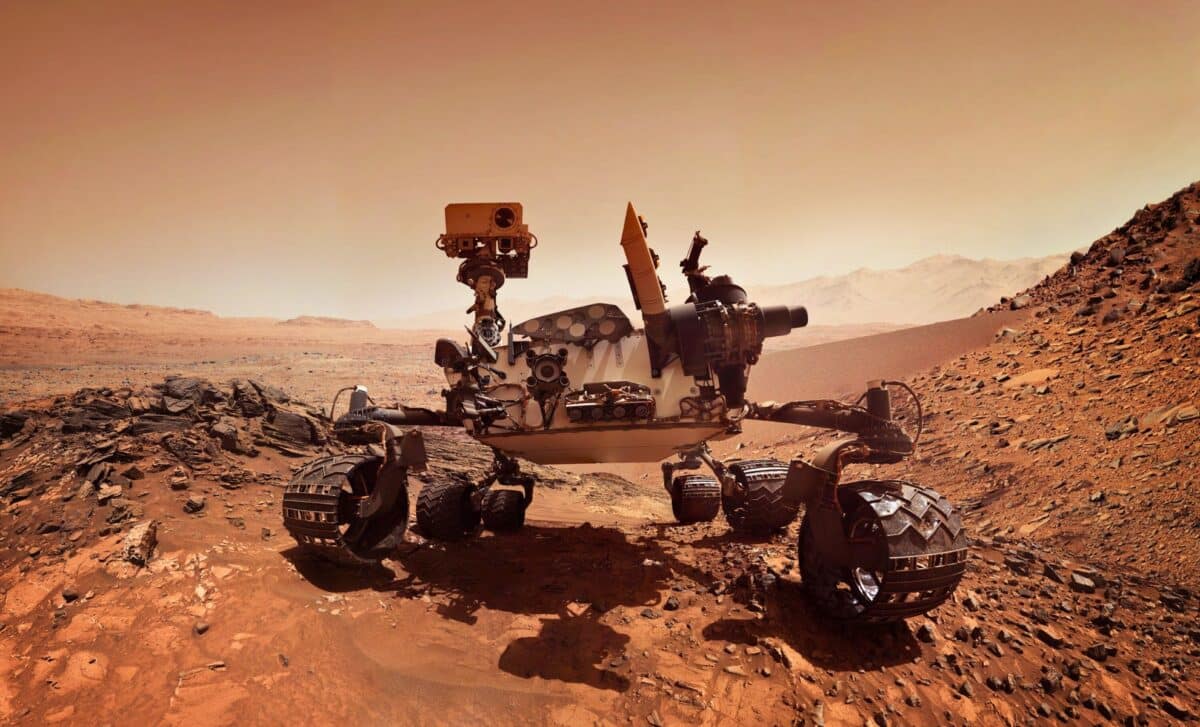
NASA’s Perseverance rover has successfully completed its first drives on Mars entirely planned by artificial intelligence, navigating the rugged terrain of Jezero Crater without human route planners. The milestone highlights a major advance in autonomous planetary exploration and demonstrates the potential of AI to handle complex decision-making on another world.
For years, Mars rovers have relied on human operators to chart safe paths. According to NASA, human planners typically divide routes into waypoints spaced no more than 330 feet (100 meters) apart to avoid hazards like rocks, sand ripples, and slopes. Communication delays, caused by Mars’ average distance of 140 million miles (225 million kilometers) from Earth, make real-time control impossible, requiring careful pre-planning of every move.
AI Charts A Safe Path Across Mars
NASA’s Jet Propulsion Laboratory (JPL) recently tested generative AI to take over this planning process. According to the U.S. space agency, the AI analyzed high-resolution images from the HiRISE camera aboard the Mars Reconnaissance Orbiter and terrain-slope data from digital elevation models. Using this information, the system produced a continuous path with waypoints, effectively replacing the manual work of human mission planners.
The AI used vision-language models to identify critical terrain features such as boulder fields, bedrock, outcrops, and sand ripples. It then created a series of waypoints for Perseverance to follow. Before sending the commands to the rover, the team verified them with a digital twin, a virtual model of the rover, checking over 500,000 telemetry variables to ensure the instructions were fully compatible with the rover’s flight software.
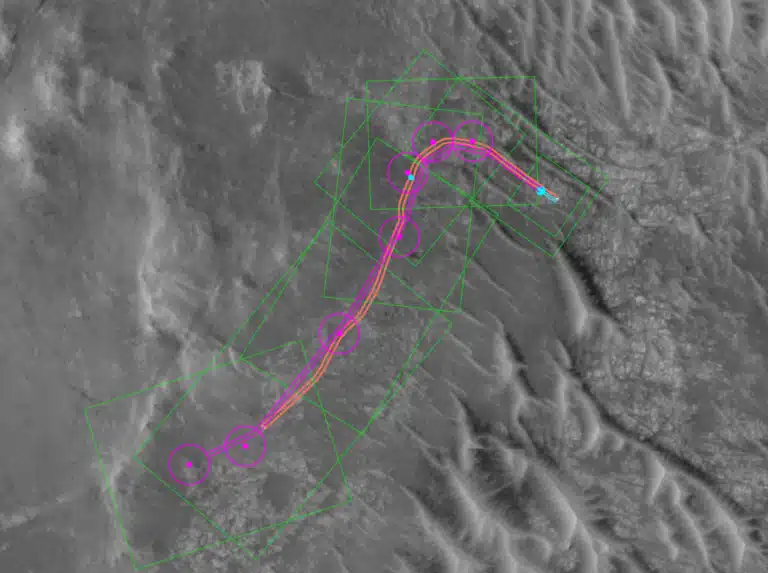 Perseverance rover’s AI-planned path on Mars, with waypoints and trajectory overlaid on terrain imagery. Credit: NASA/JPL-Caltech/UofA
AI’s First Steps On The Red Planet
During the demonstration, Perseverance drove 689 feet (210 meters) on December 8 and 807 feet (246 meters) on December 10. As stated in NASA’s release, the AI handled core navigation tasks including perception, localization, and planning. Vandi Verma, a space roboticist at JPL, said the technology shows promise for managing kilometer-scale drives while automatically flagging scientifically interesting features from the large volumes of rover imagery.
According to Matt Wallace, manager of JPL’s Exploration Systems Office, the demonstration illustrates how intelligent systems could operate across multiple planetary platforms.
“Imagine intelligent systems not only on the ground at Earth, but also in edge applications in our rovers, helicopters, drones, and other surface elements trained with the collective wisdom of our NASA engineers, scientists, and astronauts.”
The success of AI in guiding Perseverance represents a key step toward establishing infrastructure for human exploration on the Moon and, eventually, Mars.