
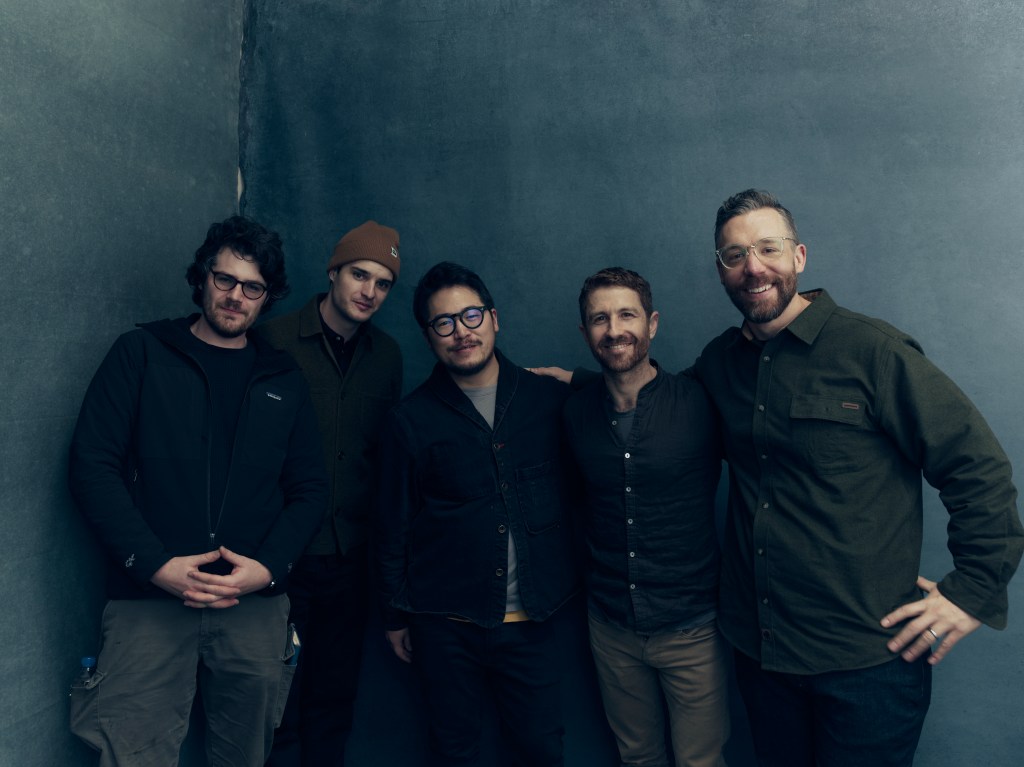
The promise and peril of artificial intelligence has become one of the most urgent topics for humanity, triggering eager speculation among investors and a lot of anxiety in other quarters. The rapidly advancing technology gets a full-scale cinematic exploration in the new film The AI Doc: Or How I Became an Apocaloptimist, directed by Oscar winner Daniel Roher (Navalny) and Charlie Tyrell, which just premiered at the Sundance Film Festival.
The title gives a sense of the filmmakers’ view of AI, suggesting optimism tempered by fear of disaster.
“An ‘apocaloptimist’ is someone who does not give into binary,” Roher said of the coinage when he and his fellow filmmakers stopped by Deadline’s Sundance Studio. “When being asked to choose between a perspective of apocalyptic doom or unbridled optimism, the apocaloptimist seeks the third way, the narrow path, recognizing that both of these things exist simultaneously and what we’re advocating for and needing is a very cautious optimism because we have the intelligence to build this technology, but we need to have the wisdom to deploy it and incorporate it into our world.”
The documentary’s producers include Oscar winners Diane Becker (Navalny), Shane Boris (Navalny), Daniel Kwan (Everything Everywhere All at Once), Jonathan Wang, and Ted Tremper.
“One of the things our film hopes to do is to give people ownership of basically their agency to learn about this in an entertaining and comprehensive way,” Tremper notes. “I refer to it as like ‘a first date with artificial intelligence’ where they can then learn how they relate to it — because one’s relationship to technology is a relationship, and we have to really be conscientious about how we move forward with it because we don’t want it to end very poorly.”
Kwan observed, ‘The thing that we need to understand about AI is that it is capable of both potential good and potential bad. And the scale and speed at which this technology is being created, which direction that we steer it, is actually really important because the consequences are huge and could impact all areas of society.”
Kwan cites the emergence of social media as a cautionary tale. “That to me is the most recent example of how I believe we failed in making sure that we also had our hands on the steering wheel. Because if we aren’t steering, we’re letting the tech industry and the people — a handful of people — decide for us the future of our relationship with this technology. And I believe that if we don’t learn from that mistake, the consequences could be really dire.”

‘The AI Doc: Or How I Became an Apocaloptimist’
Focus Features
Tristan Harris, cofounder of the Center for Human Technology, who appears in the documentary, expresses concern over the lightning-fast growth and implementation of the technology in so many areas of our lives.
“With AI, the incentive is the race to get there first to this magic prize, which means taking as many shortcuts as possible. It’s like, ‘There I am, I’m using Chat GPT and the blinking cursor tells me why my baby is burping.’ This is awesome. This is great. It’s not that the blinking cursor is the catastrophe or the apocalypse, it’s that the race to build the most powerful, inscrutable, uncontrollable technology we’ve ever invented, releasing it under the maximum incentive to cut corners on safety — that’s where the kind of darker futures that we need to steer away from is about.”
Coincidentally, Roher and Tyrell both became fathers recently. Their kids, born a week apart, are now 2 years old and are growing up in a world where AI could provide enormous benefits, or destroy humanity.
“We’re at a pivotal moment right now where we need to set them up for success,” Tyrell said of children in general. “We need to make sure that they still have an agency with this technology rather than let all the groundwork be done now so that they get what they get. I think it’s very important that we interact with it now to make sure that their futures and even well beyond them — however long the species is around — still get to have a say in what it does.”
The AI Doc: Or How I Became an Apocaloptimist is the rare Sundance documentary to come into the festival with theatrical release already locked down.
“We have distribution; Focus Features and the might of their brilliant marketers are on the case,” Roher said. “[The] film’s coming out March 27th in theaters. Buy a ticket for yourself and your mom and your dad and your dog and go and see this on a big screen. We pulled off the miracle of making a film about AI that is cinematic and deeply felt and deeply emotional.”
Watch the full conversation in the video above, including Roher’s explanation of why he spent the length of the interview with a sketchbook in hand.
Deadline Studio at Sundance presented by Casamigos.