
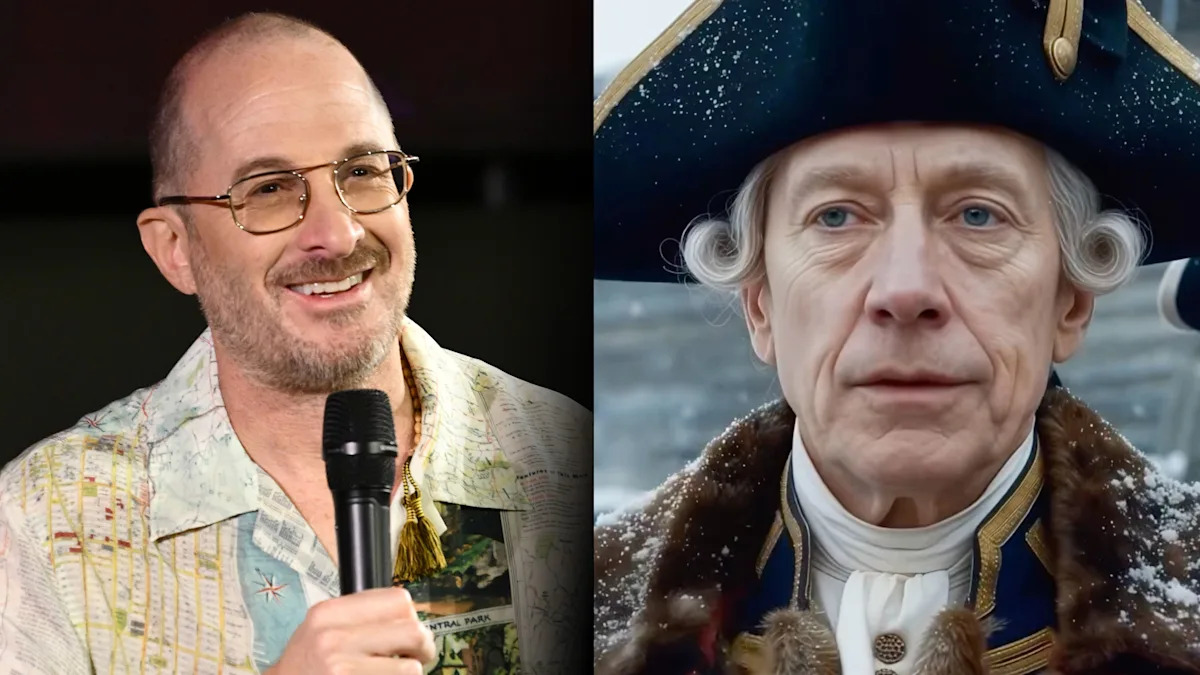
From Pi to AI? On Thursday, Darren Aronofsky released the first two episodes of his AI-generated Revolutionary War series on Time’s YouTube channel — but not everyone is excited about the prolific filmmaker’s latest venture.
Titled On This Day… 1776, the series, made using a combination of AI tools and traditional film production, is intended to roll out each episode on the 250th anniversary of the events depicted throughout the year. The first episode released, however, takes place on Jan. 1, 1776, and the second episode on Jan. 10, 1776. A trailer for the series also dropped.
On This Day comes from Aronofsky’s AI-focused production company Primordial Soup, which utilizes Google’s AI tech, DeepMind. Although the visuals are AI-created, the new series uses voices from performers with the Screen Actors Guild. A writers’ room was also set up for the series, led by Lucas Sussman, who is also an executive producer.
According to the producers, the project’s goal is “reframing the Revolution not as a foregone conclusion but as a fragile experiment shaped by those who fought for it.”
Ben Bitonti, president of Time Studios, said in a statement, per the Hollywood Reporter: “This project is a glimpse at what thoughtful, creative, artist-led use of AI can look like — not replacing craft, but expanding what’s possible and allowing storytellers to go places they simply couldn’t before.”
Aronofsky, known for films like Black Swan, The Wrestler, Requiem for a Dream and Pi, has already raised the issue of using AI in the film industry. “These tools are coming. They’re being used at an incredible adoption rate, but they’re mostly being used for slop,” he said in an August 2025 interview with the Guardian. “So I feel that, as storytellers, we need to harness these tools to help us do our work. There are a lot of artists who are fighting against AI, but I don’t see that as making any sense. If we don’t shape these tools, somebody else will.”
Yet not everyone is happy about his choice to make a TV series relying heavily on AI tools. The YouTube comments are flooded with anti-AI criticism, one user writing that the series is proof that real films are not going anywhere, and calling out its “horrible” acting, bad lip-synching and awkward pacing.
“AI can certainly help with VFX, sound effects, and cleanup in the right hands,” they wrote, “but AI cannot make a movie that anyone wants to watch. I couldn’t finish even this 4 minute long mess. This film is more about trying to hide AI’s faults than telling a good story.”
Another user criticized Google’s AI as being a system that learns by using others’ intellectual property. “The real question is what source material did the AI steal to create all these images? Most traditional FILM/TV studios are not allowing any AI use unless it’s in a closed system that doesn’t steal IP randomly. Google’s AI [is] built on the theft of everyone else’s IP. Would love to see a behind the scenes of the filmmakers explaining this.”
Several others declared the series “AI slop,” while one user called it both “wholly unethical to produce” and “deeply unpleasant to watch.”
“You can feel the lack of artistry — the lack of skilled animators and actors and cinematographers — in every shot,” the user continued. “Never do this again, TIME.”
The entertainment industry has been locked in a battle with AI for some time, with both SAG and the Writers Guild of America adding stipulations for AI protections in their contracts with studios. On Thursday, it was announced that SAG was considering a tax for studios that used digital performers.
Yet others in Hollywood are embracing AI, despite the backlash from their peers. Last year, producer Eline van der Velden’s U.K. production company Particle6 and its AI talent division, Xicoia, unveiled “Tilly Norwood,” an AI-created performer the company likened to actresses like Scarlett Johansson and Natalie Portman. Immediately, real Hollywood actors clapped back, voicing their concern that Norwood and digital performers like her would take jobs from real humans. SAG-AFTRA also spoke out, objecting in a statement that “creativity is, and should remain, human-centered” and that it opposes “the replacement of human performers by synthetics.”