
Minamata disease victims and their supporters are criticizing the Environment Ministry’s plan for the first “full-fledged investigation” into the extent of health damage caused by mercury poisoning.
The three-year study program, starting in fiscal 2026, will come 70 years after the neurological disorder was officially recognized and 17 years since a special measures law called on the government to ensure victims receive “as thorough relief as possible.”
However, the study’s objectives are already being called into question, with critics saying it will fail to identify undetected sufferers of methylmercury poisoning.
Takeko Kato, 75, who has long helped mercury poisoning patients, described the plan as “something no one wants.”
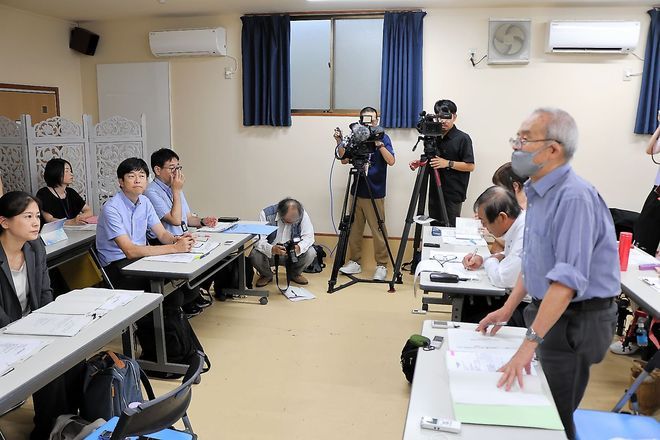
“This kind of investigation for the sake of investigation should be withdrawn and restarted from scratch,” Kato emphasized at a meeting in October in Minamata, Kumamoto Prefecture, between victims and the Environment Ministry.
The government’s stated goal of the study is to “dispel anxiety” over possible future damage, not to chart a path toward figuring out the extent of environmental hazard.
‘INEFFECTIVE STUDY’
The debilitating Minamata disease struck residents who consumed marine products from Minamata Bay tainted with wastewater from a factory of chemical manufacturer Chisso Corp.
The local public health center was informed of Minamata disease on May 1, 1956. Since then, the government has never conducted an investigation to grasp the full extent of the damage.
The government’s planned research will target places inhabited by residents who ate large amounts of seafood that were “highly exposed” to mercury, and “surrounding areas.”
These areas will then be compared with “no-exposure” districts.
To decide on the details of the envisioned research, the government started a “preliminary study” in November, covering 40 people from Amakusa and Kami-Amakusa, Kumamoto Prefecture, across the Shiranui Sea from Minamata city.
Mercury poisoning cases were broadly reported in these areas.
In the three-year study, an affiliate office of the Environment Ministry plans to examine 200 people each randomly selected from nine districts based on basic resident registers.
Officially certified Minamata disease patients or those already eligible for formal relief will not be included among the 1,800 individuals.
The subjects are expected to be interviewed by doctors and take health checks at Kumamoto University Hospital. They will also undergo magnetoencephalography (MEG) and magnetic resonance imaging (MRI) tests at the Minamata City General Hospital and Medical Center.
According to government officials, these processes should make clear if the residents are experiencing sensory impairment in their limbs, a typical symptom of Minamata disease.
However, the study will not notify subjects if they are suspected of having Minamata disease. The influence of methylmercury contamination will simply be assessed “by region.”
One reason for the victims’ objection to the health survey is the use of MEG and MRI tests.
Although completing both MEG and MRI procedures is estimated to take 90 minutes, the subjects will need to stay at medical institutions equipped with MEG in Minamata for two days and one night under the plan.
A victims’ group has proposed a larger-scale, more extensive investigation similar to the one planned by Kumamoto Prefecture in 2005, which proposed sending physicians to “interview 30,000 coastal residents” and then conducting “secondary examinations for people with suspected symptoms.”
Kumamoto Prefecture drew up the plan and submitted it to the central government one year after the Supreme Court specified in 2004 the responsibilities of both the central and prefectural governments for expanded damage from Minamata disease.
Victims’ organizations, in fact, dispatched doctors to various coastal districts in 2009 and checked 1,000 people over two days to determine if any victims had been overlooked.
The victims’ groups oppose the MEG and MRI tests because, as the Environment Ministry has acknowledged, the tests “still cannot precisely conclude whether a given individual is suffering from Minamata disease.”
The ministry has used the two technologies for more than a decade for an “objective diagnosis” of mercury poisoning. But the MEG and MRI tests failed to uncover cerebral abnormalities in 20 percent of the cases, sources said
The victims’ side has lambasted the methodology as “unable to uncover mild or moderate symptoms, as well as a variety of related symptoms, of Minamata disease.”
“We fear that the research results may lead the government to inadequately conclude that no mercury influence exists at present,” a victim said.
The Japan Environmental Council issued a similar statement in October, requesting that the survey be halted.
DIFFERING VISIONS
The government and private support organizations have different goals for the study.
The victims’ side wants to provide relief to those who are unidentified as suffering from mercury poisoning.
On the other side, a divisional chief at the Environment Ministry indicated that the study only intends to eliminate health concerns regarding Minamata disease.
The official told The Asahi Shimbun that the special measures law does “not refer to the responsibility for ascertaining the scope of damage.”
During a visit to Minamata for a memorial service in May 2025, the environment minister explained that the “study will not necessarily presuppose ongoing damage.”
Masafumi Yokemoto, a professor of environmental policy studies at Osaka Metropolitan University, criticized the government’s stance.
“The health study became part of the special measures law because the victims’ side asked that relief measures reach a range of affected people,” Yokemoto said. “The government is trying to shift the focus and rather make do with a meaningless survey.”
The professor also mentioned that a Minamata disease patient’s microphone audio talk with the environment minister in 2024 was abruptly cut off. The Environment Ministry said the patient had continued speaking beyond the preset time limit.
“The health survey is marked by the same underlying problem as the microphone cutting,” Yokemoto said. “Both incidents reflect the government’s attitude of refusing to face responsibility or listen to the voices of victims.”
(This article was written by Satoshi Okumura and Kenji Imamura.)