
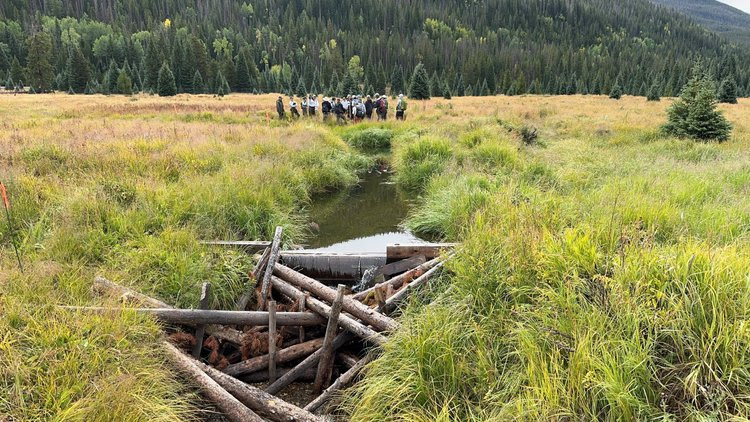
Surging runoff from the high peaks of Rocky Mountain National Park in 2025 overwhelmed the banks of Beaver Creek, a tributary near the headwaters of the Colorado River, and flooded two and a half football fields’ worth of surrounding meadows.
And that’s a good thing.
Because the lack of beneficial flooding from Beaver Creek since the early 2000s was one loud warning signal of a worrisome ecosystem collapse at the western entrance to one of the most popular parks in the nation.
Visible flooding in 2025, celebrated in stark aerial photograph comparisons by Grand County, meant the surges in Beaver Creek were hitting artificial beaver dams and lodges built to emulate past environmental conditions and recreate historic wetlands.
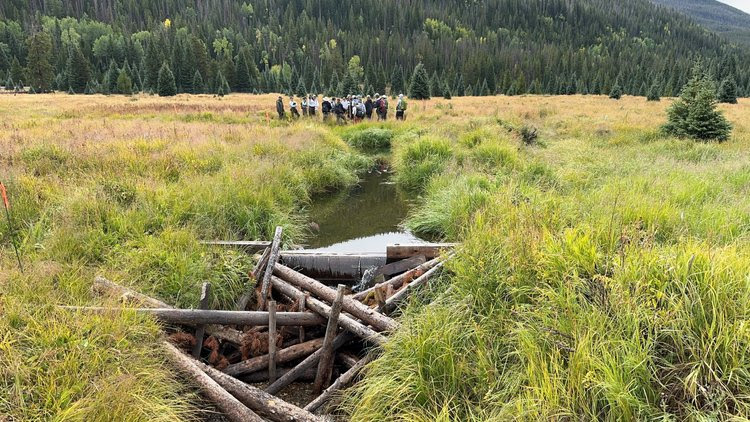 One of the artificial dam structures built along Beaver Creek to begin restoring wetlands and attracting beavers and willow growth back to Kawuneeche Valley. (Kawuneeche Valley Restoration Collaborative)
The flooding was proof that a meticulously developed plan to restore Kawuneeche’s crucial watershed over decades, among multiple government agencies and nonprofits, paid for by a wide array of funders, is reporting great progress after just a couple of years. Kimberly Tekavec of Northern Water appreciated that in person, on a field trip to the area near the first western hairpins of Trail Ridge Road last June.
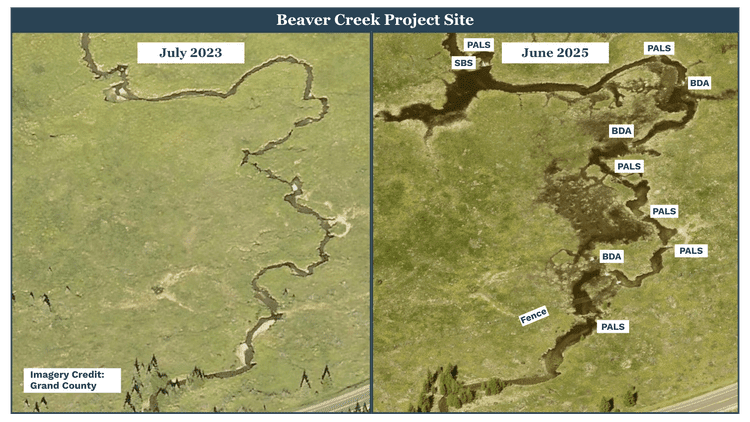 Aerial photos of Beaver Creek as it winds toward the Colorado River in Kawuneeche Valley show how artificial dam and lodge structures are rebuilding pools and wetlands to promote willow regeneration. (Grand County)
“Just seeing the amount of water, it was incredible,” Tekavec said. “We’ve toured Beaver Creek every year since 2020 and it was just … it was really, really awe-inspiring to see.”
“When you do something in the park, sometimes it takes years and years and years to see a difference,” said national park spokesperson Kyle Patterson, who helps coordinate the wide array of groups working on Kawuneeche Valley. “When something is so urgent and has declined so quickly, you think, is this going to have a fighting chance? And you could see it in a short period of time. Instantaneous is too dramatic of a term. But very quickly, which I think is a very hopeful, exciting thing.”
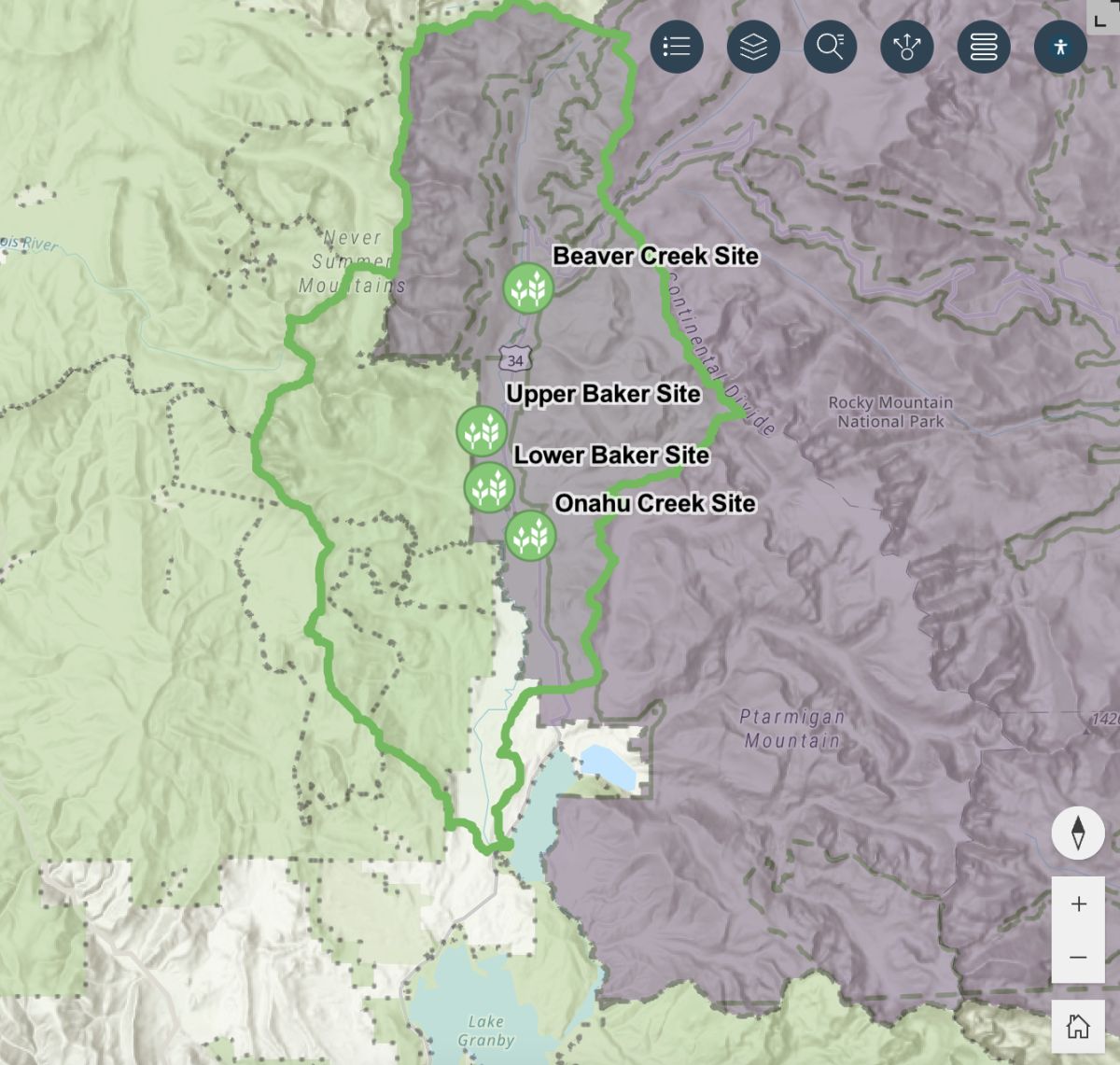 Some of the sites in the Kawuneeche Valley that are part of ongoing wetlands restoration or future plans by the collaborative, north of Grand Lake and Granby. (Collaborative map screenshot)
The decline that prompted the all-hands work in Kawuneeche Valley was a scientifically documented collapse of what biologists call a “beaver-willow state” of equilibrium that held in the valley until the early 2000s. Beavers, a keystone wildlife species for the valley, employed ample willows and young aspen to build lodges and dams. Those naturally built obstructions in Beaver Creek flooded portions of the valley to water new willows, and created marshlands that supported countless species of insect, bird and aquatic life.
Then the elk-pocalypse and moose-pocalypse happened. Moose reintroduced to Colorado farther west, in North Park, quickly populated much of the state, and thrived on the protections and feed stock of Kawuneeche inside the park boundary. Elk, meanwhile, were overrunning the park in many areas, and RMNP and its partners had already erected fences around young willows in eastern portions like Moraine Park — “exclosures,” to the elk, “enclosures” to the willow shoots in need of protection. The fences include gaps at the bottom for smaller animals, like beavers, to come and go.
Park ecologist Isabel de Silva coauthored a paper on the sudden decline of Kawuneeche in the May 2025 issue of “Conservation Biology.” The group of scientists measured everything from willow height to stream depth to pond width, concluding “the vegetation structure has changed dramatically since the early 2000s,” the main drive of “ecosystem collapse” in the valley.
A concerned coalition formed in 2020, including park leaders, The Nature Conservancy, Northern Water, Rocky Mountain Conservancy, Grand Lake and Grand County, and the U.S. Forest Service. They scraped together research and restoration funds and private grants to begin building willow exclosures and artificial dams along Beaver Creek, one of the primary headwaters tributaries snaking down from high park land to the Colorado River at the bottom of the valley.
The most obvious result is in the aerial photos, comparing the stream profile from 2023 with 2025.
The in-stream obstructions rebuild pools that help sediment settle out, improving water clarity downstream for Northern Water’s Grand Lake diversions, and slowing water to improve fish spawn and insect hatches. The protected willows are growing, and in a couple of years will reach sizes attractive to long-tooth, wide-tailed construction teams.
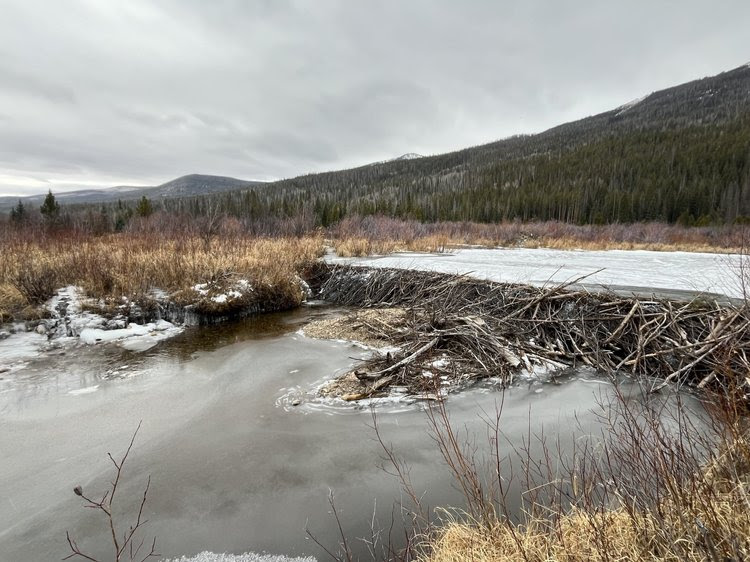 This is a dam built naturally by beavers about a mile away from the Beaver Creek restoration site, showing the natural restoration waiting to occur once protected willows have regrown to usable heights. (Kawuneeche Valley Restoration Collaborative)
Beavers have responded to willow protection and artificial lodges in earlier east side park projects, Patterson said. “But we think that they’re scoffing at us and saying, ‘Thanks for the first step, and we’ll add on to it.’ ”
Enclosures and beaver support on the east side have been credited for helping to slow down the wildfires that periodically sweep portions of Rocky Mountain National Park, including the East Troublesome fire in 2020. That enormous fire swept over the Continental Divide from Grand County, tore through the Fern Lake area, and finally slowed and was tamed in the wetlands and trimmed forests of Moraine Park.
New beaver families at the Beaver Creek site will likely take a few more years to fully populate, de Silva said. There are beavers a mile away, but they wouldn’t drag dam-building willows a mile. They are likely scouting the artificial structures and watching to see the willows in the enclosures reach usable heights, she said.
The collaborative has so far collected about $5 million for up to four restorations in the park, aiming for an eventual $20 million budget over the projects. A winter review of the Beaver Creek work calls the first restoration “about a 90% success,” de Silva said. Dam and lodge structures will be tweaked a bit, and need repairs from relentless stream pressure. Native grasses like carex thrived immediately with more water to drink.
“I was expecting the vegetation recovery to take some more time, but it was pretty instantaneous after that first season,” de Silva said.
Onahu Creek, a bit down valley to the south, will be the next restoration target.
De Silva is anticipating a May walk along Beaver Creek, where she hopes for more confirmation of that 90% success.
“Willows flower on last year’s stem, and so before we had a fence there, they didn’t have a fighting chance, they would all get eaten away by the elk and moose,” de Silva said. “So it’ll be really cool if they have catkins, which are their floral structures that have seeds. That’s something I’m looking forward to. That’s, I know, a nerdy anecdote because I’m a plant ecologist, but that’s one of the things I look for.”
Type of Story: News
Based on facts, either observed and verified directly by the reporter, or reported and verified from knowledgeable sources.