
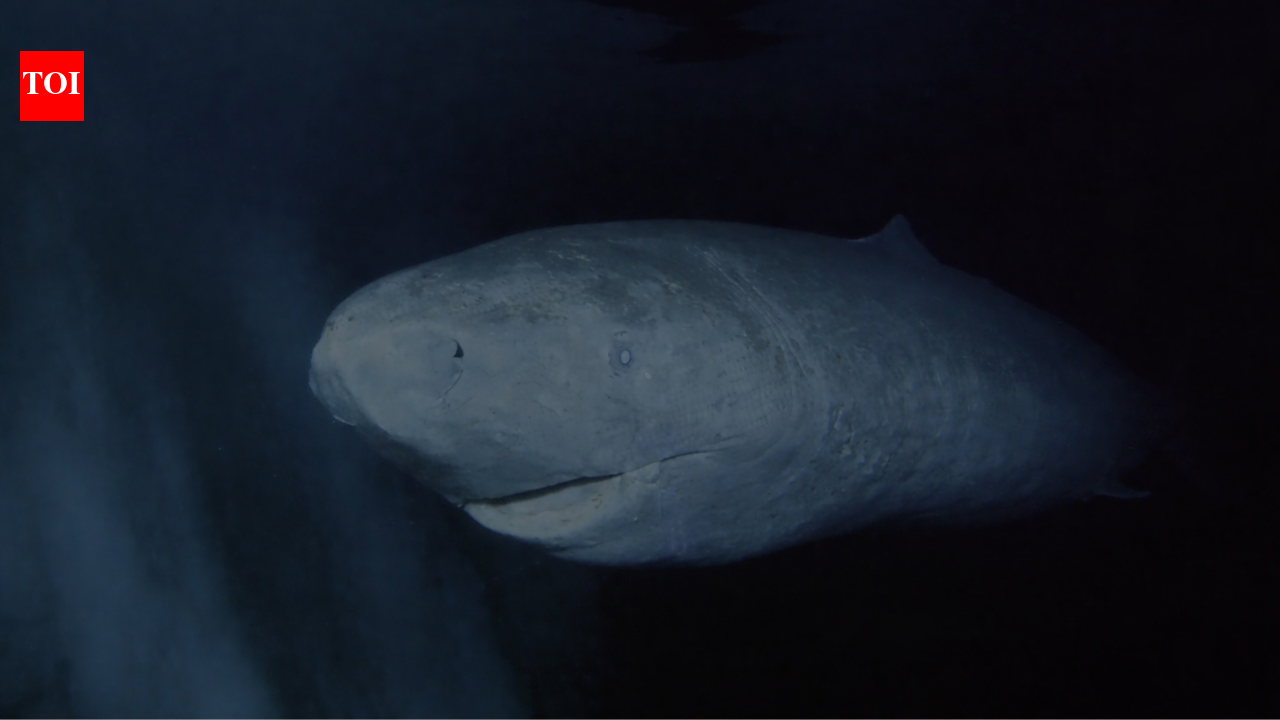
 A viral social media post has renewed attention on the Greenland shark. Scientists believe the species can live for centuries. Some estimates suggest certain sharks may be nearly 400 years old. That would place their birth in the early 1600s, before Isaac Newton was born in 1643. The claim has spread widely online. It may sound unbelievable, but it is based on peer-reviewed scientific research.The renewed interest comes from a 2016 study published in the journal Science. Researchers examined Greenland sharks from Arctic waters. They concluded the species is the longest-living vertebrate known. The largest shark in the study was estimated to be close to 400 years old. This placed its birth well before modern science began.Scientists have noted that exact ages are difficult to confirm. Even so, the wider conclusion remains unchanged. Greenland sharks live far longer than any other known vertebrate.
Why Greenland sharks live such long lives
Researchers involved in the study have said that even cautious estimates point to extreme longevity. Greenland sharks outlive whales, tortoises, and other long-lived animals. Later research has supported the original findings. No major study has contradicted them.Marine biologists say the discovery has changed how scientists think about ageing in vertebrates. It has also raised new questions about how such long lifespans are biologically possible.Greenland sharks live in cold and dark Arctic waters. Temperatures remain close to freezing throughout the year. Scientists believe this environment slows growth and reduces energy use. The sharks move slowly and grow very little each year. This low-energy lifestyle may help explain their long lifespan.
A four-century survivor rewriting what science knows about ageing
Beyond its extreme lifespan, the Greenland shark has drawn attention for biological traits that may help explain how it survives for centuries. Despite often being partially blind due to a parasitic copepod that damages the cornea, researchers have found remains of seals and other large mammals in the sharks’ stomachs, indicating they are capable predators rather than simple scavengers. Scientists believe the sharks may rely on smell and electroreception to ambush prey in deep, low-light environments. Interest in the species has grown further with recent genetic research. Studies published in 2024 report that the Greenland shark genome contains multiple copies of genes linked to DNA repair, immune response, and tumour suppression, including variants of the TP53 gene. Researchers say these traits may help explain how the species maintains biological function over extraordinarily long lifespans, making it a valuable subject for ageing and disease research.
‘Could be a US senator’: Online reactions goes savvy
Online reactions quickly took on a political edge after Tim Burchett, a Republican congressman from Tennessee, joined the conversation with a post joking that the centuries-old Greenland shark “could be a US Senator.” His remark set off a wave of meme-driven responses. One user shared an image of an ancient-looking turtle with the caption “Some turtles live for hundreds of years,” implying Congress has its own long-lived reptiles. Another joked that the shark “voted in Maricopa County last election,” tapping into election integrity memes. Others flipped the comparison, quipping that the shark was “younger than Pelosi, Schumer, McConnell, Grassley, and Waters,” while one reply told Burchett directly that “there are some Senators older than this shark.” The thread filled with weathered sea-creature images labelled with dates like “1623,” dry Southern-style one-liners, and visual-only posts suggesting prehistoric politicians, turning a marine biology fact into a broader satire of age and longevity in US politics.The idea of an animal that may have lived through four centuries has captured public attention. Online users have linked the shark’s age to major moments in human history. The comparisons have helped push the story across social media platforms. Scientists say the attention has also brought rare focus to deep-sea life and Arctic ecosystems.