
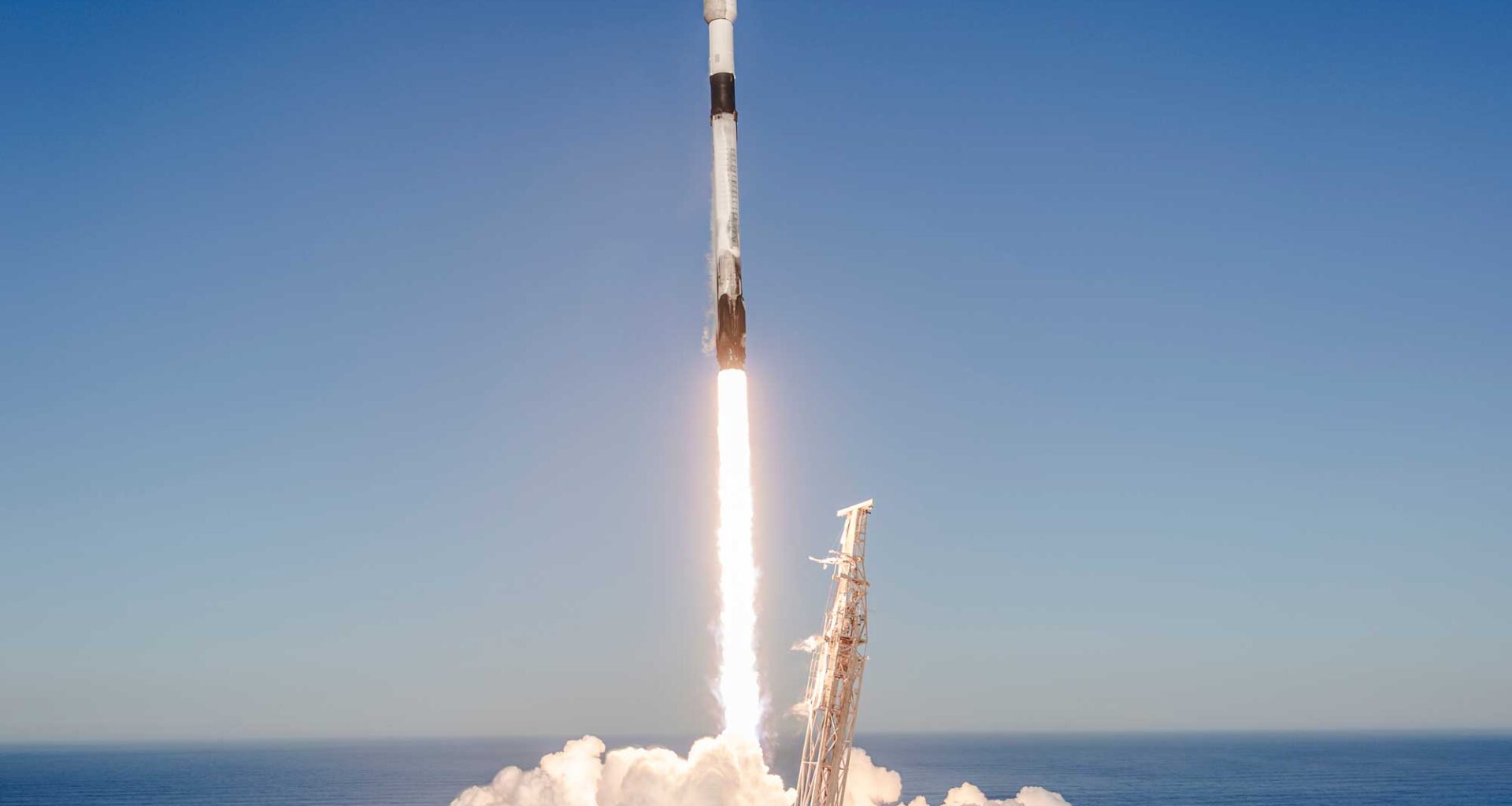
A Falcon 9 rocket launched another work week Monday at Vandenberg Space Force Base, days after SpaceX revealed a modern system to keep orbiting satellites safe from crashes.
The rocket blasted off as the West Coast’s seventh liftoff of the year at 7:47 a.m. from Space Launch Complex-4, followed by the first-stage booster’s landing on the droneship minutes later.
This marked the 31st launch and landing for the first-stage booster tasked with Monday’s mission.
SpaceX confirmed deployment of the 25 Starlink satellites approximately one hour after liftoff.
But late Monday afternoon, the firm revealed a glitch involving the second stage although it apparently didn’t affect the delivery of the satellites.
“Teams are reviewing data to determine root cause and corrective actions before returning to flight,” SpaceX said.
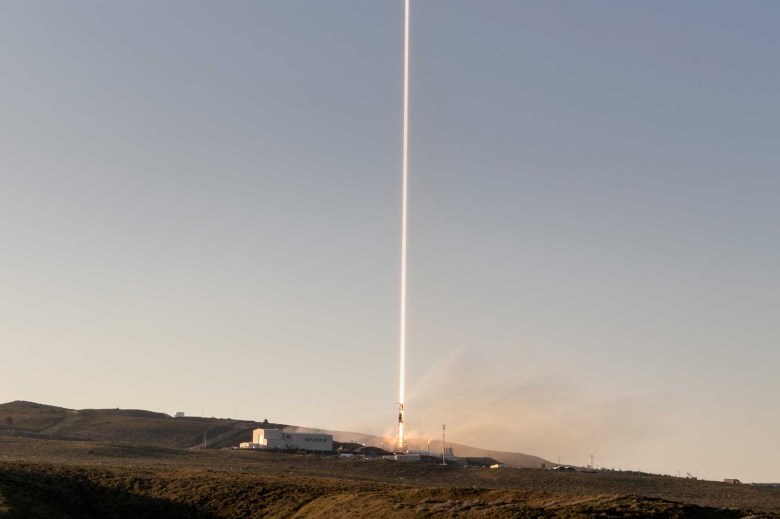
A Falcon 9 rocket lifts off Monday morning at Vandenberg Space Force Base to deliver 25 Starlink satellites into orbit. Credit: SpaceX photo
Last week, the firm revealed the development of its space situational awareness system dubbed Stargaze to serve as sort of an air traffic control for satellites in low-earth orbit.
Stargaze “significantly enhances the safety and sustainability of satellite operations in low-Earth orbit (LEO), and its screening data will be made available to the broader satellite operator community free of charge in the coming weeks,” SpaceX said.
“Practices—such as leaving rocket bodies in LEO, operators maneuvering their satellites without sharing trajectory predictions or coordinating with other active satellites, and countries conducting anti-satellite tests—have heightened the risk of collision, necessitating improvements in space-traffic coordination,” SpaceX said in its announcement.
Conventional methods usually detect objects only a limited number of times per day, creating “large uncertainties in orbital predictions,” SpaceX said.
The “volatile space weather” also hampers efforts to keep satellites safe.
“Stargaze delivers a several-order-of-magnitude increase in detection capability compared to conventional ground-based systems. Stargaze uses data collected from nearly 30,000 star trackers, each of which makes continuous observations of nearby objects, resulting in approximately 30 million transits detected daily across the fleet.”
Stargaze showed off its space traffic safety skills in late December when a Starlink satellite encountered a conjunction, or possible collision, with a third-party satellite which SpaceX didn’t name, performing maneuvers.
Initially expected to have a close approach of 5.6 miles —considered a safe miss-distance with zero probability of collision — the maneuver made the miss-distance a mere 197 feet.
The Starlink satellite performed a collision avoidance maneuver to reduce the risk, SpaceX said.
Starlink orbital data is updated and shared multiple times a day, with SpaceX calling on other operators to do the same.
“An appropriate analogy is commercial aviation: there are hundreds of thousands of flights of aircraft daily, but they are able to avoid collisions because they broadcast their location and flight plan to other aircraft. Similarly, spacecraft operators should follow this minimal standard of sharing their predicted trajectory,” SpaceX said.
“By providing this ephemeris sharing and conjunction screening service free of charge, we hope to motivate operators to take similar steps towards ephemeris sharing and safe flight,” SpaceX added.
The Starlink constellation is one of several megaconstellations already in existence with several others planned for the future by both American firms plus international companies and governments.
SpaceX will conduct another Starlink mission from Vandenberg as soon as Friday. The liftoff, of a Falcon 9 rocket carrying 25 satellites, will occur between 9:05 a.m. and 1:05 p.m.