
After riding up the AI-hype mania for two days.
By Wolf Richter for WOLF STREET.
Shares of Figma, the AI-powered design software provider – “Make your ideas real with AI,” it says on its website – plunged another 7.4% to $24.00 on Monday, and is now down by 83% from the intraday high on August 1, 2025, the second day of trading after the IPO, and down by 80% from the closing high the same day, and down by 27% from the IPO price.
And thereby, Figma has made it into our pantheon of Imploded Stocks for which the minimum qualification is a plunge of 70% from the more or less recent high.
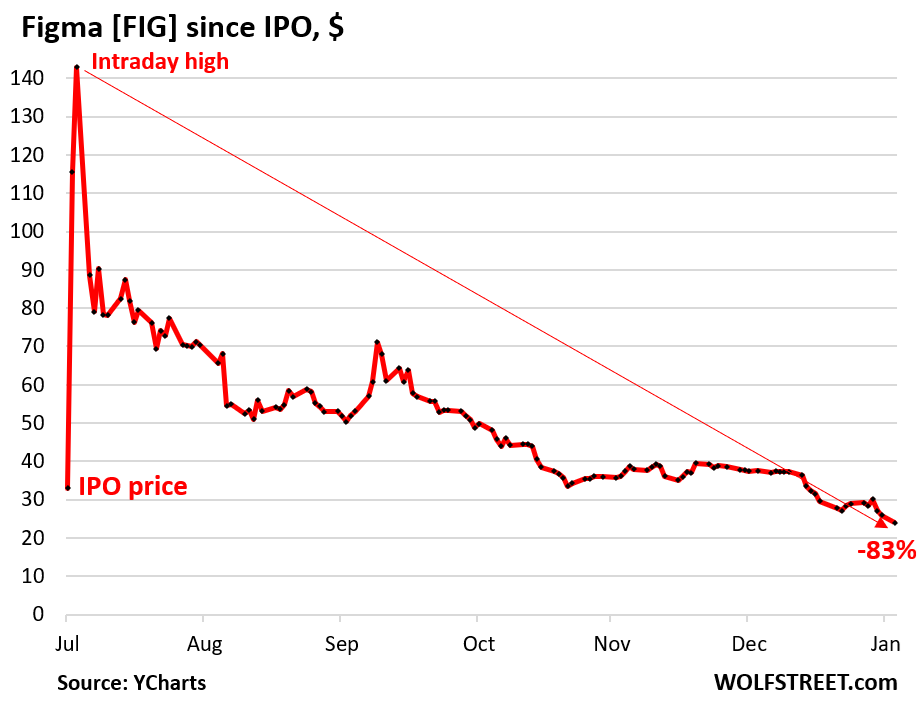
Figma went public on July 30, 2025, selling 12.47 million shares at the IPO price of $33 a share, for $1.22 billion.
But the public didn’t buy at the IPO price of $33. That’s the price at which the shares were sold by the company ($412 million), by some early investors, and by the founder (just over $800 million combined) to institutional investors that the underwriters had lined up as part of the IPO.
The next day, the first day of public trading, these institutional investors flipped some of those shares to the public that was foaming at the mouth. The first trade took place at $85 a share, then the shares exploded to $124.63 and closed at $115.50.
VC firms Index Ventures, Greylock, Kleiner Perkins and Sequoia “are sitting on $24 billion worth of stock after massive IPO pop,” CNBC gushed after the first day of trading.
The second day of trading, the same sort of mania we’ve seen in so many places pushed the price to $142.92 a share intraday, the all-time high, before closing at $122 a share, the all-time closing high, giving it a market cap of $60 billion.
Then the whole thing imploded. Today’s market cap is down to about $12 billion, which is still very high:
In the quarter ended June 30, its final quarter as a private company, but reported on September 4, about a month after the IPO, Figma at a net loss of $27 million on $250 million in revenues.
At the time, the company also disclosed that the lock-up period for some employees would expire later that week, at which point they could unload some of their shares, which would increase the supply of the shares.
The share price plunged 20% after the earnings announcement, from $68.13 a share at the close before the afterhours announcement, to $54.56 at the close the next day.
For its Q3, ended September 30, its initial quarter as a public company, Figma reported a net loss of $1.1 billion mostly due to stock-based compensation expenses associated with the IPO. It booked $274 million in revenues.
In Q3 a year earlier, when it was still a private company, it had had a loss of $16 million, on $198 million in revenues.
The five major venture capital holders have lock-up periods with staggered releases through mid-2026. And those are still to come.
Adobe had offered to buy Figma – to swallow a competitor – for $20 billion in September 2022, but they terminated the deal in December 2023 after intense scrutiny from competition regulators at the European Commission and the UK Competition and Markets Authority. Adobe had to pay Figma a breakup fee of $1 billion.
Figma’s cloud-based collaborative-design software, powered by AI, is used to build interfaces for web and mobile apps. “Start with a design and prompt your way to a functional prototype, fast,” it says. Pricing is subscription-based, ranging from a free “starter” version to $90 a month per user for the full-fledged enterprise version.
The collapse of the price of the shares from the mania high isn’t a sign that Figma doesn’t have useful products that companies and developers are willing to pay for, or that it cannot be profitable some day maybe. But it’s a sign of the mania in the markets, amid the constant and massive hype around AI and whatever else comes along. That mania will drive up anything to ridiculous highs.
And a market cap of about $12 billion, at today’s stock price, for a company with about $1.1 billion in annual revenues and big net losses possible for years to come is still very high.
The short interest is obviously huge, at 14.8 million shares, or about 8.6% of the public float. Volatility guaranteed.
Enjoy reading WOLF STREET and want to support it? You can donate. I appreciate it immensely. Click on the mug to find out how:


WOLF STREET FEATURE: Daily Market Insights by Chris Vermeulen, Chief Investment Officer, TheTechnicalTraders.com.