
The brutal realisation hit home as Kai Havertz wheeled away, pointing to the Arsenal badge on his chest, having calmly rounded Robert Sanchez and tapped in to create an unexpected echo of his winning goal for Chelsea in the 2021 Champions League final.
It capped the end of a final half-hour in which every home tackle, header and clearance was met with a mighty roar of approval from Arsenal fans. And it prompted a nagging thought.
Chelsea used to win big games just like this.
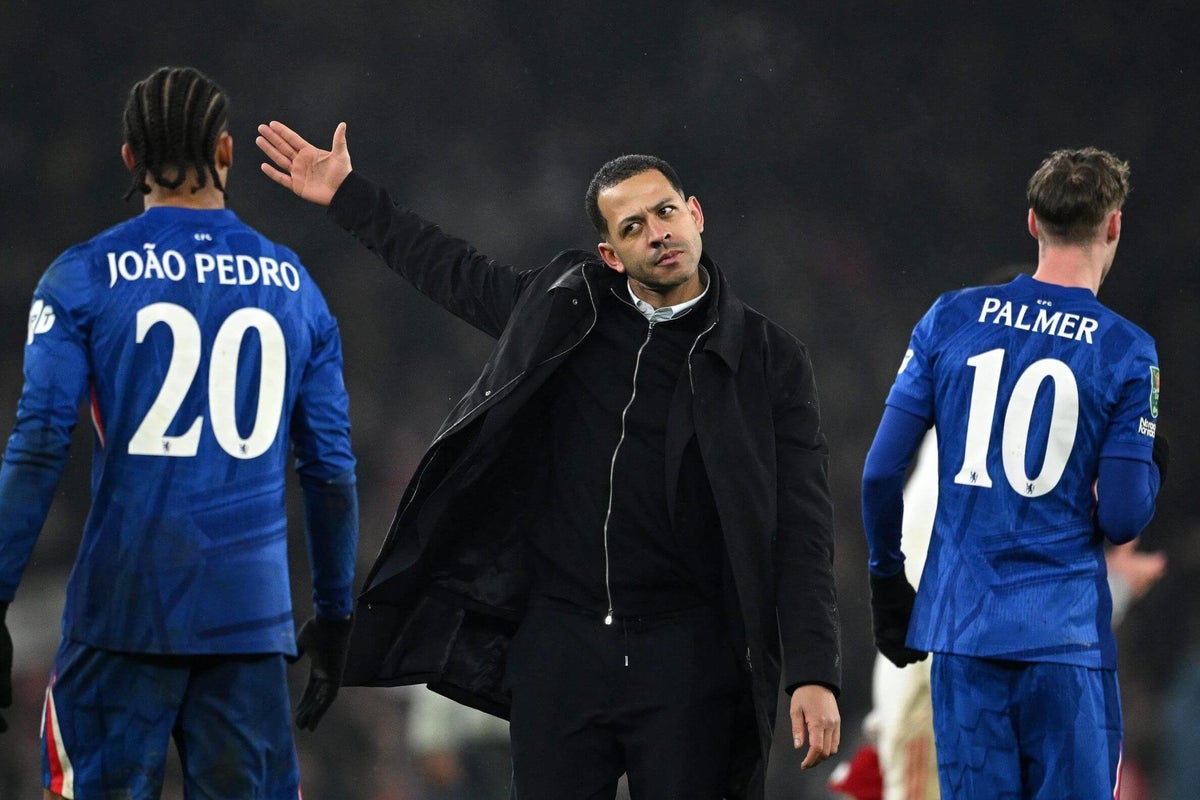
If a similar observation occurred to anyone among the travelling support, it did not show. The vast majority of the blue section stayed beyond the final whistle of this fiery Carabao Cup semi-final second leg as Arsenal’s victory anthems rang out, determined to applaud the effort of their players and new head coach in the driving north London rain.
Carrying a one-goal deficit from the first leg at Stamford Bridge last month, Liam Rosenior had crafted a sophisticated game plan aimed at holding Arsenal before trying to hit them. Chelsea lined up in a low five-man defensive block out of possession, with nominal striker Liam Delap stationed on the right flank and instructed to track Piero Hincapie’s every foray forward from left-back.
It successfully stifled Arsenal, who for much of the first hour appeared caught between an instinct to impose themselves and a keen awareness that they were not the team obliged to take risks, given the aggregate score. Rosenior’s strategy was to keep the game close before unholstering his big guns, Cole Palmer and Estevao, from the bench in the final half hour to force the issue and plant doubt in the crowd as much as in the minds of their opponents.
To some, including a few high-profile television pundits, it was an admission of inferiority. Paul Merson, the former Arsenal player speaking on Sky Sports, pronounced himself “gobsmacked” at Chelsea’s approach.
But was it not an admission of reality? Their best chance of upsetting an unequivocally stronger team?
“You can come away from home and press all over the pitch, man-to-man, and you could go 2-0 up or you could go 2-0 down,” Rosenior told reporters later. “I felt that the psychological aspect of the tie was very important as well. On 60 minutes, (the idea was) I bring on Cole and Estevao and the game opens up and we have moments in and around the box.

Estevao could only be a second-half substitute at the Emirates following a trip home to Brazil (Adrian Dennis/AFP via Getty Images)
“There was a feeling in the stadium that this tie could turn. We didn’t achieve what we wanted to, but it’s not about game plans — it’s about results. I have to give our players so much credit for what they put into the game. The goal comes when we’re just throwing the kitchen sink at the game. That’s going to happen. We have to make sure that we take the positives from that, but we’re here to get results.”
This tie was never going to be a fair litmus test of Rosenior’s prospects of success at Chelsea.
Last month’s first leg at Stamford Bridge fell just four days after his appointment as Enzo Maresca’s replacement, when he was still familiarising himself with a squad in the midst of a gruelling fixture crunch and an untimely wave of flu. Had that game ended 4-1 to Arsenal rather than 3-2, as it easily could have done, Tuesday’s second leg would have been rendered a non-event.
Deprived of club captain Reece James and winger Pedro Neto by failed late fitness tests and with the knowledge that Palmer and Estevao — the latter just off a plane after being granted compassionate leave in Brazil — could only realistically give him 30 minutes plus a possible 30 more in the event of extra time, Rosenior’s choice to take the pragmatic route from the start was eminently justifiable.
It may be an inconvenient truth for some, but Arsenal are the best team in England and in Europe right now.
They are not the prettiest team to watch but they are nasty in the nicest possible sense, with size and snarl in every position. They find pleasure in the grind and take a winner’s relish in defending.

Chelsea found their way to goal blocked by Arsenal on Tuesday (Mike Hewitt/Getty Images)
Through the fog of fierce London rivalry, Chelsea fans can grudgingly recognise in Mikel Arteta’s side many qualities they have prized at Stamford Bridge in this century.
Rosenior should take heart from the fact his team matched Arsenal’s physicality and intensity throughout.
The consequence of that was an ugly, attritional game in which fouls were frequent and long-range shots were the only ones to be had. But the visitors also needed a moment of uncharacteristic sloppiness, like the two that Alejandro Garnacho exploited in the first leg at Stamford Bridge, from Arsenal, and they never looked likely to get it.
With both teams missing key names, Arsenal had more quality in more positions. Then there is the matter of seasoning. Years are not the only measure of experience but the average ages of the two starting XIs are telling: 26 for the team in red, 23.9 for those in blue.
Those numbers are a reflection of the recruitment choices these two clubs have made in recent years, and it is hard to avoid the conclusion that Arsenal are built to win now to a degree that Chelsea simply are not.
It may not always be this way. Rosenior can take solace in the knowledge that the gap to Arsenal narrows considerably when Palmer, James and Neto are fit to start, as Chelsea demonstrated, even with 10 men for more than a half, when drawing 1-1 with Arteta’s team at Stamford Bridge in November.
February affords Chelsea more rest than January, as well as fixtures that give Rosenior the chance to build on recent Premier League momentum that should not be derailed by a narrow Carabao Cup semi-final exit against a side on course to win the title.
Then they return to the Emirates Stadium for the reverse league fixture on March 1, when more favourable circumstances may present Rosenior and Chelsea with the opportunity — and perhaps the obligation — to do more.