
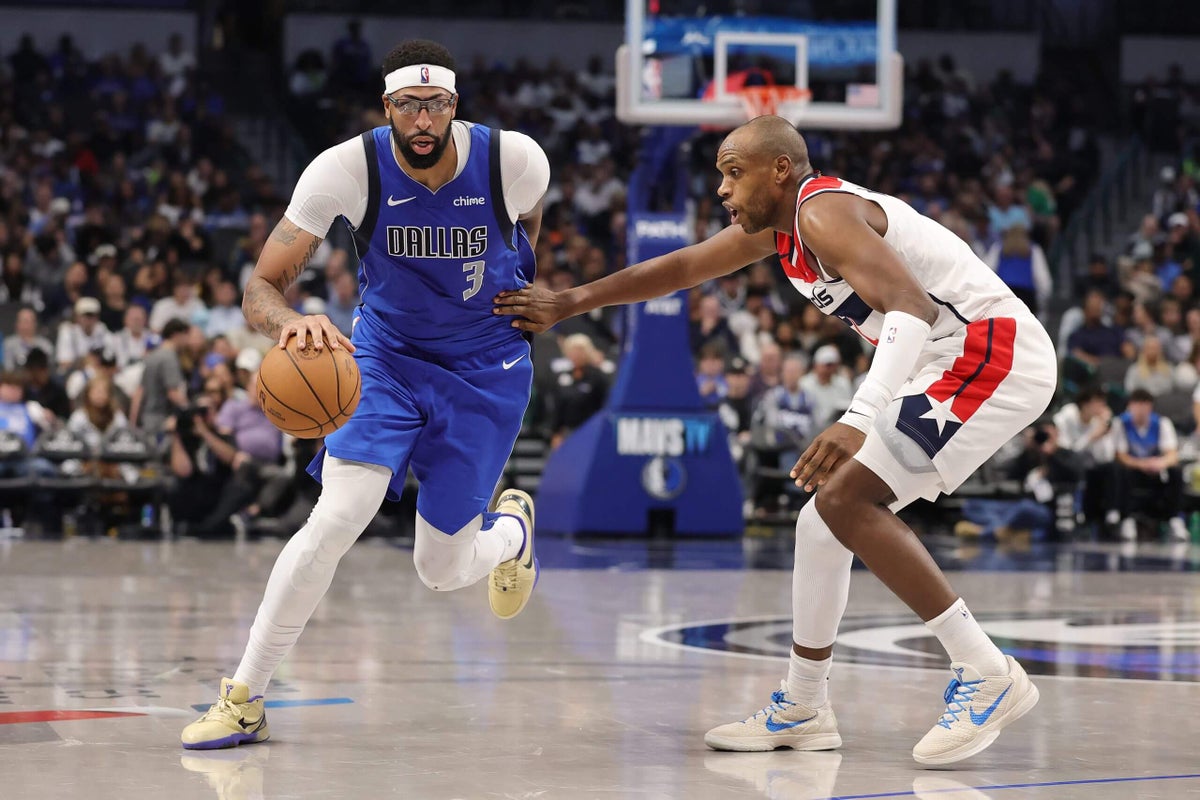
The Dallas Mavericks are turning the page on the biggest part of last season’s disastrous Luka Dončić trade.
Dallas is sending Anthony Davis to the Washington Wizards in a multi-player trade that will involve Washington sending back several draft picks, league sources confirmed to The Athletic.
Davis will head to Washington, along with Jaden Hardy, D’Angelo Russell and Dante Exum. Dallas will receive Khris Middleton, AJ Johnson, Malaki Branham, Marvin Bagley III and draft compensation.
According to a league source, the Mavericks will receive the least favorable 2026 first-round pick from the LA Clippers, Houston Rockets and Oklahoma City Thunder, meaning it likely will be 30th in the draft order. The 2030 first-round pick came from the Wizards’ Chris Paul-for-Jordan Poole trade with Golden State a few years ago, and it will convey only if it falls from 21 to 30. Dallas will also receive three future second-round picks, though none were originally owned by the Wizards.
The Wizards envision a frontcourt of Anthony Davis, Alex Sarr and Bilal Coulibaly as being one of the best defensive frontcourts in the league. This deal “came out of left field,” according to a league source. One of the reasons the Wizards are said to be ecstatic is that the outgoing first-round picks have relatively little value.
The Mavericks, meanwhile needed to do two things with an Anthony Davis deal: Shed salary and restock their cupboard of draft picks. Dallas had the fourth-highest payroll in the NBA, controlled only two first-round picks outright until 2031 an had no second-round picks at all until 2030 before the Davis trade. This move gives them more flexibility and ammunition as they try to reset around Cooper Flagg.
The trade will put an end to Davis’ tumultuous time in Dallas after he appeared in only 29 games in a calendar year.
The Mavericks acquired Davis last February in the Dončić trade. Former Mavericks general manager Nico Harrison had a long-standing relationship with Davis through Nike, where Harrison spent 19 years. Their rapport — and Harrison’s fractured relationship with Dončić — contributed to the Mavericks overlooking obvious concerns about doing the deal, namely Davis’ health.
Davis was recovering from an abdominal strain when the Mavericks traded for him. He made his Mavericks debut last Feb. 8, when Dallas tallied a franchise-record 18 blocks in a win over Houston Rockets. But Davis suffered a left adductor strain in the third quarter that would keep him out of the lineup for the next six weeks.
Davis’ adductor strain was the first of four significant injuries he suffered in his one-year stint with the Mavericks. He had surgery to repair a detached retina in his right eye last summer. Davis then strained his left calf in Dallas’ fifth game of this season, which caused him to miss the team’s next 14 contests.
In a Jan. 8 loss to the Utah Jazz, Davis sustained ligament damage in his left hand, which is expected to keep him out until at least late February.
In Davis’ time with the Mavericks, the team had a 16-13 record when he played and a 16-38 record in games that he missed. Davis’ inability to stay on the court was one of the biggest factors in the Mavericks’ decision to fire Harrison on Nov. 11 amid the team’s 3-8 start to this season.
Davis, who turns 33 in March, is owed $58.5 million next season and holds a $62.8 million player option in 2027-28. Davis had interest in extending his contract with the Mavericks this summer, but it became clear Dallas would instead reset around Flagg.
The Mavericks hoped they could be a dangerous playoff team if they could ever get fully healthy this season. That never happened. Davis and Kyrie Irving had dreamt for years about becoming teammates but were only able to share the court in one game in Dallas. Irving tore the ACL in his left knee in March while Davis was still out with an adductor strain.
The Mavericks went to great lengths to make Davis feel comfortable in Dallas in ways they never did with Dončic. Keith Chamberlain, Davis’ cousin, was given an official title with the team as player relations manager, while Davis’ personal security guard, Garrett Partman, was brought on board as a player development manager.
Davis was productive when he played, averaging 20.2 points and 10.8 rebounds, and well-liked within the Mavericks’ locker room. But he was never healthy enough to execute Harrison’s “vision” of contending for championships with Davis as a focal point.
It’s possible, depending on how the Lakers build around Dončić, that all the first-round picks Dallas received in the Davis and Dončić trades are either in the mid- or late first-round. But the Mavericks had to move Davis, whether that was now or this summer.
They chose now. It’s Flagg’s team now.