
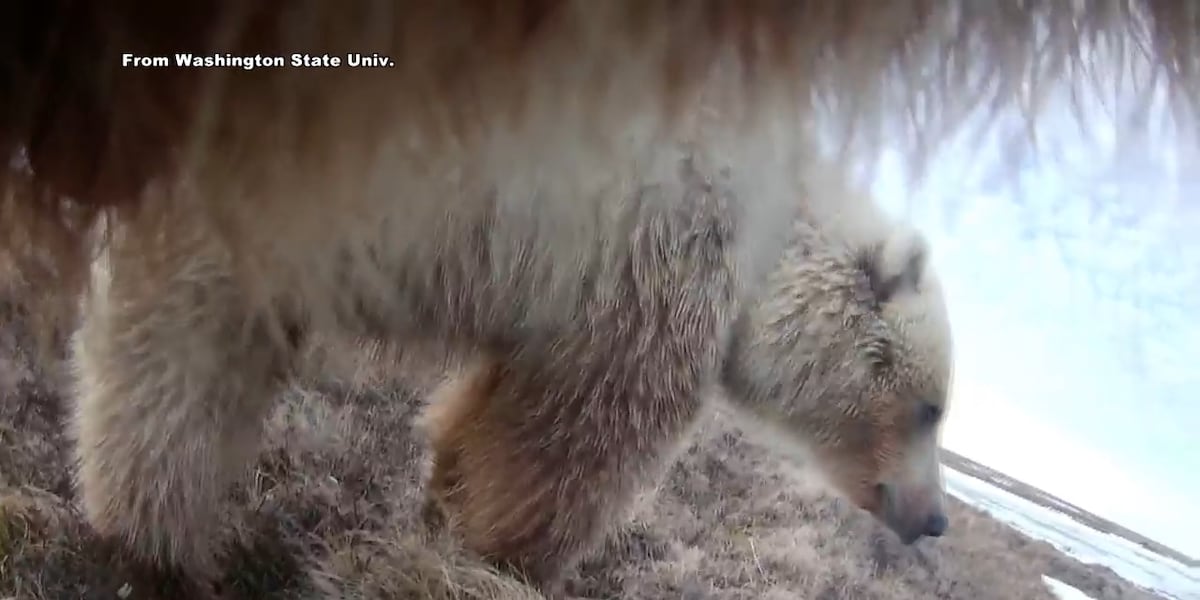
ANCHORAGE, Alaska (KTUU) – Researchers with Washington State University are working with the Alaska Department of Fish and Game to study the eating habits of brown bears living in the state’s interior.
“They have a really extreme seasonal environment where they really only have a growing period of around like 4–5 months, depending on the year,” said Ellery Vincent, a researcher on the project.
Those remaining eight months, she said, are largely spent in hibernation, leaving not much time to pack on the pounds before winter.
“The goal is to be able to understand which food resources these bears are using, how they’re using their environment to get those food resources and if there’s any key seasonal windows where food resources are extremely important for them.”
According to Vincent, the research involves putting cameras attached to collars on 12 bears, with plans to increase the number to 36 within the next two years.
The collars will allow researchers to capture up to 17 hours of footage for several months.
“We’re replacing them halfway through this season, so that way we can maximize the amount of video that we’re collecting.”
Of course, this requires the tricky task of putting the collars on the bears, which Vincent said requires researchers to track them by helicopter.
“For the purposes of this study, we are recapturing the animal, taking the collar off and then we’re also getting repeat measurements of, we’re taking weights each time, so we know how much that bear has gained over that period.”
Having 17 hours’ worth of footage from a bear’s day-to-day has led to some interesting moments, according to Vincent.
Life as a bear: cameras attached to collar on bear shows day to day life
“There was a bear that was sitting just lying down shortly after we captured him in May. He is looking down and then looks up, and then there’s a pack of wolves just sitting there, which is pretty cool,” she said.
Vincent also said the study has led to researchers noticing some differences between bears in the interior and bears closer to Alaska’s coast.
“They’re in such a food-limited environment that they actually, on average, are a lot smaller than other grizzly bear populations,” she said.
“They don’t have a reliable salmon run, and the salmon is what allows those bears to get so big. So, the Arctic grizzly bears have a lot more variable and dispersed and really highly seasonal food resources.”
According to Vincent, a goal of the study for Washington State and DFG is to learn the needs of these bears in the face of climate change.
“They’ve mentioned being able to better understand how oil development will affect bears. So, we as entities have different goals, but we’re trying to work together to be able to accomplish both of them.”
Vincent said DFG will put standard GPS collars on the bears near the end of the study in order to monitor them.
See a spelling or grammar error? Report it to web@ktuu.com
Copyright 2026 KTUU. All rights reserved.