
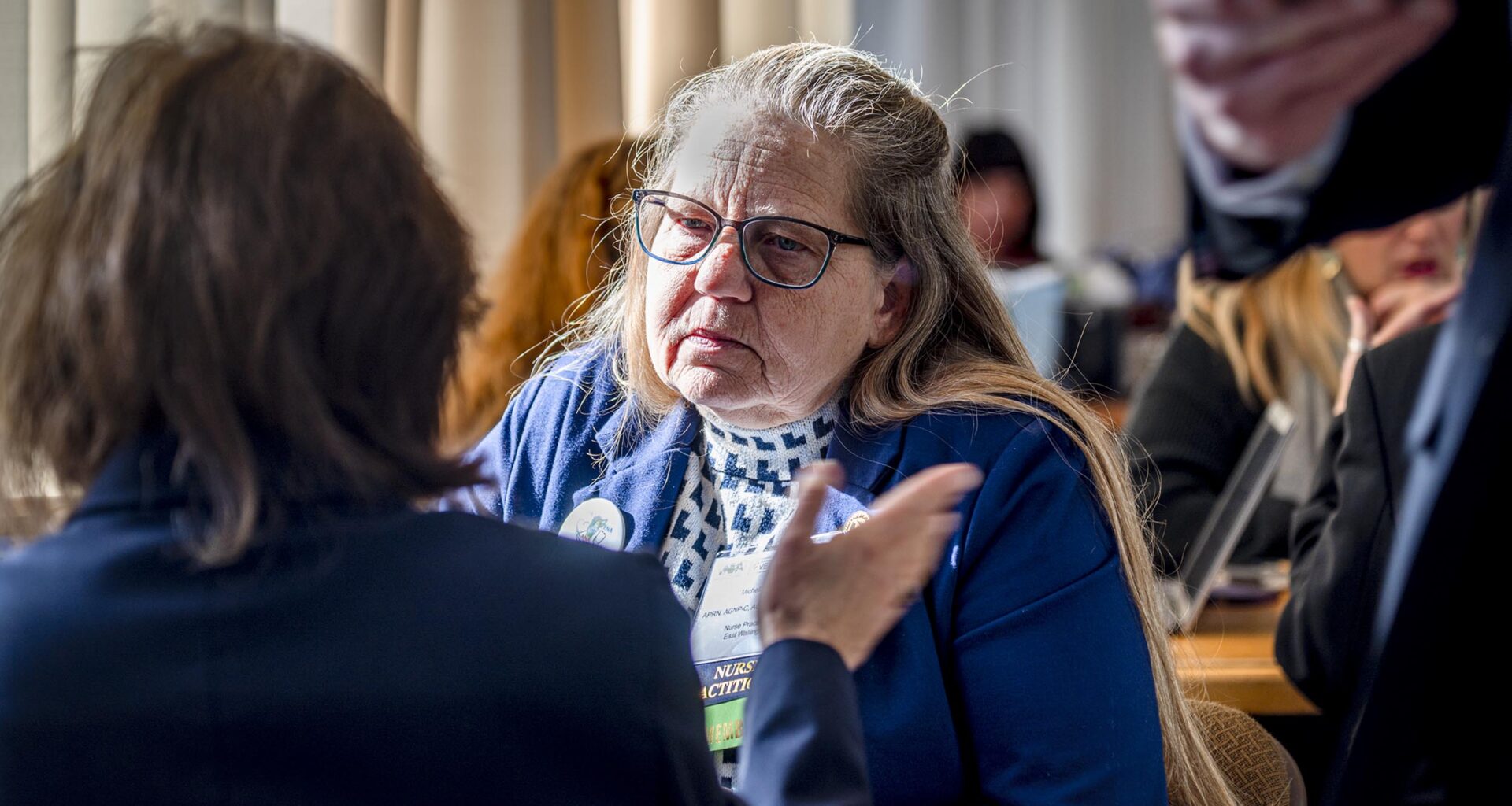
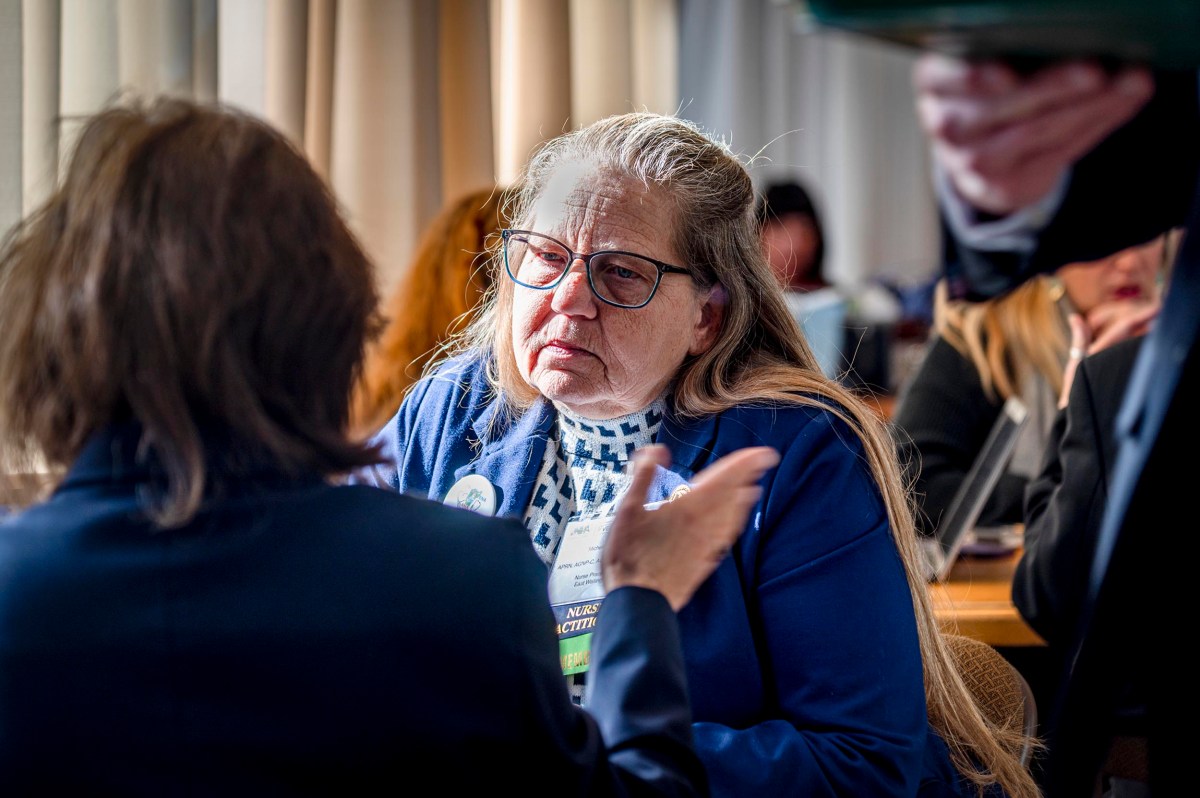
 Michelle Wade of the Vermont Nurse Practicioners Association speaks with a lobbyist in the cafeteria at the Statehouse in Montpelier on Tuesday, Feb. 3. Photo by Glenn Russell/VTDigger
A coalition of nearly 150 nurses descended on the Statehouse Tuesday morning, filling the House gallery, meeting with lawmakers and congregating in the cafeteria.
Though an annual affair, this year’s visit had added urgency, arriving on the heels of federal changes that have heightened many nurses’ concerns about the future of health care in Vermont. Specifically, they pointed to Vermont’s ability to recruit and retain a strong workforce of nurses.
On Friday, the U.S. Department of Education formally posted a rule that would limit how much nurses pursuing graduate degrees can take out in federal loans.
Though only a small percentage of nurses receive graduate level training, it is a load-bearing population, Heather Johnston told VTDigger in December. Johnston has a doctorate in nursing practice and is a primary care provider at Gifford Hospital.
“It’s a bottleneck, because if you don’t have masterly prepared and doctorally prepared nurses that are willing to be educators, then you don’t have new nurses coming in,” Johnston said. “The new nurse at the associate degree and even baccalaureate degree level won’t really be affected very much by this, but what will be affected by this is the person to teach them. If you don’t have the educator, you can’t teach them.”
The loan changes were originally outlined in H.R.1, the Trump administration’s budget reconciliation bill that became law this summer. Nurses associations — including those in Vermont — and those affected by the change have been waiting for the formal rule, and advocating against it.
The rule does not define higher level nursing degrees as professional degree programs. In excluding nurses from the professional category — which physical therapists, social workers and educators, among others, are also now excluded from — the Department of Education is proposing a $20,500 annual cap on federal loans that can go towards graduate degrees. It caps the total amount a graduate-level nursing student could borrow at $100,000.
The Trump administration says that the caps aim to incentivize schools to bring down the overall cost of tuition, as a press secretary for the Department of Education told NPR.
Practicing as a nurse does not require a graduate degree. A recent state survey of licensed nursing assistants found that 20% of LNAs completed technical school or postsecondary education, while the majority have a high school diploma, GED or some college education without a degree. A different 2023 survey found that of Vermont’s 6,944 registered nurses, 50.6% have a bachelor’s degree, 35.8% have an associate degree and only 9.4% have a graduate degree.
However, becoming a nurse practitioner, a certified registered nurse anesthetist or a certified registered nurse midwife requires advanced degrees.
Those with doctorates in nursing may focus on research and improving nurses’ clinical practice. They may also train future nurses.
An assessment of Vermont’s nursing needs for 2024-2026 identified education access as the “primary bottleneck” in a broader nursing shortage.
That survey expressed a shortage of registered nurses in the state. Specifically, it identified an increase in the number of new nursing roles needed, in addition to a need for replacement nurses as others retire or burn out of their postings.
Michelle Wade, the president of the Vermont Nurse Practitioners Association, worries about the aging population of nurses.
“The workforce is declining, and there’s not enough new nurses coming,” she said. “If we don’t find a way to keep new nurses coming, no one’s going to be there to take care of you.”
She and other nurses pointed out the burden that such a nursing bottleneck could put on Vermont’s already strained health care system. Six distinct hospital service areas in Vermont have low enough ratios of providers to patients that they qualify as health care shortage areas.
A 2022 survey from the Vermont Medical Society found that the state is short 115 primary care physicians compared to national benchmarks; the report found that every Vermont county besides Chittenden and Bennington lacks adequate numbers of primary care providers. The report’s authors expect this will only worsen by 2030.
Nursing advocates say that nurse practitioners and nurse midwives, who provide primary care, can help fill that gap. A 2023 census found that 46% of the nearly 1,000 nurse practitioners in the state work in primary care while the remaining population are divided among specialty care areas.
“Everyone knows how long it takes to get into primary care. We do not have enough providers. That’s the special niche that our midwives and our nurse practitioners have,” Kate McFaun Williams, a registered nurse and a leader in Vermont’s chapter of the American Nurses Association, told VTDigger in December.
“Particularly in rural health, we’re going to need advanced practical nurses, and we’re going to need educators,” she added.
The coalition’s Tuesday advocacy centered on these concerns of bolstering nurses’ involvement in a rural health care transformation and creating stronger pathways for nurses to practice in Vermont. The nurses met with Lt. Gov. John Rodgers, the house health care committee and distributed materials through the cafeteria.
Specifically, the group in the Statehouse focused on the $195 million grant Vermont is poised to receive from the federal government for rural health care transformation. They want nurses to play a role in decisions made surrounding those funds, especially when it comes to nursing education and workforce.
“The biggest piece I would like to have you take away today is that nurses need to be at the table,” McFaun Williams told the house health committee on Tuesday. “Currently what we’re doing isn’t working, and I think it’s because you don’t have a patient-facing clinical nurse at the table.”
She is hopeful the state will heed that when it comes to investing in the graduate nursing pipeline. But whether that means pushing for change at a federal level or focusing on Vermont is still to be decided.
The Department of Education’s proposed rule is now in its thirty-day comment period, which closes on March 2. If it is finalized, it is set to go into effect on July 1.