
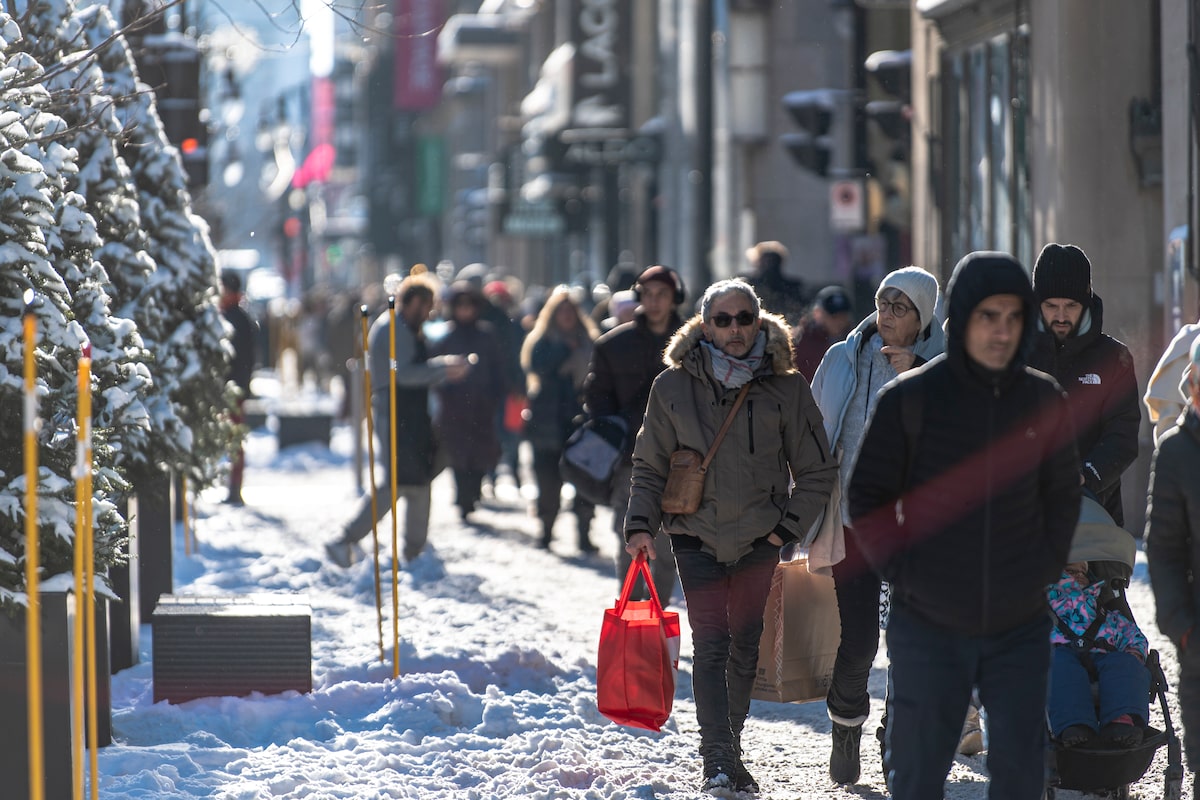
Sainte-Catherine Street in Montreal in December, 2025. Quebec’s share of Canada’s population now stands at around 21.6 per cent.Andrej Ivanov/The Globe and Mail
The first time the Parti Québécois came to power promising to hold a referendum on sovereignty, in 1976, Quebec accounted for 27.2 per cent of Canada’s population. More than 100,000 anglophones left the province during the PQ’s first term in office alone. The exodus continued after the 1980 referendum that saw Quebeckers vote to stay in Canada.
By the time of the second referendum – in 1995, following the PQ’s return to power the previous year – Quebec’s share of the Canadian population had declined to 24.7 per cent. While fewer anglophones left the province in the wake of that plebiscite, lower immigration levels than in the rest of Canada meant that Quebec’s population grew much more slowly than the populations of Ontario, Alberta and British Columbia during the subsequent three decades.
Quebec’s share of Canada’s population now stands at around 21.6 per cent. With or without a third referendum on the horizon, all signs point to it falling further in years to come. The question is: by how much?
According to Statistics Canada’s latest demographic projections, Quebec’s population is set to decline to just 18.6 per cent of the national total in 2050, and drop below the psychologically significant 20-per-cent threshold by the late 2030s. That is based on the agency’s baseline medium-growth scenario for the Canadian population as a whole.
Quebec rethinks its foreign policy in the age of Trump
The Statscan estimates largely jibe with others, including those laid out in a study released this week by Desjardins Group economists Sonny Scarfone and Hendrix Vachon. They paint a portrait of a future Quebec economy handicapped by a shrinking labour market and growing dependency ratio, as the proportion of Quebeckers older than 65 continues to rise rapidly.
“With a stagnant working‑age population and a declining labour force participation rate, the tax burden on workers will likely increase, while tax revenue growth will lag behind spending,” Mr. Scarfone and Mr. Vachon warn. “Unless there are some major changes – to productivity growth, fiscal policy or public services – the current fiscal template may become hard to sustain over the medium and long term.”
The population projections constitute a double-edged sword for the poll-leading PQ as it pledges to hold another referendum if it wins this fall’s provincial election. Quebec’s declining share of the national population serves as an argument for separation, since it heralds the province’s shrinking political influence within the Canadian federation.
By 2050, the combined population of Alberta and British Columbia is expected to reach 14 million, compared to about 10.7 million today. Quebec’s overall population, meanwhile, is expected to remain stagnant at around nine million. As the House of Commons expands to reflect a growing national population, Quebec’s share of seats in the federal parliament will continue to decline; Western Canada’s influence in Ottawa will increase accordingly.
Protecting Quebec’s distinct identity, sovereigntists can argue, will become even harder in the face of English Canada’s multicultural values and efforts to stymie Quebec’s demands for more power within the federation.
Federalists, however, could argue that the deliberate choice of nationalist governments to slash immigration levels is the real cause of Quebec’s demographic decline and, hence, a threat to its ability to protect its cultural institutions and more generous social programs.
The Coalition Avenir Québec government has cut the number of permanent residents the province intends to accept over the next three years to just 45,000 annually, or less than 12 per cent of the Canadian total. It recently abolished a provincial program that fast-tracked temporary foreign workers and international students for permanent-residency status, replacing it with a points-based system that takes applications on an invitation-only basis.
While the replacement program has some merit – in that it prioritizes skilled workers with more work experience and French-language proficiency, and favours regions with severe labour shortages – the move has left thousands of temporary residents in the lurch. Their dreams of becoming permanent residents have been shattered overnight as the government limits applications accepted under the new program to a mere 2,500 a month.
The PQ is promising to cut immigration levels even further if it wins the next election. While that might ease the province’s current housing shortage, it would create other, potentially much bigger, problems.
Quebec’s unemployment rate, at 5.4 per cent, is already the lowest of any Canadian province. Mr. Scarfone and Mr. Vachon project it could fall to 4 per cent or less during the second half of this decade under current policies aimed at reducing the number temporary residents in the province.
“This may sound positive, but it doesn’t necessarily bode well for Quebec’s economic well‑being,” they warn. “It poses big challenges for economic growth, the provincial budget and the long‑term viability of public services.”
It might also prove to be the Achilles’ heel of Quebec sovereigntists.