
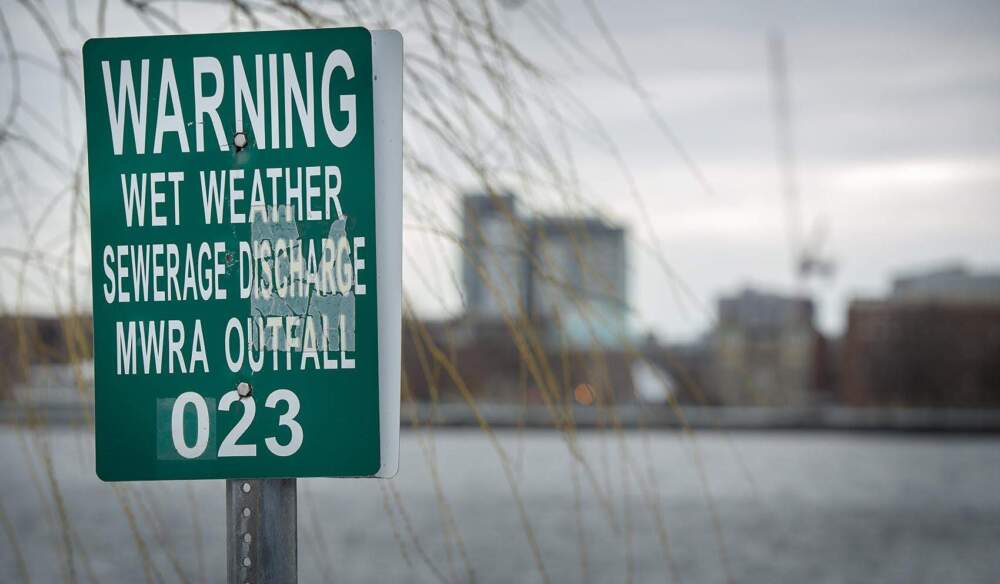
Some Massachusetts households could face higher bills as a water infrastructure authority looks to advance plans to cut untreated sewage flows into the Charles River, Mystic River and Alewife Brook.
Massachusetts Water Resources Authority staff outlined updated recommendations Wednesday to eliminate combined sewer overflows — or discharges of wastewater and stormwater during heavy rainfalls — in all three waterbodies. Staff used a model with a 2050 “typical year,” which accounts for increased precipitation due to climate change. For rarer and larger storms, CSOs would be reduced but not fully eliminated.
The projects come with an estimated total price tag of $1.28 billion, a $410 million increase over an approach outlined in October that drew criticism from groups focused on environmental cleanup and clean water.
Currently, annual household sewer system charges are expected to increase from $999 in fiscal 2029 to $2,337 in fiscal 2050, according to a staff summary. When accounting for the CSO plan recommended by MWRA staff, the agency estimates that household sewer charges would reach $2,380 in 2050.
Environmental advocates want the authority to go further and embrace higher levels of control to eliminate CSOs even during intense, rarer rainfalls. Under a five-year storm model, the annual household charge in 2050 would climb to $2,433. Under a 25-year-storm model, the rate would be $2,462.
Opponents in October criticized MWRA staff recommendations that would have permitted “limited CSOs” to continue flowing into the Charles River and Mystic River. Staff on Wednesday stressed they have now scrapped that approach as they iron out the draft CSO Long-Term Control Plan, which is due April 30.
Multiple alternative plans were at play but ultimately narrowed down as staff assessed factors including permitting uncertainty, site acquisition risks, capital costs, the impacts on vulnerable communities during lengthy construction, and stakeholder input.
“This CSO plan is marginally better than the previous recommendation, but it will still result in millions of gallons of sewage entering the Charles on a regular basis, making people sick, making it impossible for people to swim, or in most days, even boat in the river,” Charles River Watershed Association Executive Director Emily Norton said at the start of the meeting.
“The difference in cost between the level of control that you’re recommending and the level of control that we and many members of the public would like to see is minimal,” Norton continued. “It’s a difference of $84 a year in 2050 dollars, which translates into $34 a year in today’s dollars.”
Under the MWRA’s recommendation, there would be a 38% reduction in CSOs during five-year storms. For 25-year storms, there would be a 24% reduction, according to staff.
Kristin Anderson, a founding member of Save the Alewife Brook, said the MWRA’s 2050 typical year model is a “fantasy” that “does not represent reality.”
“The newest plans have been published, but at Alewife Brook, MWRA continues to ignore health impacts of raw sewage flooding in the parks, yards and homes around Alewife Brook,” Anderson said. “People have gotten sick from exposure to the nasty sewage in Alewife Brook floodwater, and this has not been addressed in the new plans. The zero CSOs in the 2050 typical year plan is not a zero CSOs plan.”
MWRA staff say 41 out of the 86 CSOs that were active in the late 1980s are closed. Since that time, there’s been an 88% reduction in CSO discharges, with the vast majority of lingering discharge being treated at CSO treatment facilities.
Eliminating CSOs would not make waterbodies “fully swimmable or fishable” since there are other pollutants still affecting environmental and public health, according to a presentation from David Wu, the MWRA’s director of environmental quality. Water quality is “generally good” at the Charles River, while quality is “mixed” at the Mystic River and Alewife Brook, his presentation showed.
For the Charles River, the MWRA’s latest plan includes installing a 10 million gallon storage tank at its Cottage Farm CSO facility at Magazine Beach, and implementing about 370 acres of partial sewer separation in Back Bay and 80 acres in Cambridge. The overall project would take between 28 and 33 years to finish, staff estimate.
“We can start seeing some benefits earlier,” said Colleen Rizzi, MWRA’s director of environmental and regulatory affairs. “For example, the tanks are estimated to be (at) the 5- to 10-year mark to design and construct, and then there’ll be some incremental benefits as sewer separation occurs in phases.”
The MWRA Board must vote on the draft plan, which could happen at meetings on Feb. 25 or March 18. Submitting the draft plan to environmental regulatory agencies would kick off a new round of public comment.