
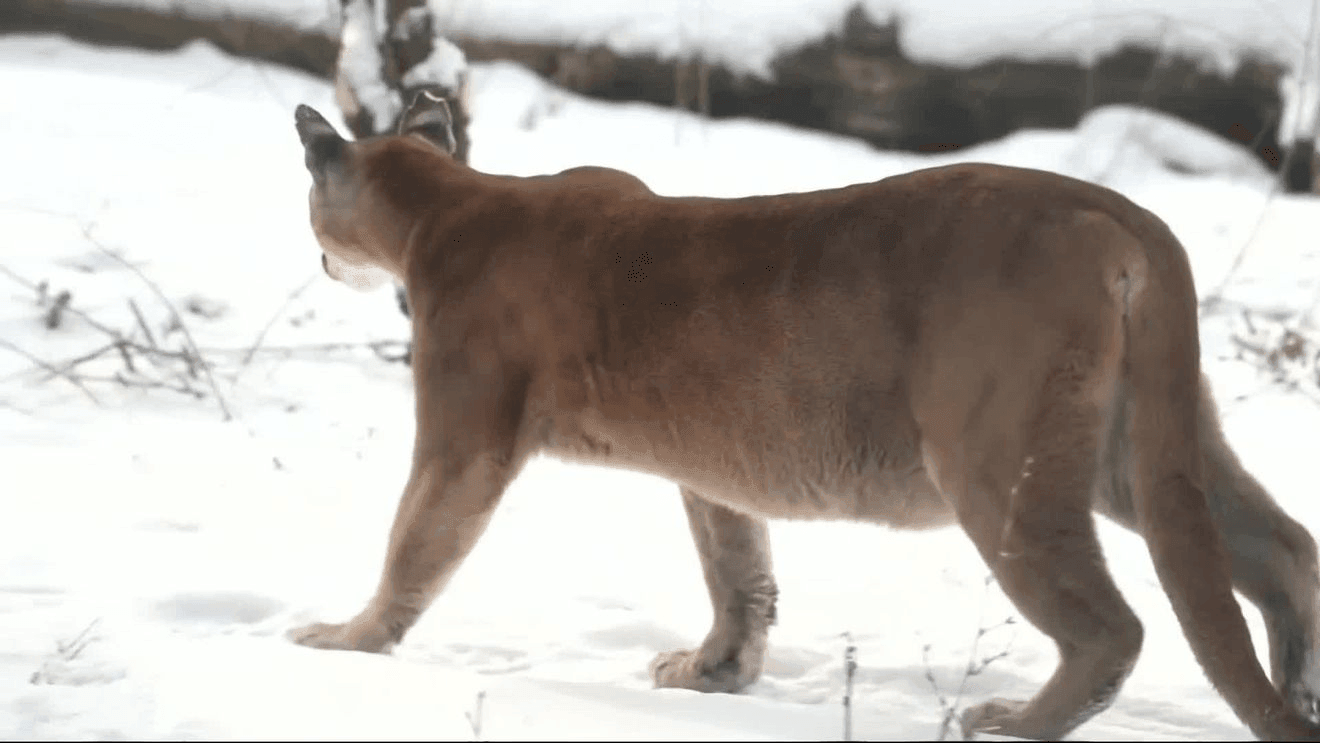
The Michigan Department of Natural Resources (DNR) is investigating a notable increase in cougar sightings, with 2025 marking a historic year for the state’s wildlife.
Brian Roell, a wildlife biologist with the DNR, explained that Michigan was once a natural habitat for cougars, with the last known cougar killed in the eastern Upper Peninsula in the early 1900s.
“Michigan was cougar habitat including both peninsulas. The last known cougar to exist in Michigan was like 1906 or 1905 there was an animal killed in the Eastern Upper Peninsula was actually captured in a wolf trap,” said Roell.
However, cougars were confirmed back in the state in 2008, and since then, the DNR has been closely monitoring these elusive animals.
“2008 is when we first identified cougars back in the state. Doesn’t mean that the animals weren’t coming prior to that. We probably did have some transient animals, but that confirmation didn’t occur until 2008,” said Roell.
Roell noted that the DNR is utilizing between 1,200 and 1,300 cameras to estimate wildlife populations, including cougars.
“Well, it definitely is it’s a tool that we’re actually exploiting. So, we’re running somewhere between 12 and 1300 cameras out for to estimate the wolf population but it’s also going to estimate other wildlife populations and we are picking up cougars on those cameras,” Roell said.
The increase in sightings is also attributed to more residents using trail cameras, which have become more affordable.
“Used to be kind of a luxury to have one now there’s many people that have multiple cameras,” Roell said. “We had 31 different sightings. They represented like 34 or 35 cats because we had the kittens.”
This was 11 more sightings than in 2024. The heatmap shows where those sightings were reported and most of the reported sightings came from photographs
Roell mentioned that while more cougars are making it to Michigan, it remains uncertain if they are staying.
However, there are patterns in certain areas of the Upper Peninsula.
“Certainly, I believe there’s more cougars making it to our state. What we don’t know now is are they staying here? It does appear we have some patterns in certain areas of the Upper Peninsula,” Roell said.
A significant milestone was reached in 2025 when the DNR documented cougar reproduction in Michigan for the first time in over a century.
“Most notably in 2025, as we did document reproduction in the state of Michigan and that’s an historic event because it’s the first time within or well over a hundred years that reproduction has been documented east of the Mississippi,” Roell said.
Despite the increase in sightings, Roell emphasized that cougars are not as dangerous as some might fear.
“Lightning strikes are far more dangerous. Just getting in your car and driving in the work in the morning is far more dangerous in Michigan than the chance of getting attacked by a cougar. So I asked people, all wildlife has the potential to be dangerous It doesn’t have to have a big claws and teeth. It could be the smallest animal So just treat all wildlife with respect and give them their distance,” Roell said.
The DNR encourages anyone who spots a cougar to report it through their “eyes in the field” web-based program, where photos can be submitted and reviewed by the Cougar team.
This data helps the DNR understand cougar patterns and their potential recolonization of Michigan.